
Hold your nose, peeps:
Power cuts such as those in South Australia this week may be the wake-up call needed for governments to relax onshore gas restrictions, Santos chief Kevin Gallagher signalled.
“I suspect blackouts will help, unfortunately, if it comes to that,” he said.
“Some parts have gone too fast to renewables, some states in terms of setting targets, and that’s going to put a lot of strain, a lot of stress on the system. My view is that gas development needs to be increased, with more supply made available to the domestic market to … provide a stronger baseload supply.”
Gas-fired generation is “the solution” to support variable energy produced by wind and solar, said Origin’s Frank Calabria.
He said that the transition towards lower-emissions energy had to be managed to prevent sustainability getting “out of step” with the other two essentials of energy: affordability and security of supply.
“As more variable or intermittent energy comes into the system … it’s clearly testing security now, and that affordability,” Mr Calabria said.
The comments came after AGL chief Andy Vesey called for “rationality and coherence” in resources policy and the market design for gas to overcome today’s problem where the “very attractive” option of using gas-fired power to support intermittent renewables had effectively been ruled out because gas wasn’t available.
By not having gas as a viable fuel and a coherent policy, “we come to this more difficult challenge of making that leap from centrally fired large coal directly into large renewables,” he said.
Two things are getting confused here. There was gas to burn in SA very profitably in the short term but the wholesaler decided it was much more profitable to protect the price spike and did not burn it. For some bizarre reason the regulator let it. That’s a structural problem in the National Energy Market (NEM) not the Renewable Energy Target (RET).
Longer term, AGL is exactly right. The gas is not available at an economic price. In fact the ex-VIC east coast average price was $15.01GJ on Friday versus the same Aussie gas available at $10.70Gj in Japan:
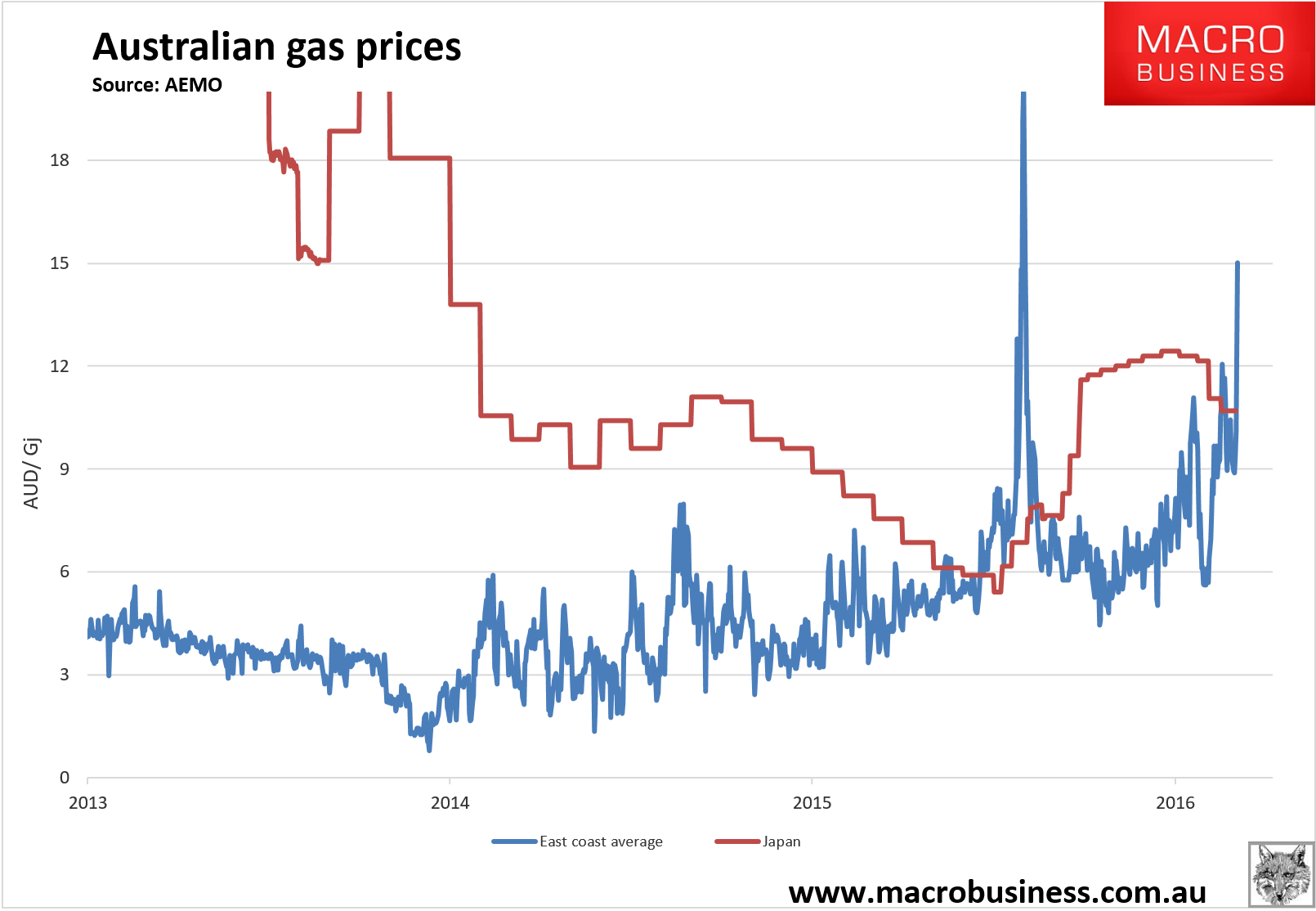
Yes, right now we are paying roughly 40% more than the Japanese for our own gas. Why is it? This:
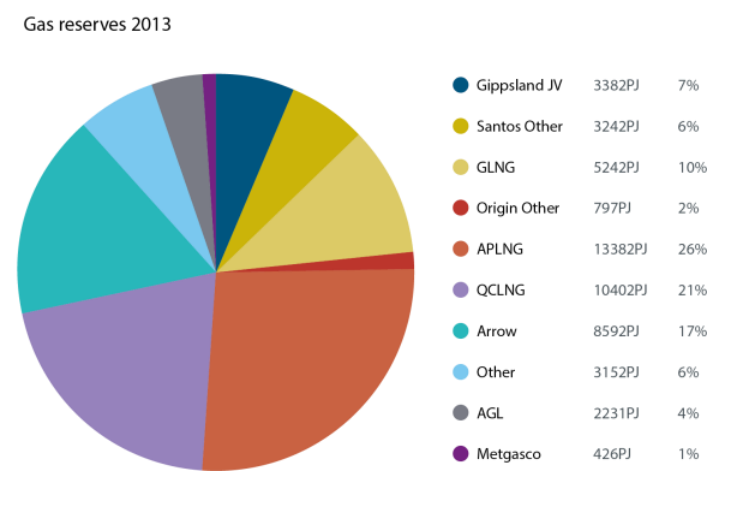
Between them, the two charming firms quoted above, Origin and Santos, are card carrying members of the east coast gas cartel comprising 44% of reserves. The other major holder is Shell with 38% (QCLNG, Arrow). These three firms operate the three Curtis Island LNG white elephants which have break even costs from $14-16, deliver bugger all jobs now that they’re built, and pay no tax revenue. They won’t release the gas locally owing to a mix of international contract obligations on which they lose money hand over fist and profiteering at our expense to recoup those losses.
Blackouts may or may not change the community’s mind about more fraccing. I doubt it. But it must be remembered that more fracced gas will only lower the price if it is reserved for domestic supply, otherwise that gas will also head offshore. There’s not enough competition, there’s not enough gas and there’s no functional market.
The only answer is domestic reservation that forces local gas into the local market. Someone has to be nationalised or the entire east coast LNG sector needs a massive new Piguvian tax that subsidises local power prices.
Or you can just lie for personal gain, like PM Do-nothing:
Turnbull government statements blaming last year’s South Australian blackout on its high renewable energy target ignored confidential public service advice stating that it was not the cause, according to emails obtained under freedom-of-information rules.
An email trail shows among other things a senior official from Malcolm Turnbull’s department seeking an explanation for the blackout at 8.31 on the evening of the storm.
Another from 7.20 the next morning outlines subsequent discussions including a 5am phone hook-up involving departmental and political staff.
Yet within hours of the calamity the Turnbull government was capitalising on the blackout, suggesting it was a function of the state’s unsustainably high quotient of wind generation which had failed to keep working in the conditions.
Arthur Sinodinos was better on the weekend:
Senator Sinodinos told the ABC’s Insiders: “I underestimated the extent of the cost of the transition to greater reliance on renewables, I have to admit.
“I didn’t realise the extent to which that increases the volatility of the system, the need to have proper back-up and security of supply.
“That was brought into sharp relief with what happened in South Australia. It’s also raised issues about the way the National Electricity Market works, the need for greater competition, interconnectors, we need to create more gas exploration.
“What’s needed to be done is we need to calmly sit down, work our way through those issues. This is not an attack on renewables or coal, this is about getting the best energy mix at an affordable price which reduces greenhouse gas emissions. We have an energy security plan we are putting together to help us address those.”
Sources say that while the federal government has long sought to persuade the states, including the Coalition government in NSW, to lift their bans on CSG, it is now adopting a new approach, examining potential incentives to the states to assist in reform that would better align farmers’ financial interests with gas exploration by different royalty sharing and land agreements.
…The federal government is also believed to be considering to act as a joint venture partner – rather than just fund feasibility studies – in other forms of energy storage such as pumped hydro.
You’ll still need reservation, Arthur, but you’re doing a much better job than your boss.
