I’ll ask the question yet again: What do you get when you shove an MCG-worth of people into a city each year, without sufficient new infrastructure investment?
Answer: Infrastructure bottlenecks, rising congestion, smaller and more expensive homes, and lower overall living standards.
Yet this is exactly what Melbourne has done as it has embarked on the mother of all population ponzis. The result has been incessant “crush loading” with the city’s roads now choked with traffic much of the time, trains frequently jammed beyond capacity, and housing woefully expensive.
The situation is also set to get much worse over coming decades, with Melbourne’s population projected to balloon by 3.4 million people over the next 35 years on the back of high immigration, representing growth of just over 1,850 people every week or 96,000 a year! That’s the equivalent of 9 Canberra’s or 2.5 Adelaide’s to be added to Melbourne’s population by 2051, according to the official forecasts (see next chart).
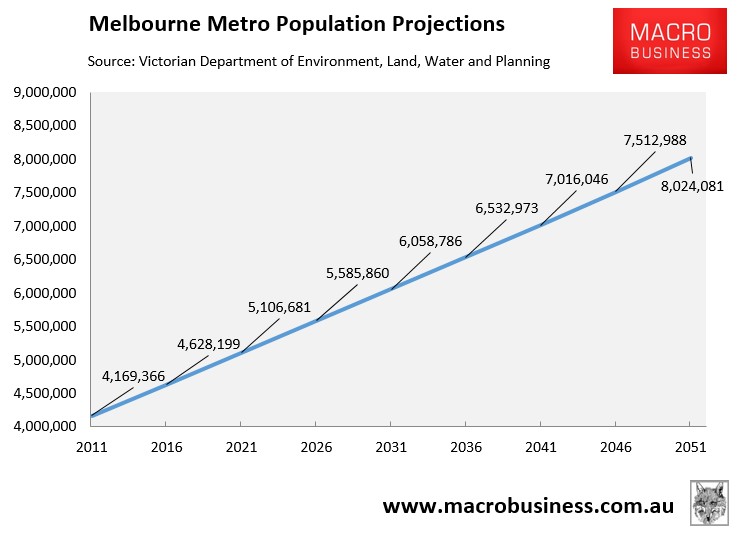
Rather than putting up with this madness, and the accompanying choking of living standards, it is worth considering what Melbourne was like before it embarked on its hyper-growth fetish.
The below video shows Melbourne’s train system in the early-to-mid 1990s, which was a time characterised by minimal congestion and relaxed commuters. I remember this period well as it corresponds to when I took public transport to school (I finished year 12 in 1995). Back then, over-crowding was unheard of and getting a seat was easy, even during the peak periods.
Add the fact that roads were also unclogged and houses were also cheap and it is easy to conclude that living standards were much better back then for the typical Melbourne household.
Australia’s future population will be set primarily by its immigration intake. It is a policy choice how big and crowded Australia becomes (see next chart).
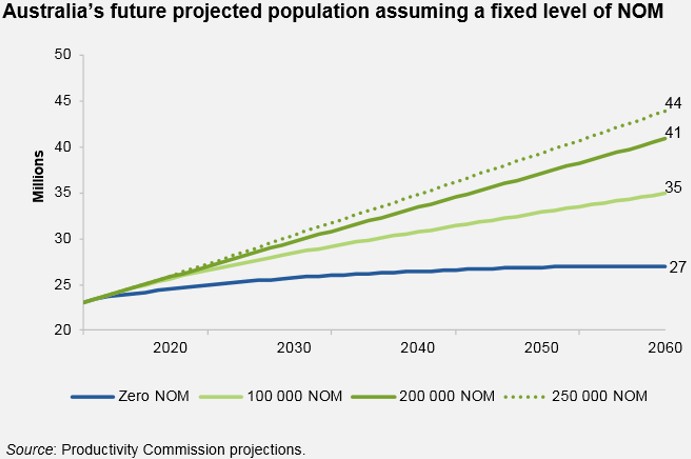
Blind Freddy can see that the optimal thing to do is reduce Australia’s net overseas migration to much lower levels than the 200,000-plus currently. Our future living standards depend on it.