
A new report from the Victorian Eco-Innovation Laboratory at Melbourne and Deakin universities has called on Melbourne to implement a hard urban growth boundary (effectively a ‘green belt’) to protect surrounding farmland from encroaching residential development. From The AFR:
Rachel Carey, a co-author of the report, said new challenges to the city’s food supply from climate change, population growth and diminishing supplies of land and water would become more of a issue as they started to affect food supplies.
“This combination of pressures is likely to lead to rising food prices, and to increasing awareness of the need to plan for the city’s food supply. We’ll need to start planning for food,” Dr Carey said.
Currently the Melbourne food bowl provides 41 per cent of the city’s food needs, but if the city continues to spread there will be less land available to grow food.
Sourcing it from other states’ foodbowls could be difficult because their major cities are also growing rapidly, and increased demand for food with less land to supply it from could lead to increased prices for households…
Policymakers must also increase urban and suburban densities inside the boundaries and “shift development pressure from the fringe to existing urban areas”.
I personally believe that urban sprawl encroaching on local agriculture is a third-order issue. It’s not like Australia doesn’t have ample farmland that could easily be used to produce fresh food. All that it would require is for farms to move further out as land gets converted to higher value uses (i.e. housing and commercial).
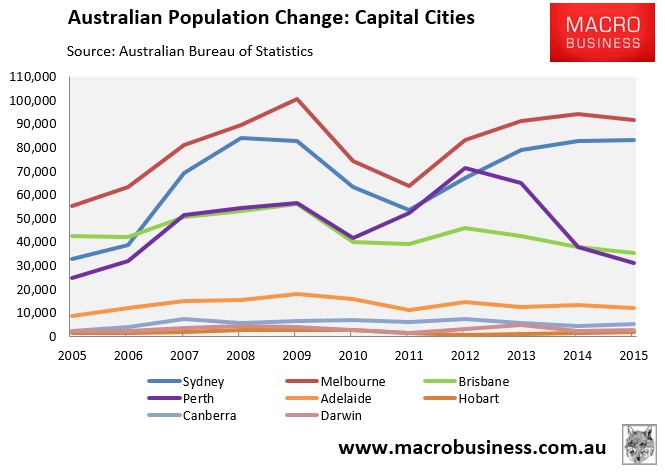
Besides, if the academics are so worried about preserving Melbourne’s food bowl, why not lobby against the Big Australia policies being run by our politicians, which funnel tens-of-thousands of new migrants into Melbourne every year? You know, the policy that saw Melbourne’s population expand by 832,000 people in the decade to June 2015:
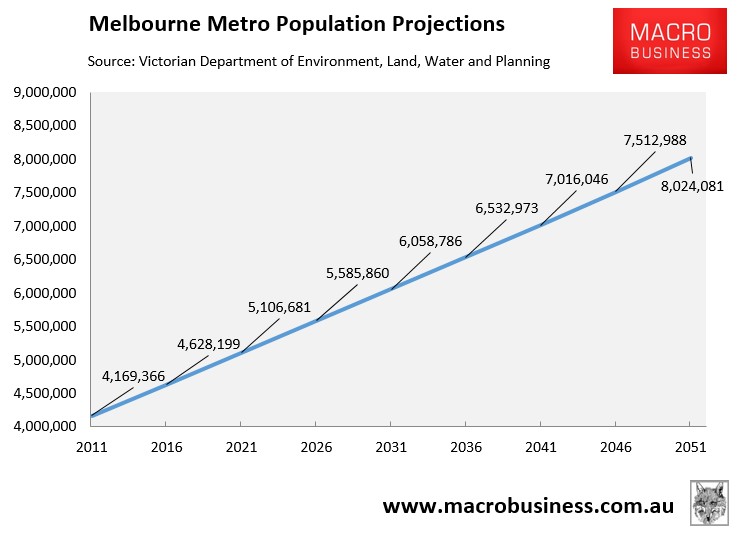
And the policy that has Melbourne’s population projected to increase by around 1,850 people per week (97,000 people per year) for the next 35 years!
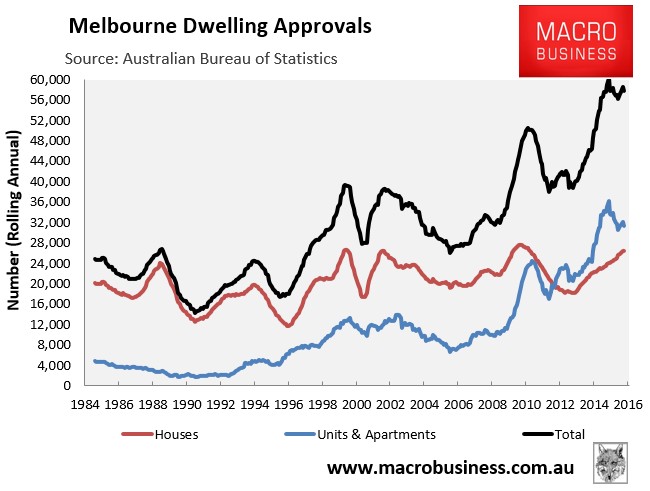
It’s not like residents aren’t already being crammed into shoe box apartments, which have become the dominant form of new housing in Melbourne to cater for this growth (see next chart).
If the academics are so worried about the food bowl, then lobby against the population ponzi. But please do not use it as a fig leaf to further restrict urban land supply and push-up the cost (and lower the quality) of housing.
