
After her recent bawls (here and here), The Australian’s Grace Collier has stepped-up her assault on the Turnbull Government’s superannuation package, warning the Coalition not to “bite the hand that feeds it”:
The base has been slapped in the face one too many times.
At the election last month, Liberal voters fired a warning shot by voting against the party in the upper house. Without real change, next time the lower house votes will go elsewhere too. The government appears to be adopting Labor’s agenda and making a cowardly attack on its supporters in the process…
Once the superannuation policy was announced, donations ceased; Malcolm Turnbull had to bail out his own election campaign.
All this, and branches around the country are now in open revolt… the superannuation policy is madness and many will fight it to the death.
Take the federal electorate of Higgins in Victoria. According to several sources within the electorate, donations towards the sitting member, Kelly O’Dwyer, are drying up. According to insiders, there are two plans being floated, both designed to remove O’Dwyer because of her advocacy for the policy…
At this point, the government is giving every indication the policy will not be amended substantially. Before the election, it begged people to back off their criticism with promises of change later. Now, it claims it has a mandate to proceed with the policy unaltered. Treachery of this kind will not be forgotten.
Nowhere above does Collier actually address the merits of current superannuation settings and the reform package.
Where is the admission that the existing superannuation system is busted, with the lion’s share of benefits flowing to the top 10% of income earners, who are perversely receiving more generous taxpayer assistance than the other 90% of income earners (see below AIST and Mercer chart).
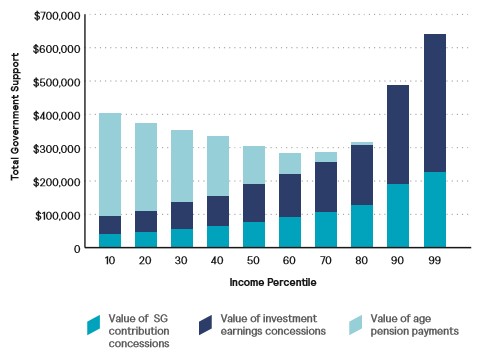
How is this optimal from either a Budget sustainability or an equity perspective?
Moreover, where is the admission that even after the Coalition’s superannuation package is implemented, high income earners would continue to receive the lion’s share of benefits (albeit less than before), as noted by AIST and Mercer [my emphasis]
[AIST and Mercer’s] research shows that the top 1 per cent of income earners will be hit hardest. Despite the heavy backlash over the plan to limit after-tax super contributions to $500,000 over a person’s lifetime, AIST and Mercer found that the measure would have almost no impact on savers overall because so few superannuants opted to inject after-tax dollars into their super pots.
The budget measure that will have the biggest impact is the $1.6 million limit on super pension transfers. Reducing the pre-tax concessional contribution cap to $25,000 will also have a sizeable effect on high-income earners.
If the lower pre-tax limits were adopted, as well as the super pension transfer cap and a doubling of the contributions tax to 30 per cent for individuals earning between $250,000 and $300,000, the level of government support for the top 1 per cent of wage earners would fall to $450,000 from $600,000 over their lifetime.
The level of support for the top 10 per cent of income earners will fall from $500,000 to about $470,000. Individuals on full-time salaries who fall in the seventh decile will continue to receive the lowest level of government support, estimated to be just over $300,000 over their lifetime.
So, under the Coalition’s superannuation package, the top 1% and 10% of earners would continue to receive the lion’s share of taxpayer assistance, only it would be a bit lower than currently. Hardly a cause for righteous indignation, is it?
The Turnbull Government would do well to ignore the special pleadings from the likes of Grace Collier and continue to focus on developing good policy in the national interest – reforms that blend Budget restraint with fairness, as well as combine efficiency with equity.
The Coalition’s best hopes of holding on to government rest with it capturing the ‘middle ground’, not lurching to the right and governing in the interests of the wealthy elite.
Australia needs more policy along the lines of the superannuation reform package, not less.
