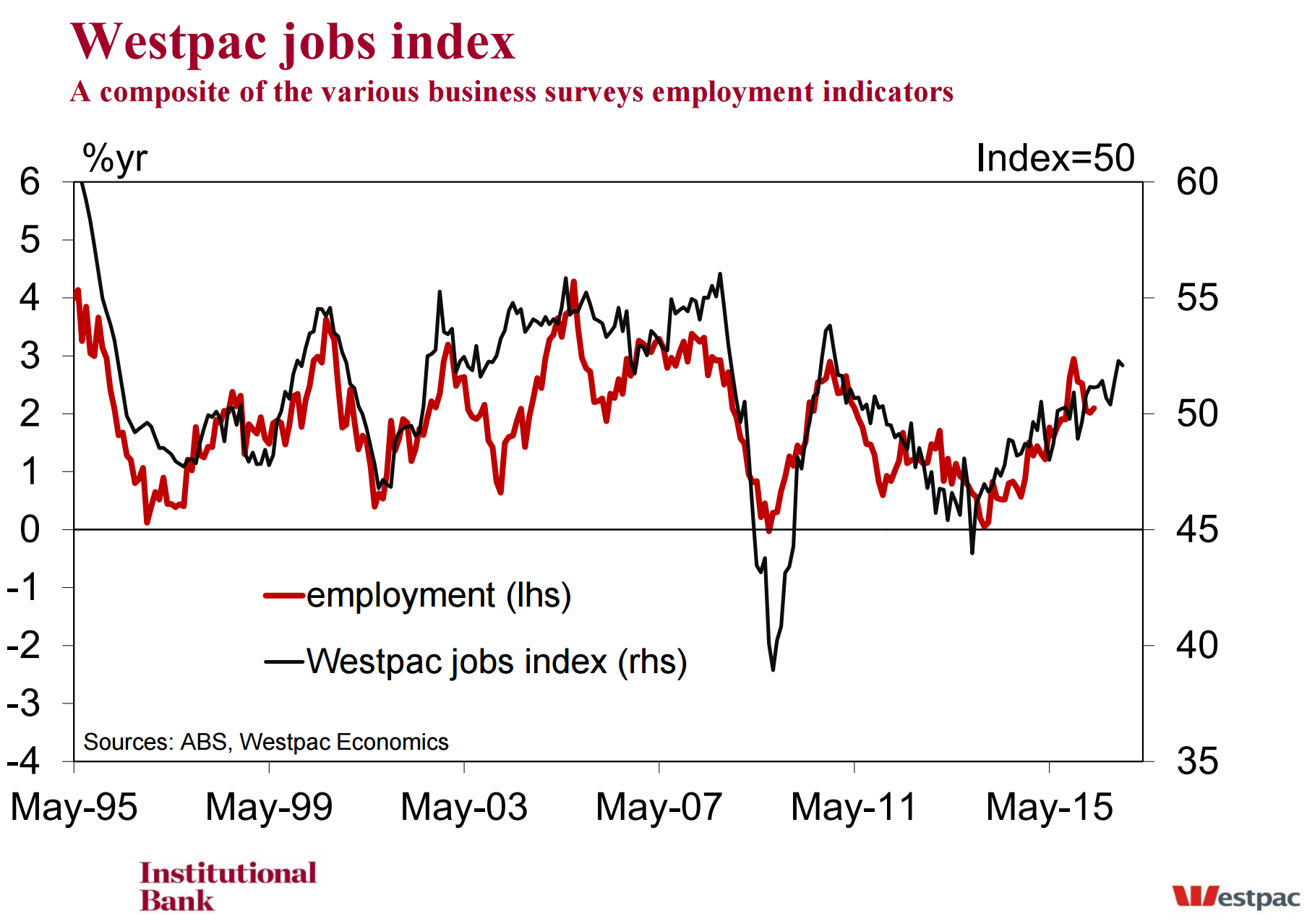
• The latest update of the Westpac Jobs Index continues to paint a picture of a constructive labour market.
• There are many business surveys out there and most have questions that are applicable to the labour market. To generate a broad and deep labour market indicator, Westpac compiles all the relevant indicators from these surveys into the proprietary Westpac Jobs Index. • At just above 52.1 in May (it was 52.3 in Apr), the Jobs Index is now at the highest level seen since Jun 2010. The recent low was 49.2 on Jun 2015. The Index is set so the long run average equals 50 but historically the index has to drop below 45 before it is associated with negative annual employment growth.
• From Sep 2015 to Nov 2015 the pace of employment growth accelerated to almost 3%yr while the Jobs Index was suggesting that employment growth should be closer to 1¾%yr. We argued that such surges (and following ebbs) in employment are not unusual and as such we thought that employment growth would fall back towards the Index sometime in the first half of 2016. In Mar, the ABS reported that the pace of total employment growth 2.0%yr but did pick up to 2.1%yr in Apr. So while pause in employment in early 2016 has ended, the three month average gain Feb was –3.0k , by Apr employment growth was still a subdued average of 11.8k per month in the three months.
• So where to next? The May Job Index reading of 52.1 is pointing to employment growth holding picking up from its current 2.1%yr pace as we head into the Dec quarter. But given the recent surge to almost 3%yr, it is likely that there could be some near term underperformance in the way of statistical give back in employment growth.
• Of note in the components of the index this month; 1. The AIGoup surveys remain very volatile rising from 48.8 in Feb to a recent peak of 52.1 in Apr before easing to 50.5 in May. 2. The NAB monthly employment indicator has been on a stronger trend since Jan. 3. At 52.4, the Westpac-ACCI composite is at its highest reading since Apr 2008.
• The trend improvement in the Jobs Index we have seen since early 2014 has been matched by a trend improvement in the Westpac-Melbourne Institute Unemployment Expectations. Expectations did wobble through the first three months of 2016, which was associated with a dip in the Jobs Index, but both have improvement in the in Apr and May.
• In the past, Unemployment Expectations have given us heads up on potential turning points in the Jobs Index. As such, the recent improvement in Expectations may suggest that the improvement in the Index is associated with more positive labour market outcomes.
• At least for now, the outlook for the labour market remains constructive overall even if some of the indicators are providing a bit more of a mixed picture.
The driver of the index is the NAB business survey which has been much more bullish than other metrics. The NAB survey is excellent but when it has dislocated from many other indicators I put a question over it.
David Llewellyn-Smith is Chief Strategist at the MB Fund and MB Super. David is the founding publisher and editor of MacroBusiness and was the founding publisher and global economy editor of The Diplomat, the Asia Pacific's leading geo-politics and economics portal.
He is also a former gold trader and economic commentator at The Sydney Morning Herald, The Age, the ABC and Business Spectator. He is the co-author of The Great Crash of 2008 with Ross Garnaut and was the editor of the second Garnaut Climate Change Review.