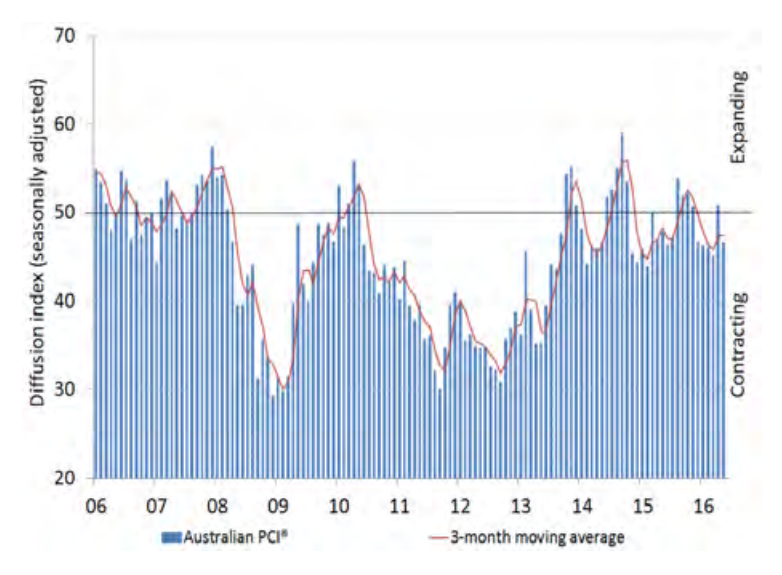
§ The national construction industry moved back into contraction in May, with the Australian Industry Group/Housing Industry Association Australian Performance of Construction Index (Australian PCI®) dropping 4.1 points to 46.7 points in the month (50 points is the threshold that separates expansion from contraction).
§ This fall in the Australian PCI® in May signalled the industry’s fifth month of decline in the past six months.
§ Across the four sub-sectors in the Australian PCI® , apartment building experienced a significant weakening with the sector contracting at its steepest pace in 33 months. In contrast, house building returned to growth, with activity in the sector rising at a solid rate after three consecutive months of contraction.
§ Engineering construction turned down in May following a return to growth in the previous month while commercial construction continued to decline, albeit at a broadly unchanged rate.
§ The key activity sub-index in the Australian PCI® fell below 50 points in May (i.e. contracted) after showing signs of a mild recovery in April. And of concern for the outlook, new orders lost ground, declining at the second sharpest rate since February 2015.
§ Reflecting this deterioration in operating conditions, construction employment declined in May following slight growth in April. Deliveries from suppliers contracted for a second consecutive month.
§ Apartment building respondents to the Australian PCI® linked the further softening in conditions in May to over-supplied apartment markets and tighter lending criteria for investors. House builders were more positive, citing low interest rates and house price increases as supporting relatively firm levels of demand. The drop in engineering construction activity was attributed to the continued decline in mining-related construction, although some businesses noted new infrastructure work was in the pipeline or awaiting decisions to proceed.
Forming a downtrend that will get much worse into 2017. Full report.
David Llewellyn-Smith is Chief Strategist at the MB Fund and MB Super. David is the founding publisher and editor of MacroBusiness and was the founding publisher and global economy editor of The Diplomat, the Asia Pacific's leading geo-politics and economics portal.
He is also a former gold trader and economic commentator at The Sydney Morning Herald, The Age, the ABC and Business Spectator. He is the co-author of The Great Crash of 2008 with Ross Garnaut and was the editor of the second Garnaut Climate Change Review.