
Following yesterday’s forecast from Deloitte Access Economics that that the Turnbull Government’s company tax cut, announced in Tuesday’s Federal Budget, would cost $55 billion over a decade, the Australian Treasury has announced today that the cost to taxpayers would be $48 billion. From The AFR:
Treasury Secretary John Fraser said it was not standard practice to reveal costings beyond the forward estimates, but the Treasurer Scott Morrison had authorised him to reveal that the government’s company tax will cost $48.2 billion over 10 years and increase the level of GDP by a little over 1 per cent.
While the company tax cut might raise the nation’s GDP by 1%, modelling from Janine Dixon from the Centre of Policy Studies at Victoria University showed that cutting company taxes would actually reduce national income – the best measure of living standards – by a commensurate amount:
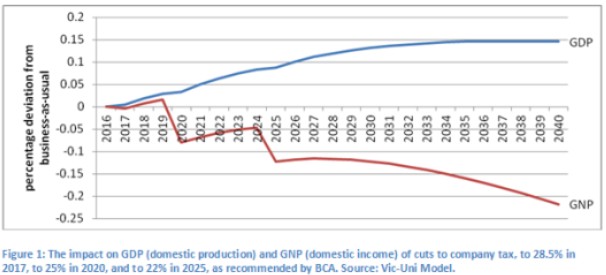
As I keep arguing, cutting company taxes would primarily benefit foreign owners/shareholders at the expense of Australian taxpayers, hence lowering national income.
This is because the benefit of any company tax cut to domestic owners/investors would be offset by a commensurate reduction in imputation credits. By contrast, overseas investors who do not receive imputation credits would benefit fully from any company tax cut.
To quote former Prime Minister Paul Keating:
“Australia’s dividend imputation system works such that the company tax is, in effect, a withholding tax – a tax temporarily held by the Commonwealth which is returned to shareholders when their dividends are paid. So, whether the company tax is withheld by the Commonwealth at a rate of 30% or 25% is immaterial – the Commonwealth is going to return the money to shareholders anyway, regardless of the rate. But the shareholders who will receive a benefit are foreign shareholders”.
Hence, a company tax cut would primarily benefit foreigners, and by extension larger corporations at the expense of small businesses. This is because around 98% of small businesses (i.e. those employing four or less people) are wholly Australian owned and, presumably, indifferent to slashing the company tax rate. By contrast, 30% of large companies (i.e. those employing more than 200 people) are at least partly owned by foreigners, who would be the primary beneficiaries from the Coalition’s policy.
Peter Martin also made the same argument yesterday:
The main beneficiaries of the company tax cut will be overseas-owned companies, and not all of them will increase their investment as a result. Some will simply pocket the gift. Those that are already here will get a reward for something they were going to do anyway. The government will have to make up the lost tax by collecting more from other people, or so the argument goes.
We should also not forget that The Australia Institute (TAI) has released analysis of data from Australia and OECD countries showing that:
- There is no correlation between corporate tax rates and economic growth in OECD countries.
- Countries with lower company tax rates have lower standards of living, measured as purchasing power of GDP per capita.
In addition, Australia’s historical data shows that:
- Wages and mixed income has declined as a share of GDP as corporate taxes have been lowered.
- Average unemployment rates have risen as company tax rates have lowered.
- Growth in foreign investment as a share of GDP was strongest when Australia’s company taxes were highest.
Moreover, according to the TAI’s recent “Follow the Money” Podcast, the top 15 companies in Australia would receive one-third of the benefits of a company tax cut, with the CBA alone benefiting to the tune of $600 million per annum from a 5% cut to the company tax rate (from 30% to 25%).
Given foreigners would be the main beneficiaries of a company tax cut, and local residents would be made worse-off, why should we support it?
