The problem with basing your Budget on a pack of lies is that they might get found out. And that is precisely what is happening to Scott Morrison. As I wrote last week, the keystone the Coalition’s 2016/17 Budget was its iron ore forecast which was always fantasy and appears to be collapsing even faster than I feared:
The Budget assumes an iron ore price of $60 spot ($55 FOB) across the forward estimates. It hasn’t used Singapore futures as a guide, which would give it a price of $43. It hasn’t used Chinese futures which would give it a price of $48. It hasn’t used sell side research which would give it a price around $40.
It has used a recent average price during the most spectacular mini-bubble in spot pricing in living memory.
Overnight, the spot price collapsed 3.6% to $55.60CFR, now $10 or so below the Budget outlook price of $55FOB. Worse, Chinese futures are now pricing $40FOB for the year ahead and Singapore futures are pricing $35FOB.
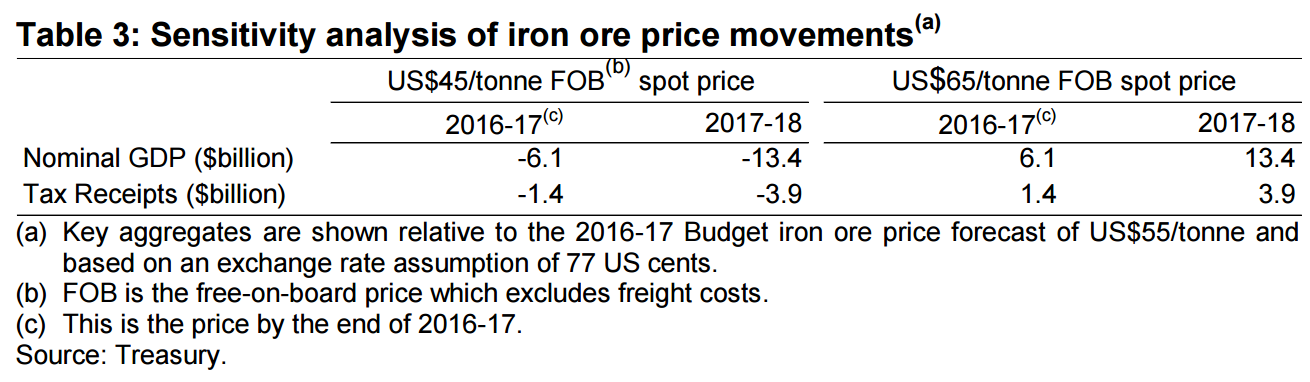
Here’s the Budget’s own sensitivity analysis:
Advertisement
The impact of iron ore prices being US$10 per tonne lower/higher, based on the sensitivity analysis presented in Statement 7 is set out in Table 3. A US$10 per tonne reduction/increase in the iron ore price results in just over a $6 billion reduction/increase in nominal GDP in 2016-17. These illustrative impacts differ from those presented in the 2015-16 Budget due to a more comprehensive analysis presented in this year’s Statement 7. In particular, the sensitivity analysis now assumes that export commodity prices fall/rise over the course of a year rather than an immediate movement. The effect of this is to reduce the impact in the first year of the analysis. The effect in the second year is in line with the earlier sensitivity analysis. For purposes of comparison an immediate fall/rise in the iron ore price would have a direct effect in the first year of around an $11 billion reduction/increase in nominal GDP in that year.
In short, futures pricing has already torn up the Budget outlook for nominal GDP and revenue by roughly -1.5% of nominal GDP and revenue by $8 billion every year over the forward estimates.
This is beyond disgraceful. It is pure and simple the corruption of the Budget process in a bloody great Banana Republic.
The National Australia Bank has told clients Australia’s triple-A credit rating is at risk as a result of the budget as Labor treasury spokesman Chris Bowen prepares to make preserving the rating a key plank of its election policy.
Mr Bowen will say on Tuesday the AAA rating is at risk because the Coalition refuses to admit the nation faces revenue problems. He will also promise to bring forward the mid-year budget update, from December to within three months of the election if Labor wins, to update economic forecasts.
Ahead of Mr Bowen’s speech, Coalition Finance Minister Mathias Cormann ramped up pressure on Labor over its costings, telling Fairfax Media that Labor had a $66.4 billion, four-year budget black hole and over 10 years, this could be as much as $190 billion.
The bank’s global head of research, Peter Jolly, wrote to clients on Monday saying that Standard & Poor’s was likely to be the first ratings agency to lose patience with Australia over government debt level, placing its rating on “negative outlook”, indicating it could change in the next six to 24 months.
“Normally they [Standard & Poor’s] rubber-stamp the triple-A on the evening of the budget,” Mr Jolly said. “This time, both Moody’s and S&P have been more circumspect.”
He said the different approach this time could mean Standard & Poor’s had lost patience with the government over debt and the rating was under “active consideration”.
Mr Bowen will argue that defending the AAA rating is “not just a matter of pride” but that confidence in the economy and the borrowing costs of state governments and major corporates could rise too, if the rating is downgraded.
“This budget does virtually nothing to improve the situation . . . the contribution to fiscal consolidation from government decisions in this budget amounts to just $1.7 billion over four years,” Mr Bowen will say.
“The Treasurer, in doggedly insisting that Australia doesn’t have a revenue problem, is endangering our AAA rating.
“Once you’ve lost a AAA rating, it’s very hard to get it back . . . the best strategy on the AAA rating is: don’t lose it.”
It’s gone by year end without change and if it’s not S&P it’ll be Moody’s which has already declared the Budget a pack of lies:
“The projected increase in revenues as a share of GDP is based on a return to robust nominal GDP growth which generally comes with a higher revenue-intensity of growth. Our forecast for nominal GDP growth is somewhat more muted than the government’s. We estimate that the adjustment to an environment of lower commodity prices is still underway and will continue to weigh on corporate profitability and wage growth. As a result, improvements in the government’s revenues may be somewhat more muted than currently budgeted.
David Llewellyn-Smith is Chief Strategist at the MB Fund and MB Super. David is the founding publisher and editor of MacroBusiness and was the founding publisher and global economy editor of The Diplomat, the Asia Pacific's leading geo-politics and economics portal.
He is also a former gold trader and economic commentator at The Sydney Morning Herald, The Age, the ABC and Business Spectator. He is the co-author of The Great Crash of 2008 with Ross Garnaut and was the editor of the second Garnaut Climate Change Review.