Cross-posted from Investing in Chinese Stocks.
Ren Zeping of Guotai Junan writes:
Money over the money go? China in recent years the money supply growing faster, but the economic growth rate has been declining, financial departing from widening between the entities. 2014 M2 grew 12.2% GDP growth of 7.3% in 2015, M2 grew 13.3%, GDP growth of 6.9% in 2016 from January to February M2 growth of 13.3% expected Q1 GDP growth of around 6.5% in January new yuan loans 2.51 trillion yuan, the first quarter is expected to 4.3 trillion yuan or so, do not send money into the real economy, fall into a liquidity trap. M2 / GDP has quickly climbed to 205.7%. Where’s the money? The core may be two to go: First, to maintain the cycle of debt and Ponzi financing rolling , resulting in large capital precipitation currency’s velocity V decreases. Second, since the current round of monetary easing cycle turned, first in 2014 – the first half of 2015 boosted the stock market bubble, and then push the second half of 2015 liters of first- and second-tier cities housing bubble core. Financing structure, capital flows and asset-liability ratio circumstances indicate that financing platform, real estate and heavy chemical industry overcapacity formation of the current demand for funds “black hole.” Financing these three main areas of government endorsement credit or housing prices is expected to support the financial soft constraints obvious characteristics of the funds is not sensitive to price, credit resources through continuous occupation maintain balance, stiff and dead, rolling become Ponzi financing.
The economy is slowing, while M2 and credit growth increases:
In recent years, rapid growth of the money supply, but the economic growth rate has been declining, departing between finance and the real growing. 2014 M2 grew 12.2%, GDP grew by 7.3% in 2015 to 13.3% M2 growth, GDP growth of 6.9% in 2016 from January to February M2 growth of 13.3% expected Q1 GDP growth of around 6.5% in January new yuan loans 2.51 trillion yuan, the first quarter is expected to around 4.3 trillion yuan, broad money supply and nominal GDP growth rate of real rip constantly queen, super-currency flows into the real economy is not falling into a liquidity trap. M2 / GDP has quickly climbed to 205.7%.
iFeng: 中国已落入流动性陷阱 超发的货币都去哪了?
This isn’t surprising in light of marginal utility. Debt has marginal utility, and it becomes most obvious with Ponzi debtors who need to increase their borrowing in order to finance their existing principal along with the interest payments. For these borrowers, rising debt has a negative utility: debt increases, but none of the debt is used for growth. The long-term value of the firm is zero as equity is turned into debt, until finally there is no more equity.
He goes on to argue why China will not experience higher inflation, due to the excess capacity and what I call “peak debt” or negative utility. The central bank can only increase the supply of credit and money where there are borrowers. In China’s case, that is in equities and then first-tier housing. There is one way China could experience inflation though: via the currency. A lack of confidence in the yuan or significant depreciation would cause prices to rise and increase the demand for credit.
The boom has pushed price ratios into orbit:
Shanghai E-House Research has released the 2015 Home Price to Income Ratios for 35 cities:
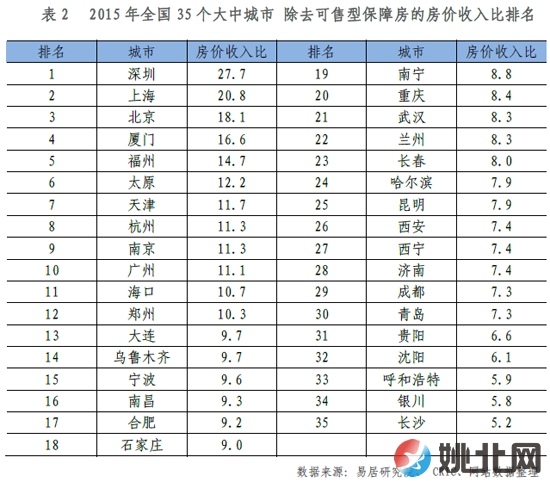
Shenzhen is on top with an average home price that is 27.7 times the average annual salary. Shanghai, Beijing, Xiamen and Fuzhou round out the top five.
The top 35 cities have a higher ratio than the national average, and homes are said to be 12% above fair value based on this measure:
The report shows that, according to the National Bureau of Statistics caliber 2015 national commercial housing price earnings ratio of 7.2, in which 35 major cities price earnings ratio of 8.7, the magnitude of deviation from the reasonable value of 12%.
Shenzhen is 111% above fair value, while Shenyang is 14% below fair value, according to the report.
Data show that the price earnings ratio deviation value terms, 35 City Super City quarter offset value by 25%. Shenzhen price earnings ratio deviates from fair value of as much as 111%, Xiamen aspect of price earnings ratio of the magnitude of deviation from the fair value is also up to 70% deviation from the reasonable value of the amplitude of Beijing has reached 45%, Shijiazhuang deviation as high as 45%, Shanghai, Fuzhou areas, namely, a shift of about 40%. The Shenyang price earnings ratio of only 6.0%, prices deviate from the value of the amplitude is -14%.
iFeng: 无处安放的“刚需”:多城房价与收入增幅明显“倒挂”
Even dead realty is in a bubble now for Beijingers:
Qingming, in some surrounding areas in Beijing and Shanghai, the former cemetery crowded with vehicles in Beijing and Shanghai. Someone says, “was born in Beijing, and was buried in Hebei; born in Shanghai, Jiangsu and Zhejiang in the funeral”, Hebei and Jiangsu and Zhejiang in the “off-site tomb” favored to become the ring cities “remote tomb,” notes the rise of reality. This phenomenon is driven cost or other reasons? Just how Chinese cities funeral costs high? “China Network in” this reporter conducted a survey.
…Hebei Mountain pagoda cemetery just over 50 kilometers away from Beijing, a staff member surnamed Chen introduced since the beginning of 2013 foreign sales, the cemetery more than 80% of customers are from Beijing, many customers say, where “cost-effective.” According to its introduction, the price of cemetery tomb doubled from one square meter price of 16,500 yuan to more than two square meters priced at 80,000 yuan range. “The most expensive 9500 yuan last year, by many customers from Beijing looted.”
…It is understood that Beijing can provide a small section to the tomb of the price between 2000-9800 yuan, three-dimensional burial, tree burial, funeral flowers, lawn burial, while providing only a few hundred charges yuan and the free spread scattered ashes buried deep and other services. However, for the pursuit of the traditional way of two people buried in the tomb is about 10,000 yuan in Hebei, in Beijing is difficult to find suitable conventional grave.
Around Shanghai, Suzhou, Jiashan and other places, prices generally double cave tomb at around 30,000 to 40,000 yuan, representing Shanghai cemetery price has obvious advantages, but also some of the cemetery for the residents of Shanghai opened a sales and grave shuttle bus.
Reporters found that, compared to the surrounding cities, Beijing, Shanghai and other large cities to buy land policy and policy limits more stringent graves, so the “big tomb monument,” “living tomb” and similar needs are not met, but also an important factor “place-tomb” rise.
Although state regulations banned “living tomb” sales, but cemetery Mountain Pagoda staff member surnamed Chen admitted that there are many customers who bought the cemetery is the grave “life points”, that is, during his lifetime purchase. It is understood that out of a total of more than 30,000 sets of cemetery monument, has sold about 10,000 units.
China has an answer for high costs and lack of space in the city: recycled graves and joint interment to increase gave utilization rates.
Ministry of Civil Affairs and other nine ministries in February this year published “Guidance on the implementation of land ecological burial” clear, “and actively promote recycling graves,” “encourage family members to use a single tomb buried ways to enhance utilization rates.”
iFeng: 环大城市墓:河北墓地每平米9500被北京人抢光
But there is more evidence today that the bubble is about to pop:
A woman in Beijing wants to sell her house for 5.1 million yuan, willing to accept 5 million. She’s in a good school district and in February, her neighbor put his home up for sale at 4.9 million and sold it for 4.8 million on the same day, and he told her to she should list hers for 5 million. She soon found out that by listing it for 100,000 yuan more, there were no buyers. People came to look at the house, but left without saying anything. Over the Qingming holiday weekend, only two people came to look at the house, others had planned to visit, but never showed up.
Another woman wanted to buy a home for 5.4 million and thought it expensive, but seeing another house sell for 5 million and prices rising, she decided to buy. The homeowner refused to sell and raised the price to 5.6 million, so she walked away. Two weeks later she gets a call from the agent, no one has come to look at the house in two weeks and the owner is willing to sell for 5.4 million. The buyer decides she’s not really interested anymore, the house is still a bit expensive.
Homelink said new buyer traffic fell 26% in March from February.
iFeng: 看房人减少 房主“顶点”卖房落空降20万没人买
It remains to be seen if this represents a blip or an emerging shift in sentiment.