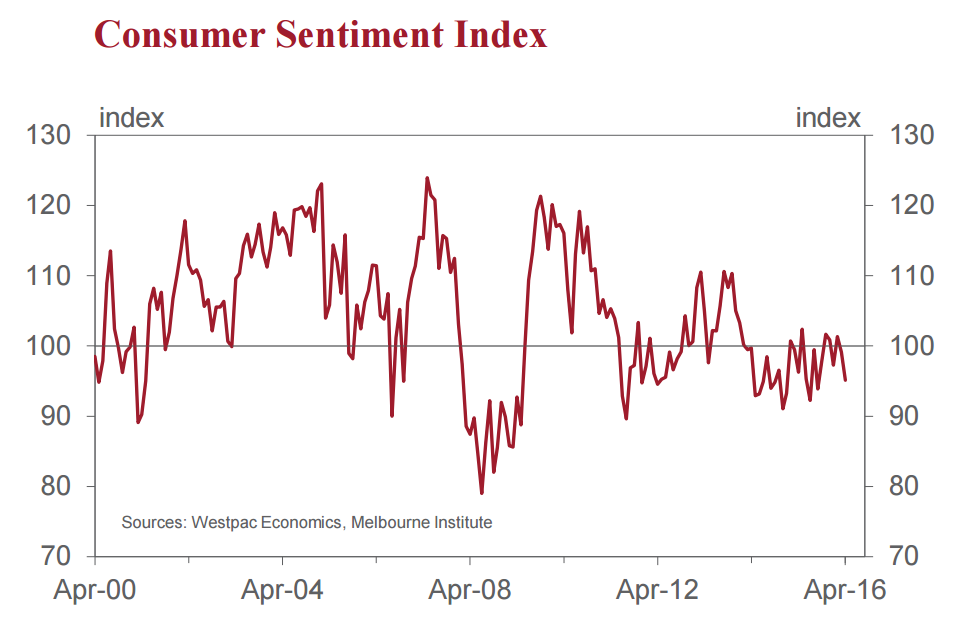
• The Westpac Melbourne Institute Index of Consumer Sentiment fell by 4.0% in April from 99.1 in March to 95.1 in April.
This is a disappointing result. After holding above 100 in the November–February period the Index has now been below 100 for two consecutive months. A print below 100 means that pessimists outnumber optimists. That had consistently been the case in the March 2014 – October 2015 period when the Index only exceeded the 100 level twice in 20 months. With four consecutive readings above 100 we were hopeful that confidence had moved on to a sustainable higher plain. Today’s result would appear to dash those hopes.
It appears that international and market developments continue to create unease for respondents although the signals are mixed. The Australian sharemarket fell 3% over the month and media coverage on China continues to highlight risks. On the other hand the US sharemarket rose 2.4%. Specific sentiment towards housing fell sharply.
A standout development over the month has been the solid rise in the AUD, up another 2¢ over the month, pushing over 77¢ US at one stage to a nine month high. Given that rebalancing of the economy towards service exports – tourism and education in particular – has been an important positive development over the last two years, respondents may now be interpreting any increase in the AUD as adverse for future growth.
The Index is now 6.4% below its reading six months ago in November.
Four of the five components of the Index fell in April. The sub-index tracking assessments of ‘family finances compared to a year ago’ declined 3.8%, while the component tracking expectations for ‘family finances over the next 12 months’ fell by 6.6%. There was also concern about the economic outlook, the component tracking views on ‘economic conditions over the next 12 months’ down 5.5% and the component tracking expectations for ‘economic conditions over the next 5 years’ down 5.9%.
The ‘time to buy a major household item’ component was the only one to increase, registering a modest 1.0% gain.
The news was better around the labour market. The Westpac Melbourne Institute Unemployment Expectations Index fell by 1.8% (a fall indicates that respondents are more confident around the outlook for the unemployment rate). The state mix was notable in April with big improvements in NSW and Victoria partially offset by deteriorating unemployment expectations in the mining states and South Australia. 13 April 2016
Prospects for the housing market softened. The ‘time to buy a dwelling’ index tumbled by 9.2%. There was a substantial fall (–13%) in NSW, which had already been registering the weakest sentiment and pushed the NSW Index back near the lows of mid last year.
The outlook for house prices improved though with the Westpac Melbourne Institute Index of House Price Expectations rising 5.3% after a 9.8% gain in March to be at its highest level since September.
The Reserve Bank Board next meets on May 3. Despite this disappointing read on Sentiment we expect the Board will keep rates on hold for another month. We retain our call that rates will remain on hold for the remainder of 2016.
David Llewellyn-Smith is Chief Strategist at the MB Fund and MB Super. David is the founding publisher and editor of MacroBusiness and was the founding publisher and global economy editor of The Diplomat, the Asia Pacific's leading geo-politics and economics portal.
He is also a former gold trader and economic commentator at The Sydney Morning Herald, The Age, the ABC and Business Spectator. He is the co-author of The Great Crash of 2008 with Ross Garnaut and was the editor of the second Garnaut Climate Change Review.