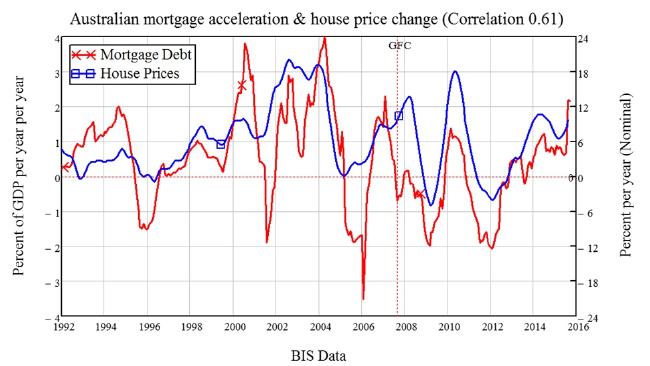
…foreign buyers have certainly played a part, the key factor driving rising Australian house prices in the last three years has been accelerating mortgage debt.
So what’s the problem? The problem is that nothing — not even Donald Trump’s popularity — accelerates forever. At some point, the level of mortgage debt relative to income will stabilise; well before that happens, the acceleration of mortgage debt will decline, and prices will fall.
This has already happened twice in recent history in Australia: in 2008 and in 2010. On both occasions, deliberate government policy stopped the fall in prices by encouraging Australians back into mortgage debt — firstly via the First Home Vendors Boost under Rudd and secondly via the RBA’s rate cuts from 2012 which were undertaken with the hope they would encourage more household borrowing. In both cases the acceleration of mortgage debt resumed, as did the bubble in prices.
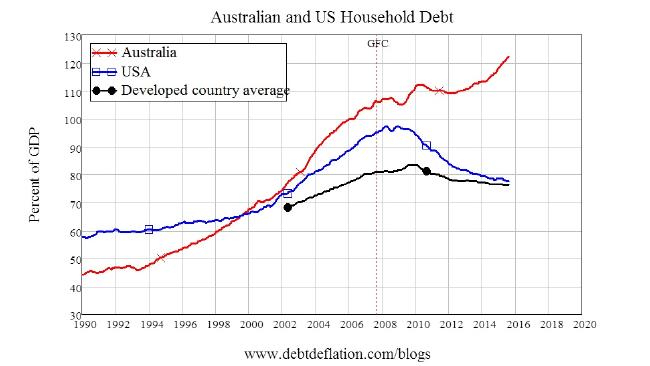
But couldn’t the government do that again, and keep prices rising? Yes it could: the RBA still has 2 per cent of rate cuts in its depleted arsenal and further cuts could entice yet more household borrowing. But each time this trick has been pulled in the past, the outcome has been ever higher levels of leverage. Today, Australia has the highest levels of mortgage debt and total household debt, in the world — more than 120 per cent of GDP compared to under 80 per cent in the USA and the rest of the West.
As MB has said many times, the thing will continue to inflate until the bubble managers run out of ammunition. We believe that that is closer than most realise given:
the RBA probably can’t cut to zero. We need some uplift to fund the current account deficit. We estimate 50-75bps is the bottom;
bank funding costs will keep rising in any scenario in which the RBA needs to cut further so that means banks will keep half, thus households only have 50-75bps of easing left;
the Budget can no longer stimulate like it did during the GFC given rising net public debt-to-GDP so any shock requiring further RBA easing will not have as great a fiscal support and the hit to growth will be harder;
during that shock we are very probably going to lose the AAA rating, downgrading the banks in the process and exacerbating the first two points.
Advertisement
The Australian housing bubble has engulfed the entire political economy of the country, so much so that we are actually going to vote on it at the next election. Ipso facto the bubble will not end until the entire political economy is changed with it.
David Llewellyn-Smith is Chief Strategist at the MB Fund and MB Super. David is the founding publisher and editor of MacroBusiness and was the founding publisher and global economy editor of The Diplomat, the Asia Pacific's leading geo-politics and economics portal.
He is also a former gold trader and economic commentator at The Sydney Morning Herald, The Age, the ABC and Business Spectator. He is the co-author of The Great Crash of 2008 with Ross Garnaut and was the editor of the second Garnaut Climate Change Review.