
From CLSA:
Technicals….AUD heading North as is Gold but not markets (Laurence Balanco)
Catching up with Laurence Balanco yesterday and talking currencies we discussed the recent strength in the Aussie dollar and I was surprised when Laurence said his target was .78 for the AUD/USD. His target could well prove conservative, with my Japanese colleagues expecting Australia to be the big beneficiary of a compressing Japanese yield curve. With the advent of NIRP in Japan, the hunt for yield has begun and that necessitates capital flowing overseas which will help to weaken the Yen.
So where to go? – Australia of course given our high quality yield, providing structural support for the Aussie near term. Laurence notes large speculators/HF are now positioned marginally net long the AUD at 13% of total open interest after been short since June 2015 ( = the shorts have been cleared).
From a pure price perspective the AUD has broken above initial resistance provided by the 200-day MA and the October/December 2015 highs at the 0.7375 area. This opens the door for a test of next chart resistance at the 0.7570 area provided by the March/April 2015 lows. A break above this level would point to a test of next chart resistance at the 0.7957 area.
OK, so what else does Laurence Blanco say?
It’s time to sell again
Laurence has been flagging the typical behavior of a period of ‘traders’ remorse’ when price action returns to support levels, now resistance, following a price breakdown. With lacklustre volumes through this short but sharp rebound, we still classify it as a kickback rally. In addition, it is worth noting that the following markets have now tagged or are very close to tagging overhead resistance: Nasdaq 100, Russell 2000, Nikkei 225, ASX200, Kospi 200, JCI and PSEi. Copper is at its 200-day MA. The US 10-year yield has run into overhead resistance at 1.90-1.96% with WTI and Brent fast approaching resistance at $42.03- 45.16 and $42.23-45.19 respectively. It’s time to sell again!
So, the Aussie is going charge skywards as global share markets and commodities sell off? I’ll take the other side of that bet. Over to the AFR for more:
The fortunes of the Australian dollar have been bolstered by a pick-up in commodity prices, and signs of the resilience of the local economy, which grew at an impressively brisk 3 per cent clip over 2015.
Buoying sentiment even further is the fact that the Reserve Bank of Australia has kept interest rates fixed at 2 per cent since May last year, making it one of the few central banks in the world which is not employing monetary tools to push its currency lower.
In an effort to unblock this liquidity, the European Central Bank and the Bank of Japan have cut the interest rate they pay on the money that banks park in their vaults. This should encourage banks to lend more, although there is little evidence that this is happening.
What is clear, however, is that negative interest rates – like other forms of unconventional monetary policy – are effective ways to drive foreign exchange rates lower.
Actually, that is decidedly unclear. Here’s the Aussie versus yen with negative rates marked:
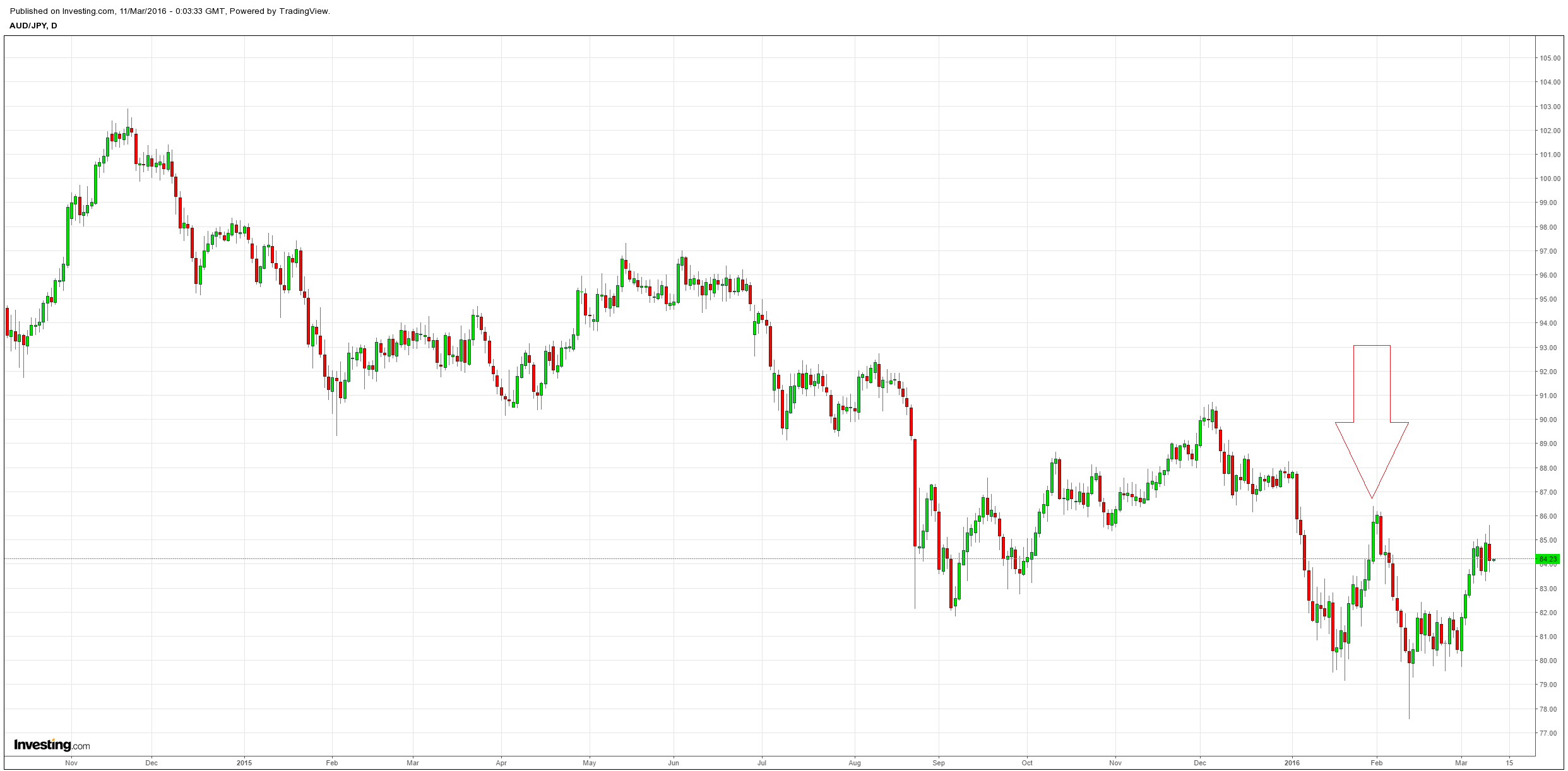
The recent rally has accompanied the big commodity price bounce during which you’d expect the Aussie to rise so we the evidence so far is that negative rates in Japan have lowered the Aussie. Of course that may change.
Here’s the AUD/EUR with negative interest rates marked:
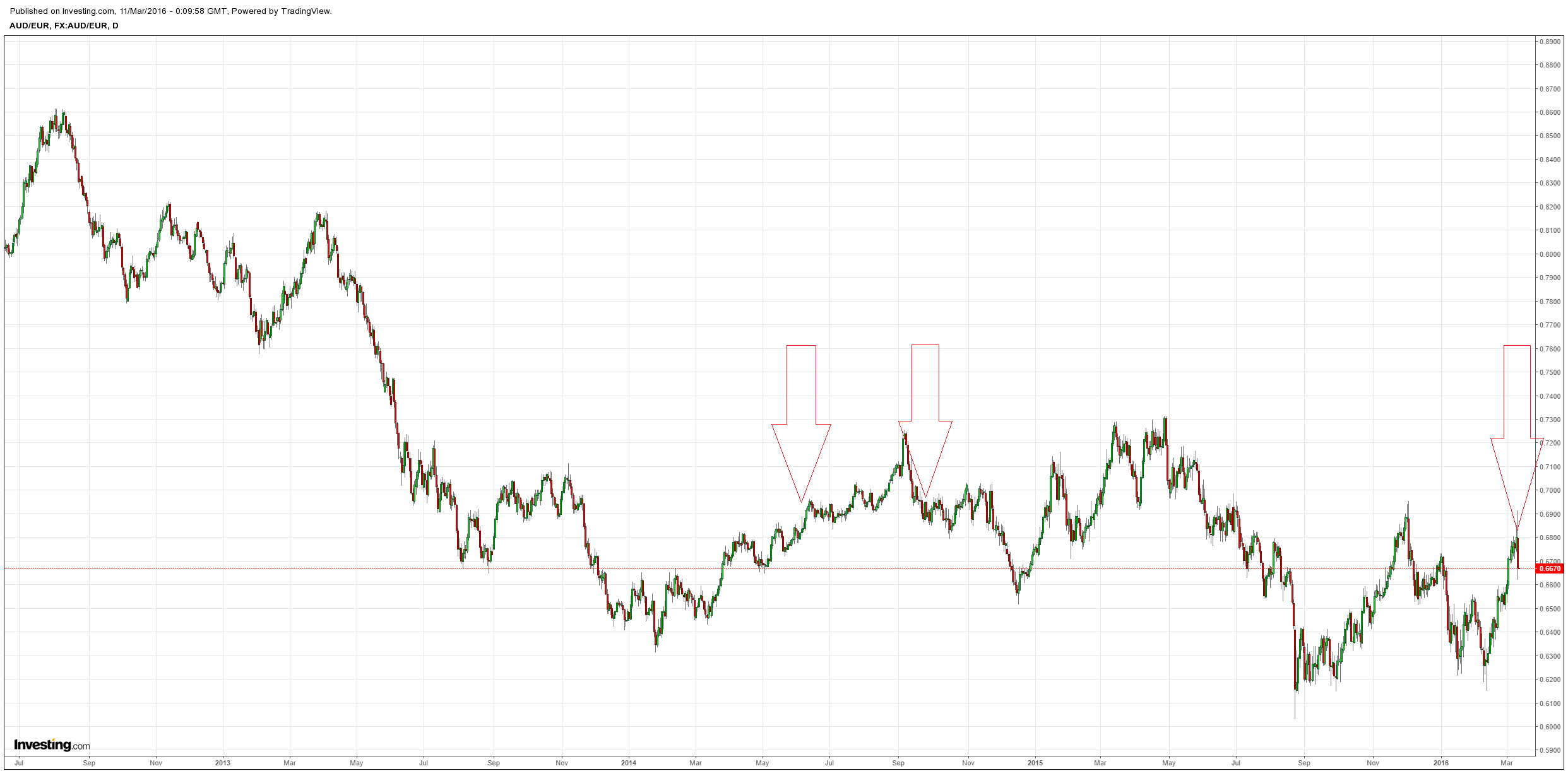
In both cases the reaction to cuts into negative have backfired and in both cases the Aussie remains in an unbroken downtrend.
- interest rate differentials;
- global and Australian growth (more recently this has become more nuanced for the Aussie to be more about Chinese growth best captured in the terms of trade);
- investor sentiment and technicals; and
- the US dollar.
On the first, interest rate differentials, here are the charts. The Japanese spread has increased at the long end but not much at the short and remains in a large downtrend:
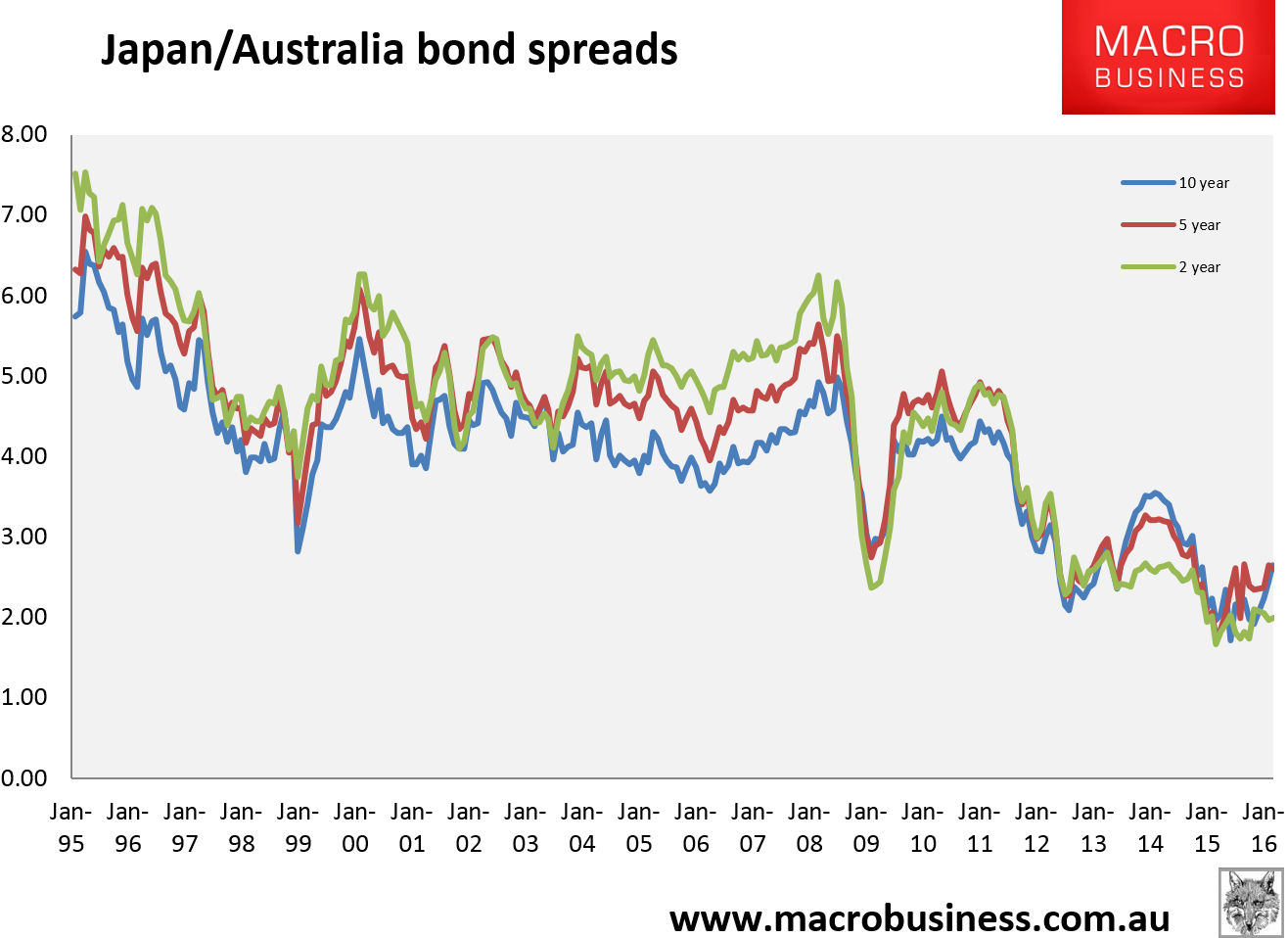
The German spread is similar: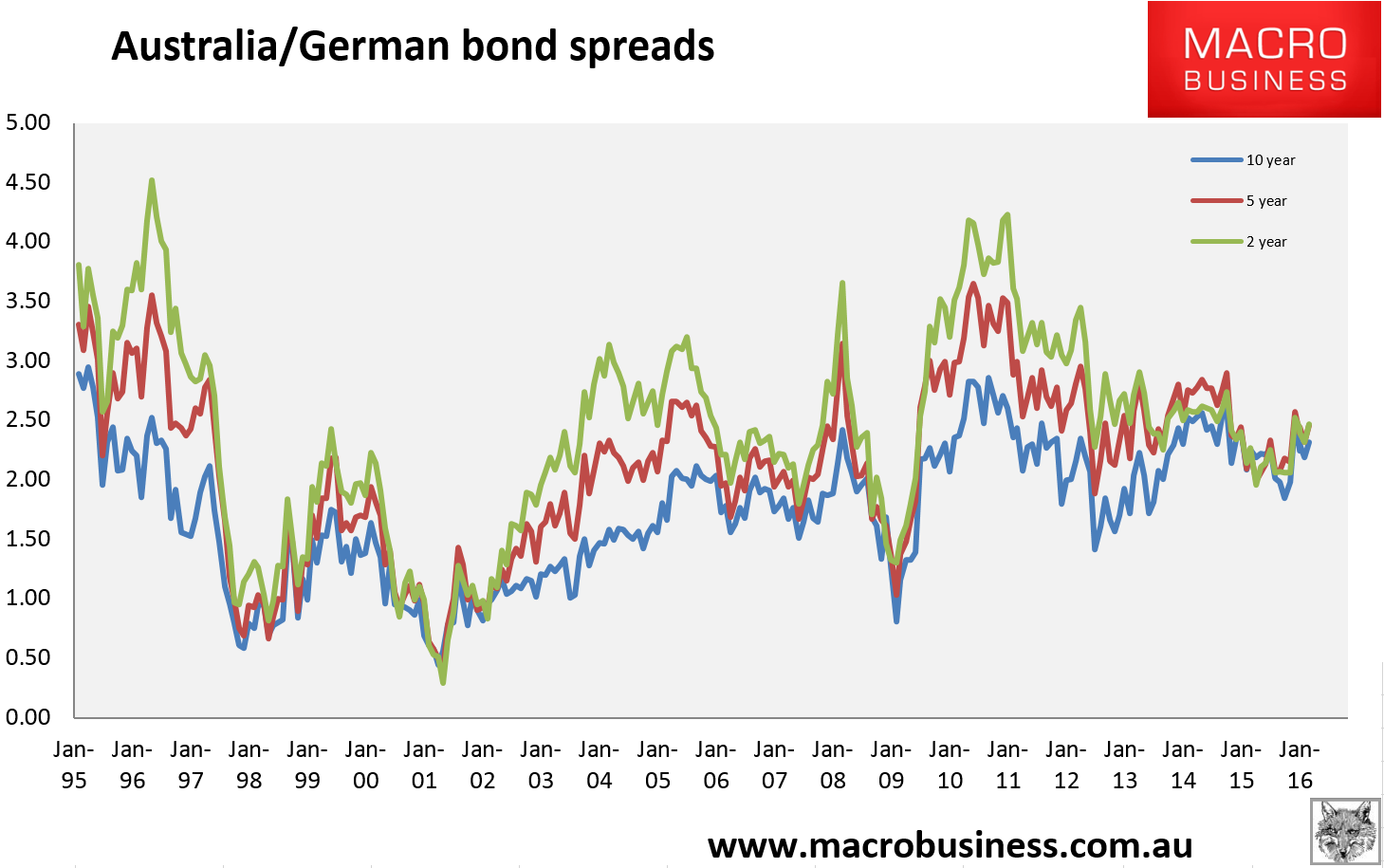
The US spread is still contracting at the short end but has pushed out a bit at the long end. Again within a big downtrend: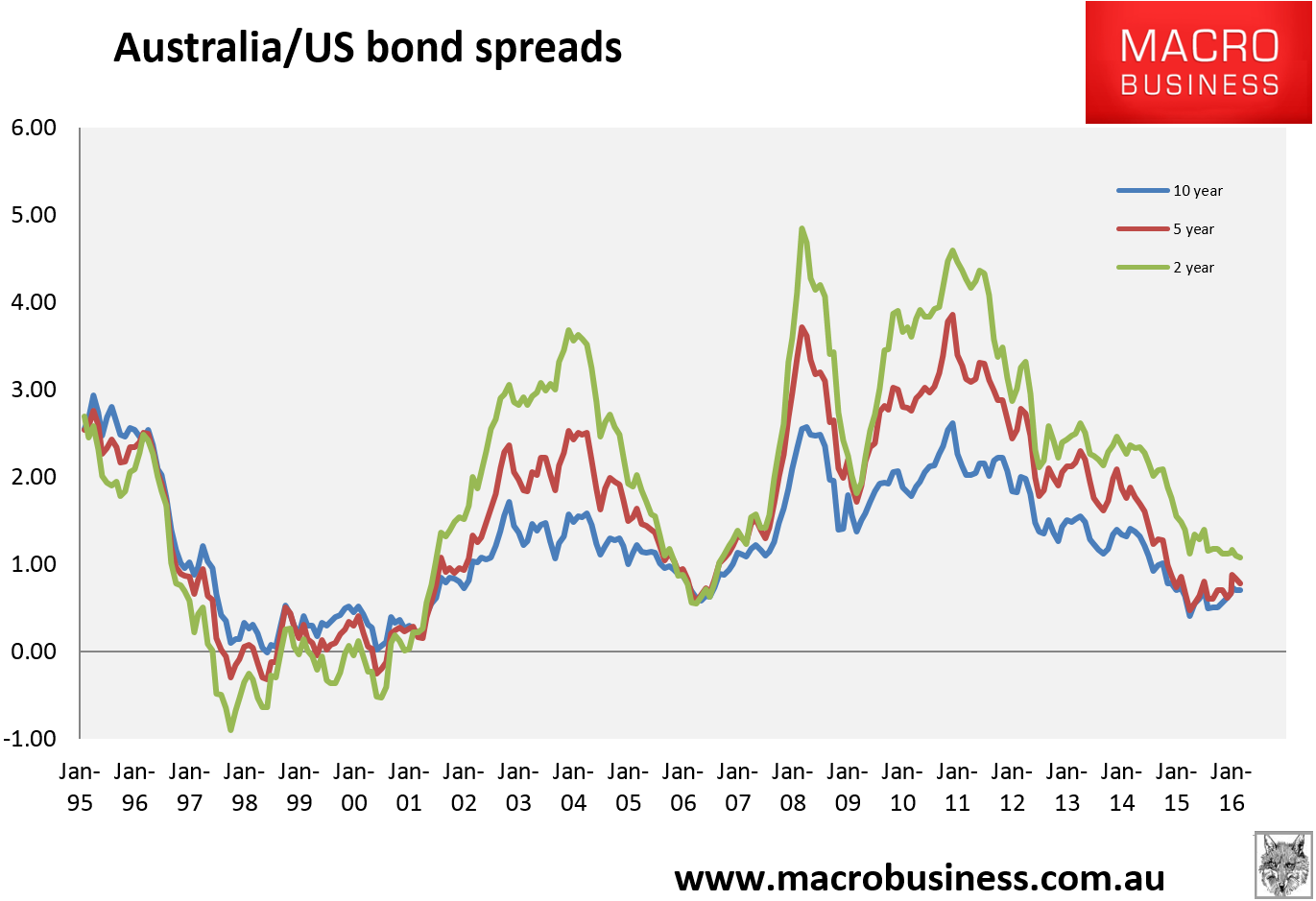
There is nothing in these to cause panic stations that Aussie is about to rise sustainably I would have thought. Add in that more rate cuts are still coming and there’s greater room for the spreads to contract than expand given other jurisdictions are already very negative.
On the second of the five drivers Australia is enjoying some glow from its recent 3% print but that is rear vision mirror stuff. MB still expects growth to be weak (most do) because of the:
- combined capex cliffs in mining, cars and residential construction;
- overly tight Budgets;
- peaked house prices, and
- ongoing terms of trade falls.
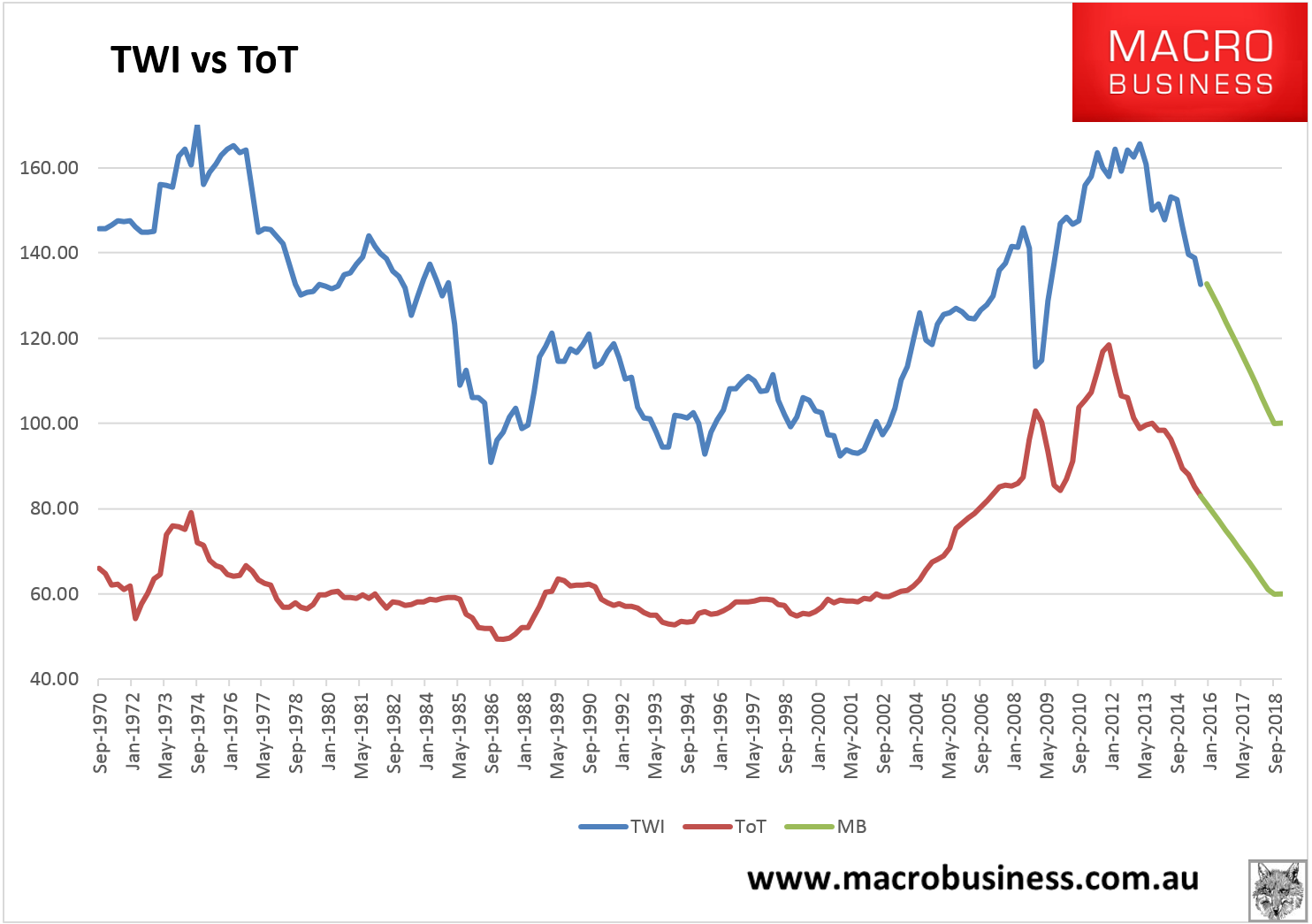
In short, the growth advantage will fade as we get deeper into the year and the key component of the growth outlook for the currency is the terms of trade which has a very strong correlation with currency value:
On the third of the five drivers, sentiment and technicals, both are bullish. The market is long Aussie 17k contracts:
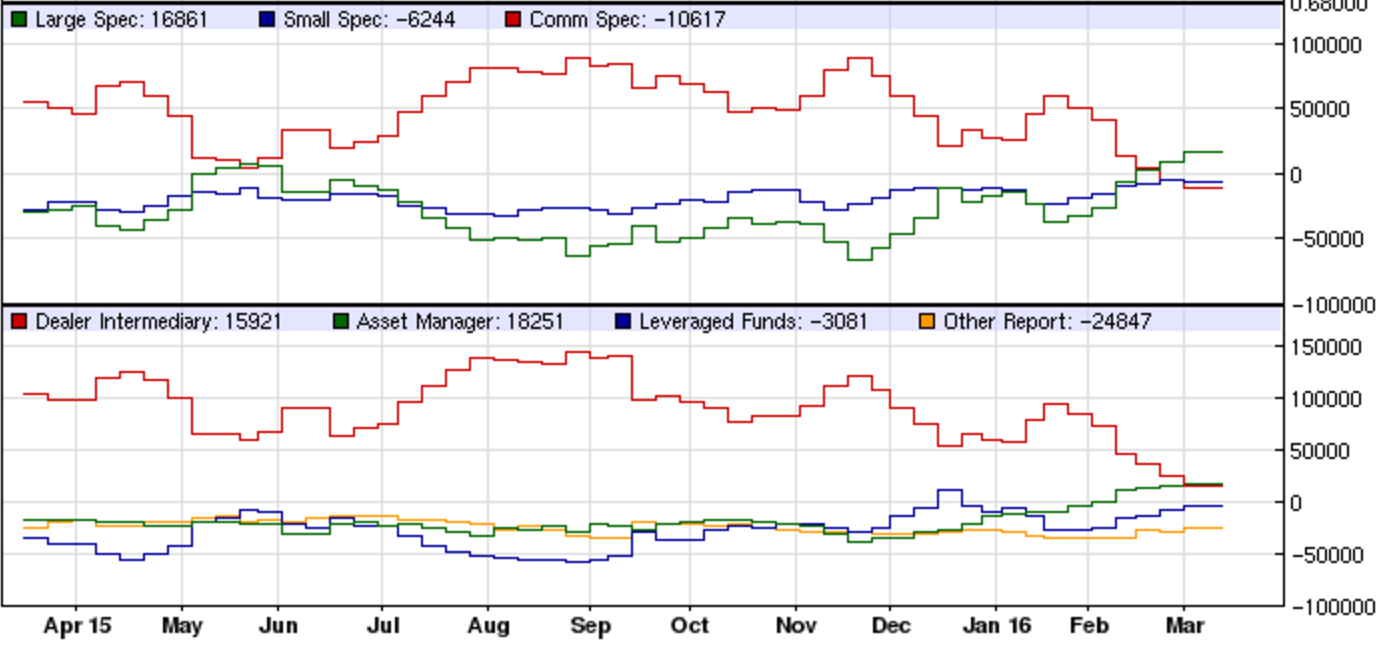
The longest its been for eighteen months. And technicals are also bullish:
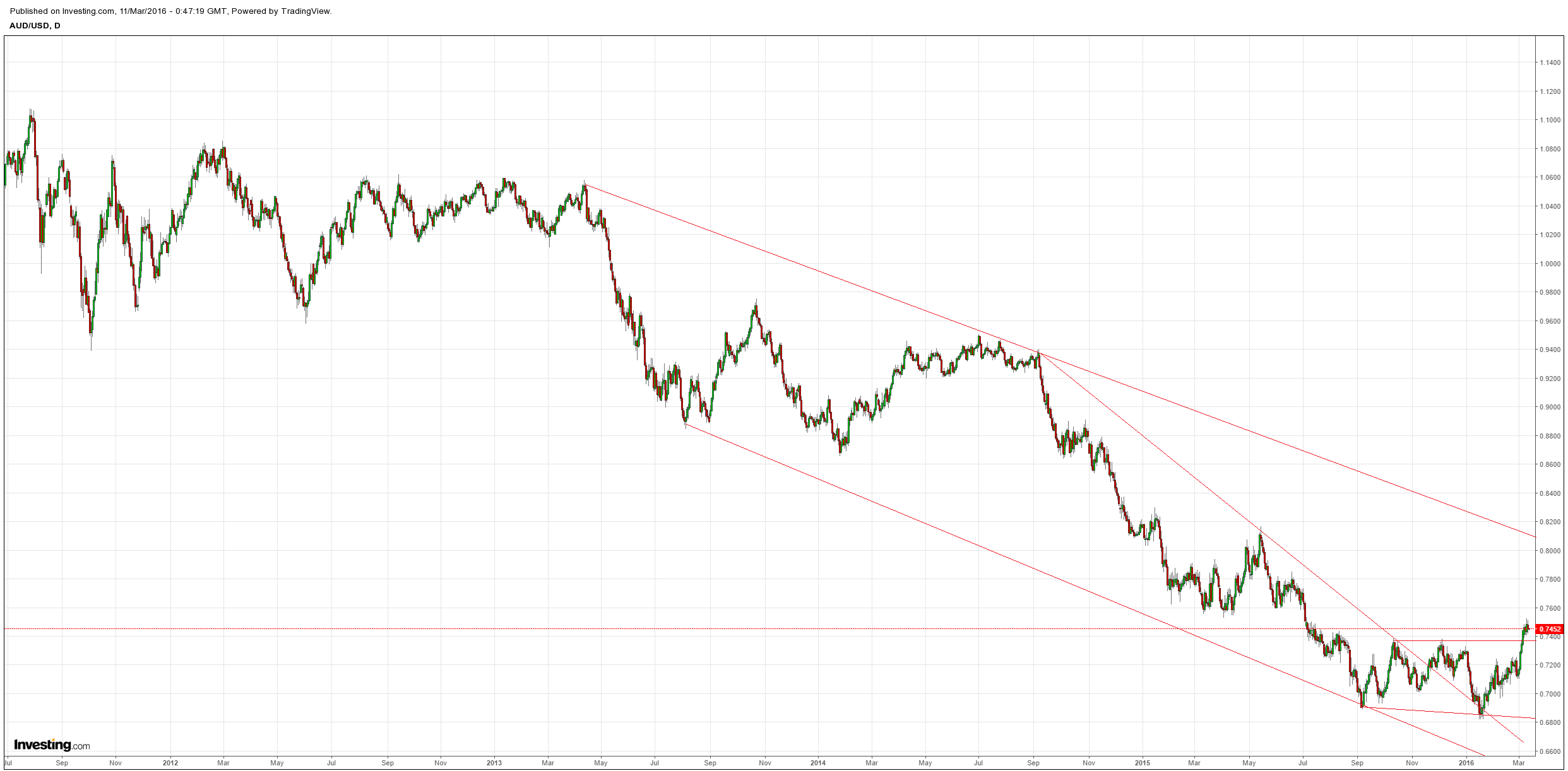
We’ve broken out of our recent trading range and are pushing higher with resistance at 76 and 78 cents but the larger downtrend is intact, which is clearer still on the monthly chart:
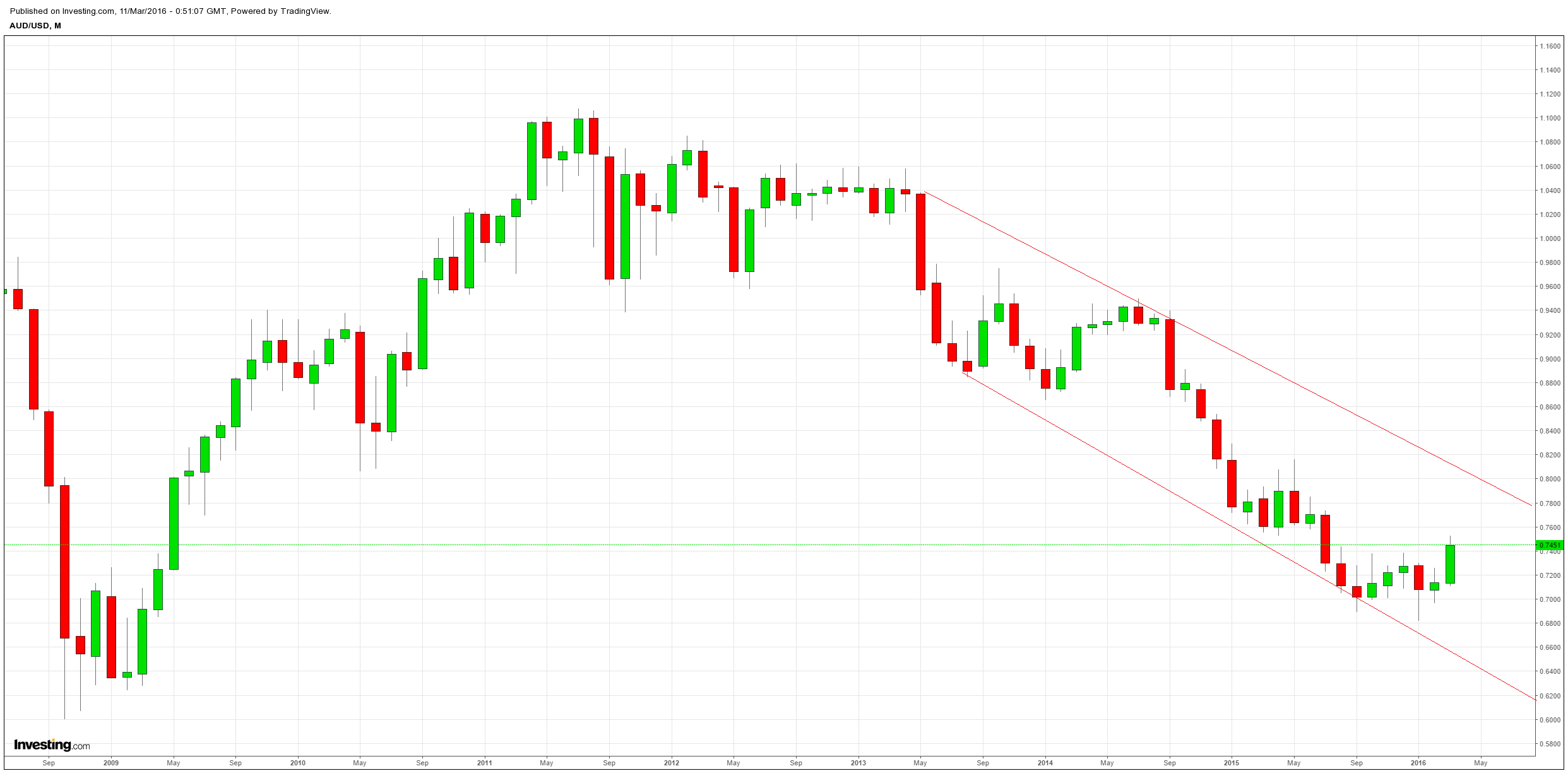
As you can see, we’ve been through several of these rising periods during the big decline but the trend remains solidly down.
On the last driver, the value of the US dollar, we see perhaps the most vexed question of all. It is US rate rises and its strong dollar that is one key driver of the global commodities bust and, increasingly, wider volatility and end-of-cycle prognostications. It will definitely reverse at some point. However, for the moment, the US economy is holding up OK and the Fed may have paused but is nowhere near reversing course:
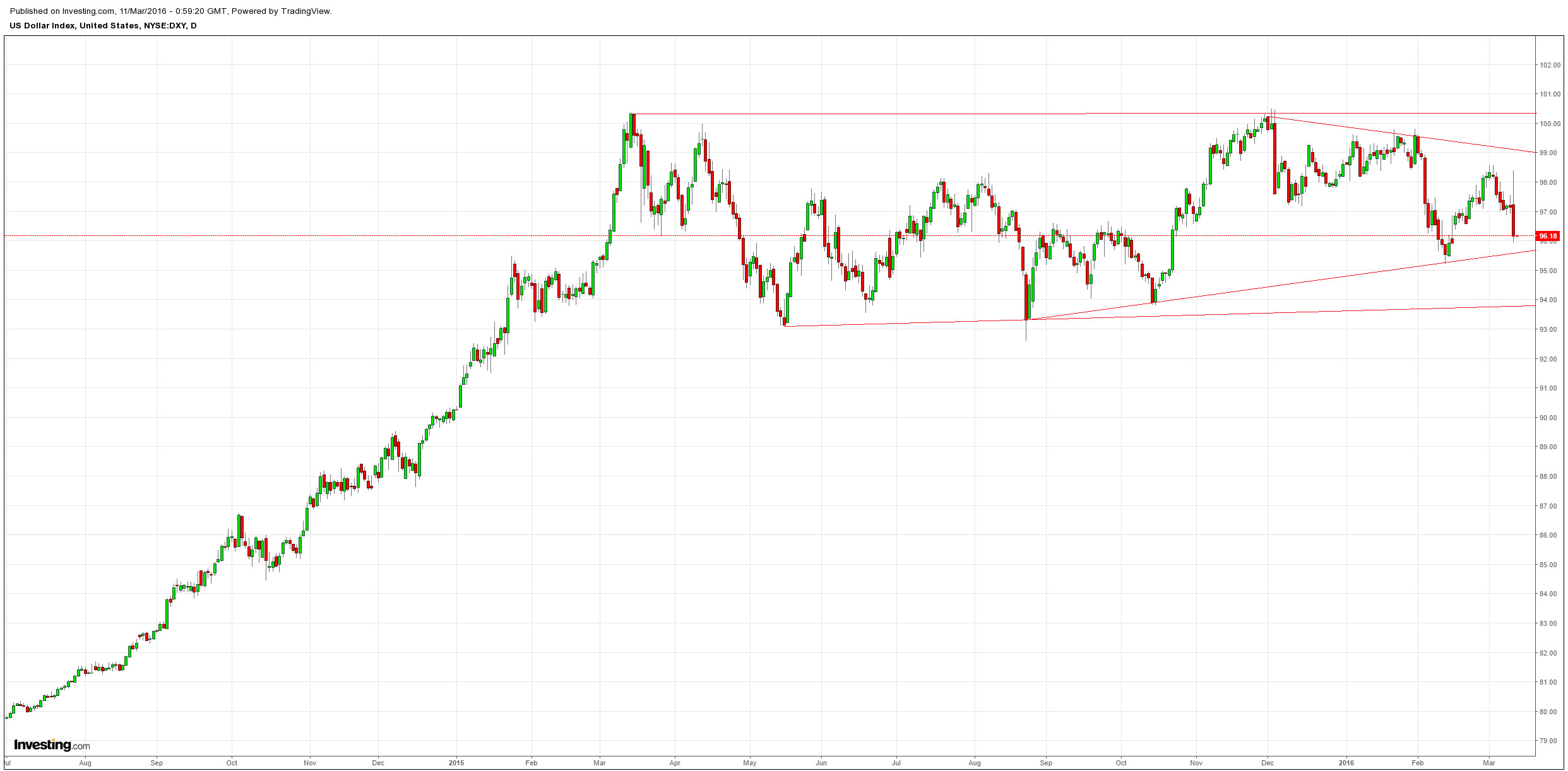
That is about as neutral as a chart can be with a symmetrical triangle within a sideways channels. The jury is out!
The US dollar will break down if markets crash again with commodities given the it will force the Fed to reverse course. But the Aussie will also tumble in that context so that is not a reason to buy it. If markets don’t crash again with commodities then the Fed will tighten and the Aussie should come under renewed selling pressure despite the complication of the counter-intuitive market reaction to currencies in the NIRP economies which are rising instead of falling!
Put all of that together and what do you get other than a growing migraine? I put it to you that:
- the recent bounce has been more the result of commodity price strength than the yield spread;
- the other drivers tend to push the currency around within larger trends not set them;
- if (when in our view) commodities reverse so will the Aussie.
