
The Parliamentary Budget Office (PBO) has released a new report showing that the projected combined fiscal health of the Commonwealth and State Governments has deteriorated badly, with the Commonwealth accounting for around 80% of this deterioration. From The Canberra Times:
Australia’s national fiscal deficit – the combined budgets of our federal and state governments – is projected to deteriorate by $34.1 billion more than expected over the next four years.
The PBO says that means the projected deficit has widened from $88 billion to $122.1 billion since all 2015-16 budgets were delivered last year…
It says Commonwealth revenue has been downwardly revised by a huge $46.4 billion since former Treasurer Joe Hockey’s second budget.
It says net capital investment worth $2.5 billion has also pushed the government’s fiscal balance further into the red.
Those two figures have been only partially offset by larger-than-expected falls in projected Commonwealth government expenses – thanks to record-low wages growth for government employees – of $15.billion.
The reasons for the slump in Commonwealth revenue are well known and centre on the slump in commodity prices and the terms-of-trade, which has dramatically lowered nominal GDP growth (the key driver of Commonwealth revenue growth), in particular company taxes and personal income taxes.
The states so far have held up better due to the booming property markets in Melbourne and Sydney, which have offset commodity-related weakness in Western Australia and Queensland.
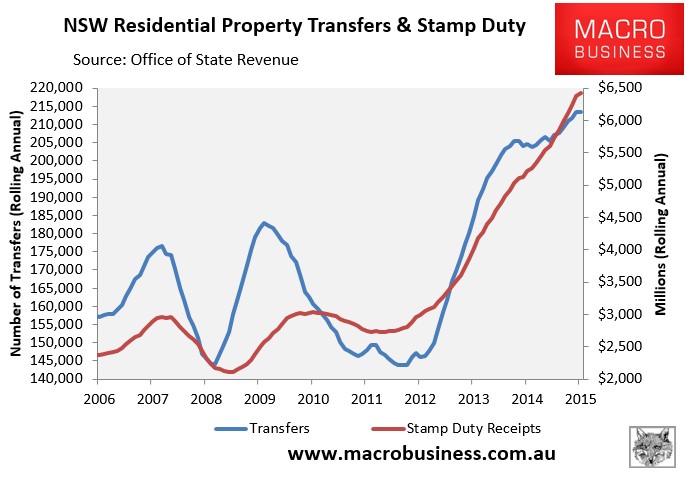
For example, New South Wales is enjoying the largest stamp duty boom in its history, with receipts jumping by an incredible $3.09 billion (+92%) since June 2013 to $6.43 billion as at December 2015:
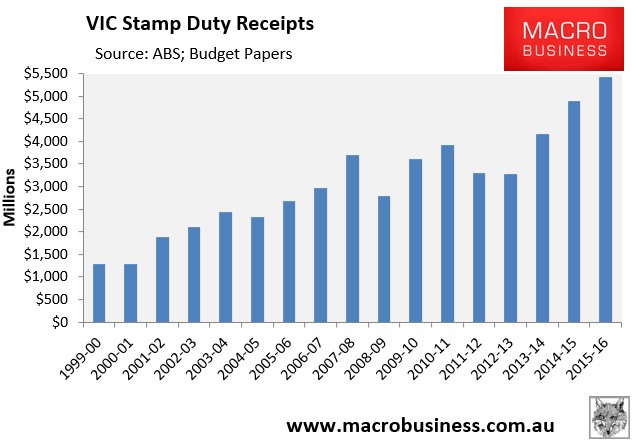
Victoria, too, is riding the stamp duty wave, with receipts projected to hit a record $5.42 billion this financial year:
Both housing “booms” are long in the tooth, however, and likely to correct in the second half of this year. And with it will come lower stamp duty receipts along with lower economic activity as the negative wealth effect takes hold and construction activity slides.
For point of reference, the post-GFC correction in stamp duty receipts saw a peak-to-trough decline in receipts of around 30% in New South Wales and 24% Victoria – both of which were off only minor housing market corrections.
However, given the epic size of this boom, both governments should expect a much bigger correction in receipts next time around – probably during the 2016-17 and 2017-18 financial years.
It’s only a matter of time before the states join the Commonwealth’s Budget malaise.
