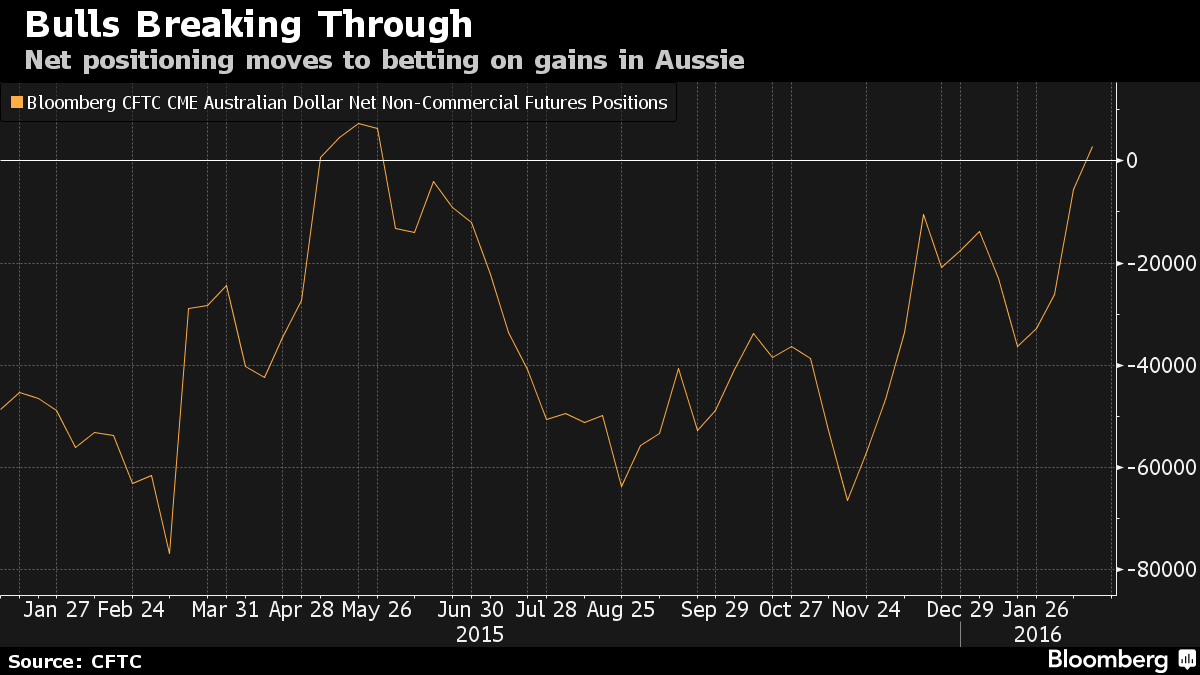
They’re queuing up to be bullish the Aussie now, from Domainfax:
“A rise in commodity prices, an improvement in risk sentiment and still well-anchored [US Federal Reserve] hike expectations are the perfect combo for the Australian dollar,” National Australia Bank currency strategist Rodrigo Catril said.
“Our fair value model suggests the Aussie still has more upside and now a US73 cents handle looks well within sight,” he said.
Hedge funds and other large speculators turned bullish on the Australian dollar last week for the first time since May 2015, while Macquarie Bank Ltd. said selling South Korea’s won is now the favored way to bet against China.
Although Asia’s largest economy is the primary destination for both Australian and South Korean exports, the Aussie’s 0.6 percent drop this year pales in comparison to a 4.2 percent slump in the won that’s come as China’s benchmark equity index has plunged. Expectations of relative price swings for the Australian dollar are the lowest since the first half of 2015 when compared with a JPMorgan Chase & Co. index for the overall currency market.
The Aussie dollar has climbed about 6 percent from a near seven-year low reached in January amid signs Australia’s labor market is recovering enough to allow the Reserve Bank to extend a nine-month stretch in which interest rates have remained unchanged. In contrast, wagers against South Korea’s won have been rewarded amid mounting speculation its central bank will ease policy as exports tumble, with the prospect of even further weakness if China resumes devaluation of the yuan, also known as the renminbi.
“The international macro-fund community is no longer universally bearish on Aussie and some are even considering taking out outright long Aussie positions,” said Gareth Berry, a foreign-exchange and rates strategist in Singapore at Macquarie. “There are several things happening in Korea now that make it a target for people who wish to express a negative view on the renminbi.”
Economists and market traders agree that foreign investor flows into government bonds were holding up the local unit.
“What we are seeing in the market place is that as more institutions [central banks] go negative, larger parts of the global yield curves trade below zero,” said Pimco portfolio manager for Australia Robert Mead.
“That means markets that have positive yields are then sought after, so places like Australia or US that have yields in the 1 or 2 per cent range start to become sought out purely as an alternative to negative rates elsewhere in the world.
“It’s not necessarily driven by any country’s domestic fundamentals; it can be driven by technical flows from large cohorts of global investors trying to avoid negative yields,” said Mead.
Goldman Sachs Asset Management’s head of fixed income for Asia-Pacific Philip Moffitt agrees, and says this could prove a headache for the RBA.
He has noted that more central banks in Asia with US dollar reserves are prioritising allocations into Australia.
“Our base case is that the Fed’s sensitive to market movements, so is going to tighten more gradually,” he said.
“The European Central Bank and the Bank of Japan are going to throw the kitchen sink at it, and China is still weakening.
“In that environment, the Australian dollar stays bid, and that’s the Achilles heal for the adjustment process,” he said.
If the Fed hikes again I’ll eat my hat but, yes, the other’s will keep easing even faster. The real question here is will negative interest rates make their currencies rise as has happened in the Japan?
Anyway, all of this is quite besides the point. It is the spread that matters and the RBA will be forced to cut again as:
the terms of trade keep falling;
capex cliffs in services, resi, mining and cars combine in H2;
ABS Numberwang passes;
the crazy house price election takes its toll on consumption and
and the Mining GFC returns once today’s happy convulsion passes.
Any push higher in the Aussie is just another selling opportunity. That rise to neutral for market positioning is bear’s dream.
David Llewellyn-Smith is Chief Strategist at the MB Fund and MB Super. David is the founding publisher and editor of MacroBusiness and was the founding publisher and global economy editor of The Diplomat, the Asia Pacific's leading geo-politics and economics portal.
He is also a former gold trader and economic commentator at The Sydney Morning Herald, The Age, the ABC and Business Spectator. He is the co-author of The Great Crash of 2008 with Ross Garnaut and was the editor of the second Garnaut Climate Change Review.