
Amid the ongoing ructions in the Chinese economy, Treasurer Scott Morrison and Minister for Northern Australia, Josh Frydenberg, have called for calm, highlighting the underlying strengths of the Australian economy.
In his first major interview for 2016, Treasurer Morrison called for a “cool head” about China, noting that its downturn was “not unanticipated” and that “the fundamentals of the Australian domestic economy I think are very sound”.
It was a predictable response for somebody in his position, who doesn’t want to scare the punters.
Minister Josh Frydenberg, by contrast, sounded less measured, noting that Australia had to “get used to these lower prices for longer”, but that ongoing population growth and urbanisation meant that Australia’s fundamentals remained strong:
“But at the same time my message is to Australians is that the fundamentals are still strong, namely greater population growth, greater urbanisation, greater middle classes”…
Seriously Josh, is this the best that you can come up with? How exactly will “greater population growth” via immigration improve the living standards of the existing population? It is not a sustainable economic strategy, but rather one giant “can kick” that juices aggregate growth (more inputs equals more outputs) while everyone’s share of the economic pie stagnates.
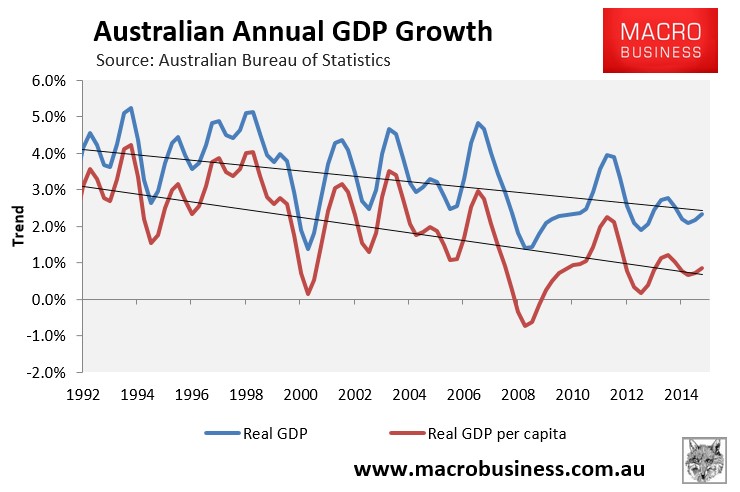
One only needs to refer to the below charts to see the folly of such an approach. Despite solid growth in aggregate real GDP, growth in per capita terms has plummeted since immigration exploded from 2004:
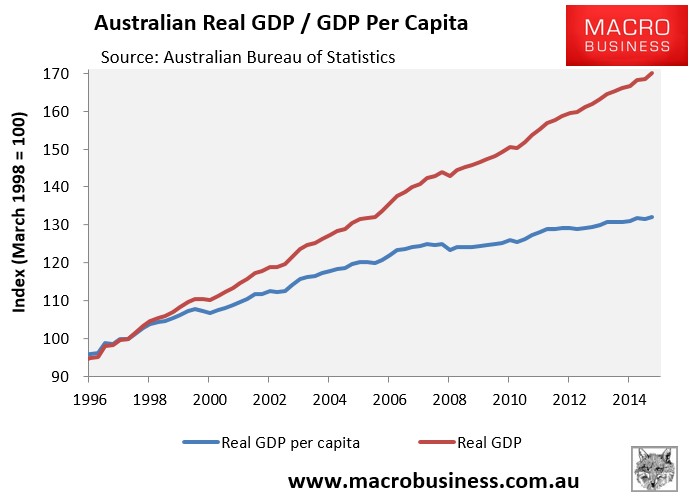
Indeed, since the GFC, around 70% of Australia’s growth in headline GDP has come entirely from growing the population, rather than improved productivity:
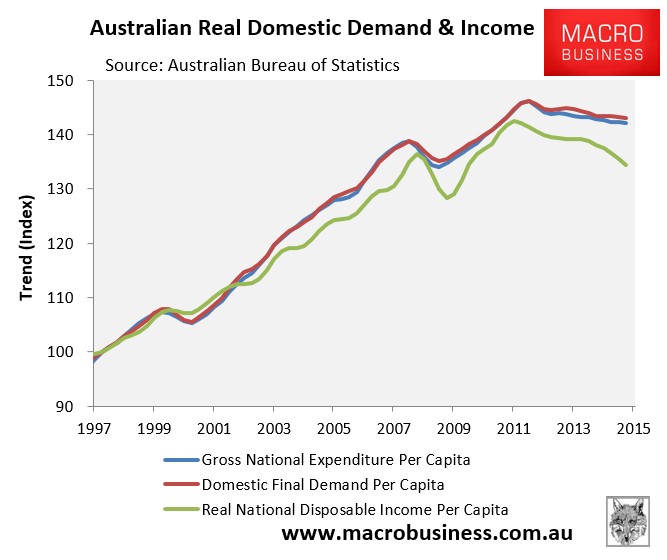
Worse, better indicators of Australia’s living standards, such as real domestic final demand and real national disposable income per capita, have been falling for several consecutive years, suggesting that Australian living standards are going backwards:
How exactly will cramming more people into Australia’s cities improve the situation, Josh? And what will your government do to ameliorate the negative externalities that also lower living standards, but are not necessarily captured by the aggregate economic statistics? These include:
- Worsening infrastructure bottlenecks (think more time stuck in traffic jams);
- Reduced housing affordability and livability (think smaller, more expensive homes located further out);
- Diluted fixed mineral endowment as Australia’s resource base is shared among more people (i.e. less resources per capita); and
- Increased environmental degradation.
Nobody could credibly blame the Coalition for the global collapse in commodity prices – it is beyond anybody’s control. That said, Australians are looking to the Government for sustainable economic policies that will genuinely boost productivity and per capita living standards. Not “dumb growth” that will cause economic indigestion in the longer-term and lower living standards.
The population ponzi is not part of the solution, Josh.
