This was a softer than expected correction and while statistical issues still make us question the magnitude of the strength, overall Australia should be described as having a robust labour market outside WA.
In Dec, total employment fell 1k compared to a market median of –10k with a range of –45k to +15k. Westpac’s forecast was for –17k.
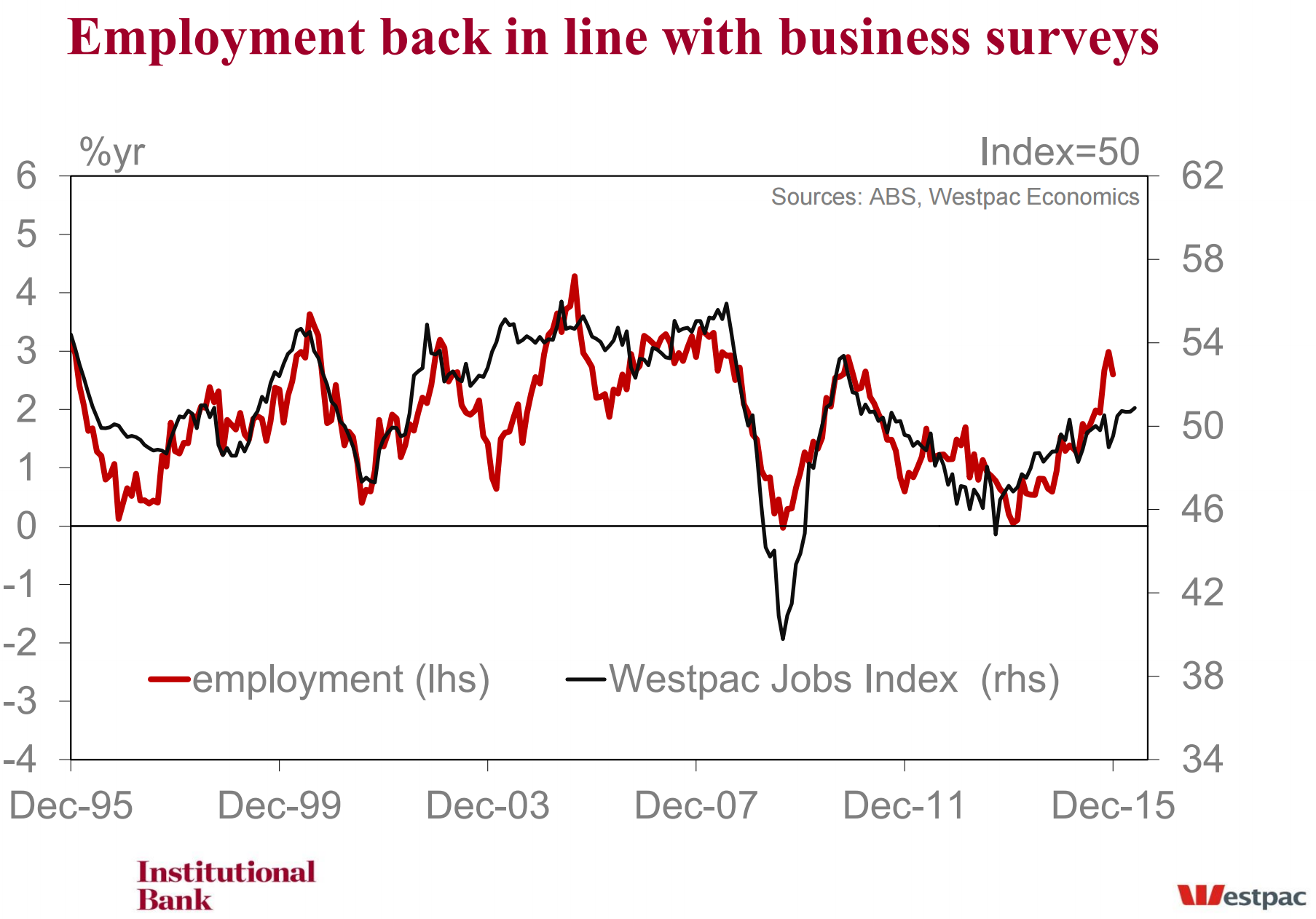
Total employment has now grown 301.3k (or 2.6%yr) in the year to Dec; this is a moderation from the acceleration from 2.0%yr in Sep to 3.0%yr in Nov. Revisions were minor this month.
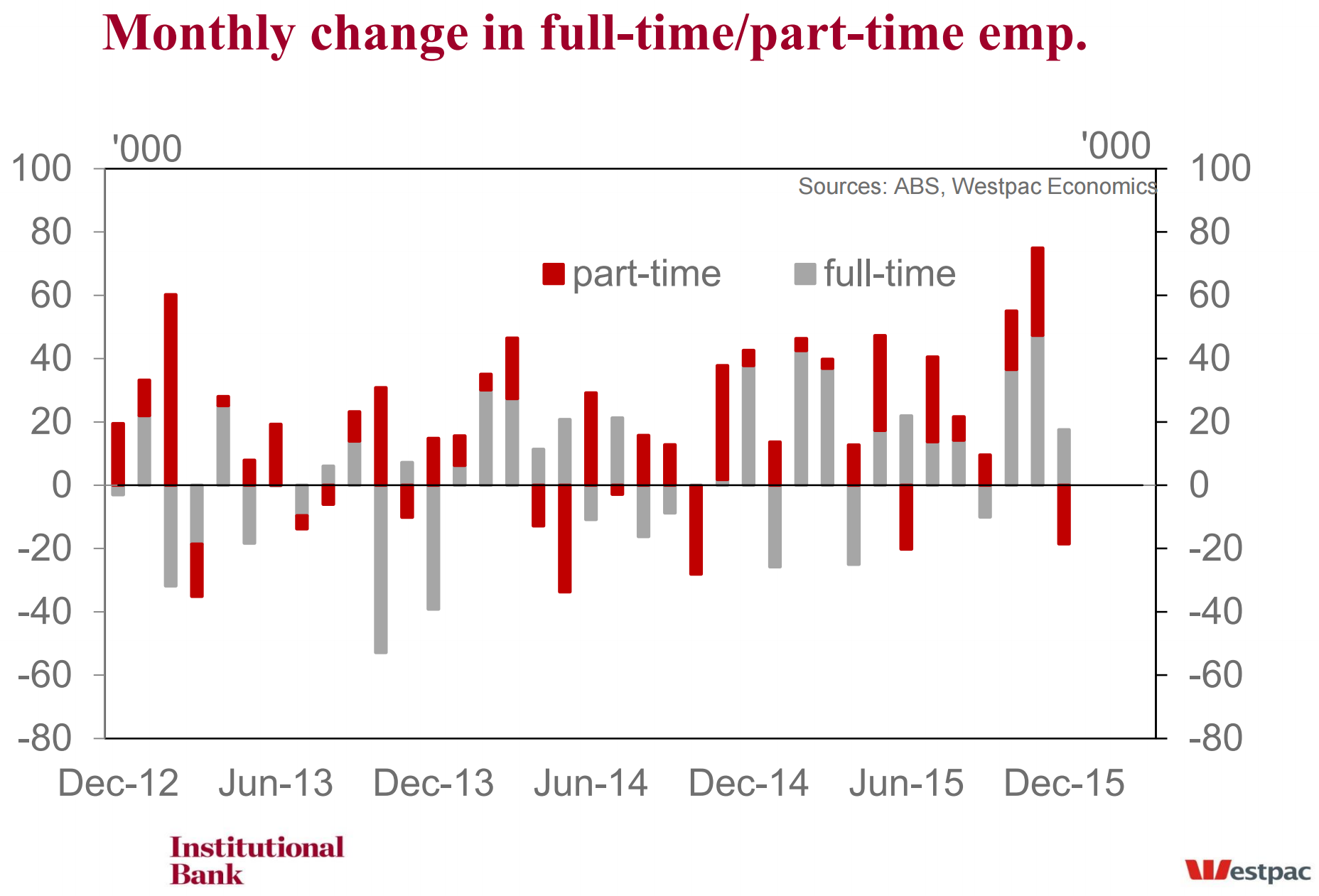
The mix was very interesting with a 17.6k rise in full-time employment (187.2k or 2.3%yr) and a 18.5k decline in part-time employment (114.1k or 3.2%yr). So while part-time employment growth has outpaced that for full-time employment in the year, working from a larger base full-time employment has grown more in outright numbers. What is also interesting is that in the year, female employment has lifted 179.3k (3.4%yr) while male employment has grown outright lesser 122.1k (1.9%yr). The strength in female employment is consistent with the growth in employment shifting to service sectors in particular health, education and hospitality.
There was the expected moderation in participation (from 65.28% to 65.15%) and the unemployment rate fell to was flat at 5.8% (5.76% from 5.84% at two decimal places).
While the Dec survey was a less upbeat update than we have seen in recent months, it is still a positive outcome and one that would give comfort to the RBA as they return from their summer recess. There are a number of reasons to think that grounds for a robust labour market are quite clearly defined. Firstly, other labour market indicators, while not as robust as the labour force survey, are still definitively positive. Secondly, the improvement in the labour market has been the greatest in NSW where the unemployment rate has dipped to a national low of 5.2% and the state’s pace of employment growth is a very robust 4.4%yr which is consistent with a rebalancing of growth away from resources and towards services.
So what of the sample rotation and seasonal adjustment issues? In the ABS’s own words; “[s]tarting with the December 2015 estimates, the ABS has improved the analysis of the relative contribution of the three components of the sample [matched common sample, unmatched common sample and incoming rotational group] to changes in aggregate employment (in original terms)”.
In a nut shell the ABS argues that using this methodology around a third of the gain in employment in Nov may have been due to sample rotation while in Dec all the negativity in Dec was from with sample rotation or, to a lesser extent, the unmatched common sample.
So yes there was some sample rotation correction but less than many, including ourselves, had anticipated. But stand by for Jan 2016. The ABS notes;
“In looking ahead to the January 2016 estimates, it is important to note that the outgoing rotation group in December 2015, which will be replaced by a new incoming rotation group in January 2016, has a relatively low employment to population ratio (59.7% in December). If the new incoming rotation group has an employment-to-population ratio that is more similar to the average (61.9% for all rotation groups in December 2015), or is relatively higher than the average, there is likely to be some degree of contribution to employment growth from this rotation group change.”
That is, the sample rolling out has a lower than average attachment to the labour force than the population. If the new sample rolling in is more like average, or above average, then the sample roll will make a positive contribution to the survey outcome.
Looks pretty decent for now if strength still exaggerated.


This was a softer than expected correction and while statistical issues still make us question the magnitude of the strength, overall Australia should be described as having a robust labour market outside WA.