
Former Victorian premier, Jeff Kennett, has today lamented the proliferation of tiny ‘shoe box’ apartments across Melbourne, noting that “developers were building too many small, poorly designed apartments and cramming too many apartments into small sites in the suburbs. ‘We’re going to hit a brick wall soon’ [Kennett said]”
Kennett’s comment came as The Age revealed that the Andrew’s Government in Victoria is considering making changes to planning rules that prevent small backyard homes (granny flats) from being rented out:
The Andrews government has pledged to review the rules around granny flats after an expert committee advising on Melbourne’s 40-year plan suggested planning obstacles for smaller-scale infill projects be removed to create more affordable housing.
Acting Planning Minister Lisa Neville said the government was “making sure planning rules keep pace with people’s needs”.
While I am not opposed to development per se, the proliferation of housing ‘shoe boxes’ does highlight an inconvenient truth.
With the federal government intent on running a “Big Australia” policy via ongoing high rates of immigration, while the states favour urban consolidation to save on infrastructure costs, we will need to find ways of cramming millions of extra people in to our existing cities’ footprints. This necessarily means less housing space for existing and future residents, lowering their quality of life, other things equal.
Take Melbourne, whose population has already increased by around 800,000 people in the decade to June 2014 to 4.4 million people:
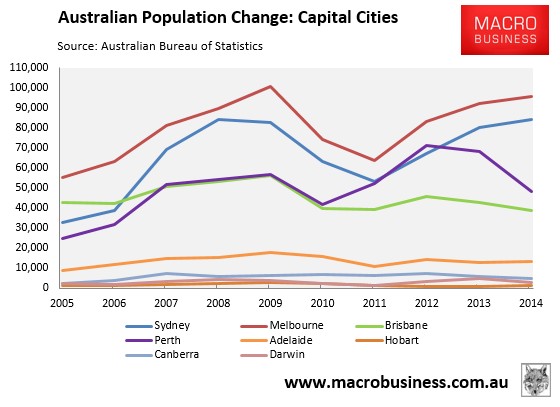
The “Plan Melbourne” blueprint, released last year. projected that Melbourne’s population would balloon out to 7.7 million by 2051 – that’s a further increase of 3.3 million people or 75% over June 2014’s population.
The bottom line is that with rampant population growth, driven primarily through immigration, Melbournians and the residents of the other major Aussie cities, will have to get used to smaller housing, higher congestion, and overall reduced amenity. That is, unfortunately, our future.
