Morgan Stanley don’t think so, given that it “Dick Smith’s voluntary administration was driven by, among others, excess inventory, aggressive store roll out and weakening cash flows, which, we believe, aren’t indicative of the wider CE (consumer electronics) market.”
Further:
We note that the demise of DSH serves as a reminder to focus on retailer operating margins and not just on retail sales growth. Indeed, DSH continued to post strong 7.5% sales growth up to Jun-15.
During the same period, average specialty sales growth across our coverage universe was 4.4%, double the 2.2% from FY14. Some investors interpreted this as a signal that releasing spreads were about to improve. We maintained our more cautious outlook, following our retail team, who expected operating margins to remain flat.
So for listed property trusts – or A-REITs – what is the impact of a DSH closure?
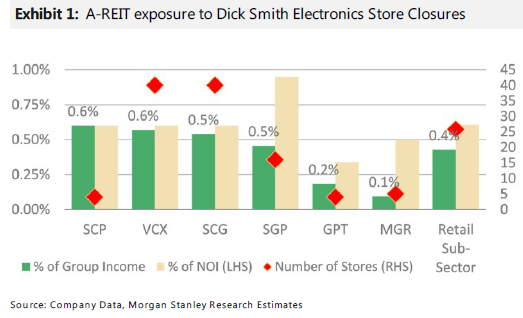
Whilst our AREIT coverage universe accounted for 109 of the 393 Dick Smiths stores in Australia and NZ, the potential downside risks to earnings are limited to just 0.4% on a full-year basis, assuming the stores remain vacant.
The impact on FY16 is likely to be even more limited, given the:
1) timing of the collapse,2) relatively high potential to backfill the vacated space (high mall occupancy >99%),
3) potential to drawdown on rent guarantees, and
4) potential to release boxes at higher rents, given DSH’s mini major status in most malls.
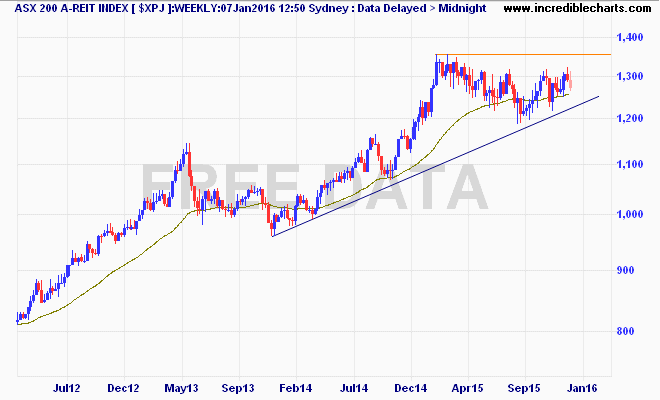
The ASX200 A-REIT index (XPJ) doesn’t seem to mind either, still fairly elevated and pausing here, compared to the broader market: