
HSBC chief economist, Paul Bloxham, has released a research note today talking-up the Australian economy’s resilience, whereby he claims the economy is successfully rebalancing away from mining-led growth:
Commodity prices have fallen to a 12-year low, China’s growth has slowed, global trade has been anaemic and yet, Australia’s domestic activity indicators have been lifting. Local jobs growth has picked up, business conditions have been at seven-year highs and consumer sentiment has been rising. Why?
The answer is: Australia’s growth is rebalancing. How is this possible? Well, first, the mining sector is only 10% of the economy, so its influence is not as pervasive as is often thought. Second, Australia is the lowest cost producer of iron ore and has longterm contracts to sell LNG, so export volumes are still ramping up. Third, when the mining boom was strong, much of the rest of the economy was held back by tight financial conditions, which meant that there has been significant scope for a pick-up in the non-mining sectors in response to loosened financial conditions: low interest rates have driven a housing boom and the lower AUD has lifted net services exports.
2016 is set to see a continuation of this rebalancing theme. Mining investment is set to fall again, while resources export volumes rise further, driven by new LNG projects ramping up production. The housing boom, which had been the first stage of the rebalancing act, appears to be cooling, but the services sectors have now taken the ‘growth baton’ and are driving job creation. Australia’s trade connections to Asia are set to continue to broaden beyond resources, to services and agricultural products.
Low inflation means the RBA has scope to cut further, although financial stability concerns are making it reluctant. Our central view has another cut, now in 2Q (previously 1Q). However, a tangible fall in the AUD could obviate the need for it. We believe policymakers should be focused on structural and budgetary reform in the lead up to this year’s Federal election (likely to be in September or October).
The clearest downside risk is a sharp downturn in China. However, this would now probably need to have a significant impact on Chinese households, and their willingness to buy Australian services and assets, to see a significant local downturn.
All so very orthodox. Not surprisingly, I disagree with Bloxo’s assessment.
My main issue is that the economy’s so-called “rebalancing” is based on an unsustainable housing bubble, whereby housing values, household debt, bank offshore borrowings, and dwelling construction are all tracking at record highs and are nearing the end of the cycle.
In the second half, the housing market – both values and construction – are likely to begin falling, which will suck the life out of employment. And this housing downturn will be accompanied by a steeper fall in mining investment, not to mention the shuttering of the car industry from October.
Sure, the RBA could cut official interest rates further – maybe by another 150 bps – but don’t expect much of this to be passed onto borrowers, given bank funding costs are also on the rise. The federal government would also be constrained in its ability to undertake another stimulus package (if needed), seeing as it must protect Australia’s AAA credit rating in order to prevent the banks’ ratings from being cut in tandem (further raising their funding costs).
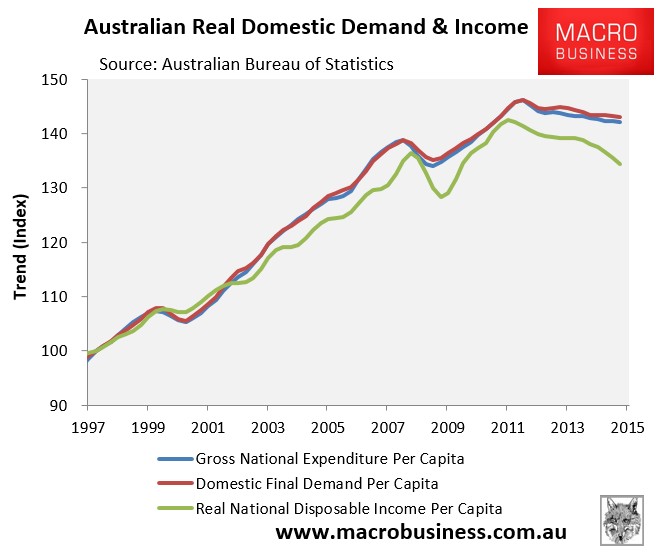
All of this is, of course, is occurring against the background of falling real domestic demand and national income (see next chart), which will act as a headwind to business profits, household incomes (and spending) and Budget revenues.
Australia can only kick the economic can down the road for so long.
