
Treasurer Scott Morrison last night opened the door to allowing the states to get a fixed share of income tax in return for the commonwealth receiving all the revenue from an increased GST. From The AFR:
The proposal, based on an idea put forward recently by South Australian Labor Premier Jay Weatherill, would enable the Commonwealth to use the proceeds from a GST increase to compensate low and middle income earners and fund cuts to personal and company income taxes.
The income tax, which grows faster than GST, would enable the states to better keep pace with the rising costs of health and schools funding…
The proposal will be discussed further by the Prime Minister and the Premiers at Friday’s Council of Australian Governments meeting in Sydney, and modelling of the proposal will be undertaken and discussed again by the Treasurers when they next meet in February.
As I explained when South Australian Premier, Jay Weatherill, first raised the proposal in last month, the idea certainly has merit. Any reform that helps to end the continual buck passing, cost-shifting, and blame game between the two levels of government should be thoroughly examined.
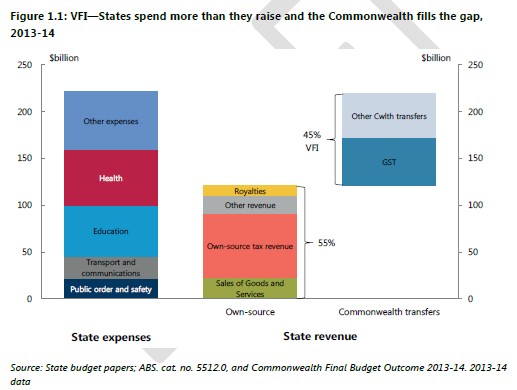
One of the key factors holding back state governments, and preventing good outcomes for taxpayers, are the vertical fiscal imbalances (VFI) embedded in the current federal system, whereby the states’ responsibilities are well in excess of their revenue bases.
The extent of the VFI were outlined clearly in the Government’s 121-page discussion (green) paper on the reform of Australia’s federation, released in June, which noted that the Commonwealth raises 82% of total tax revenue, the states and territories 15%, and local government just 3%.
The states and local governments, therefore, are left heavily reliant on Commonwealth funding, as illustrated in the next chart:
Another related issue holding back the federation, and resulting in bad outcomes, is duplication, whereby there are multiple areas of shared responsibility for key policy areas (e.g. health and education) across the state and federal governments:
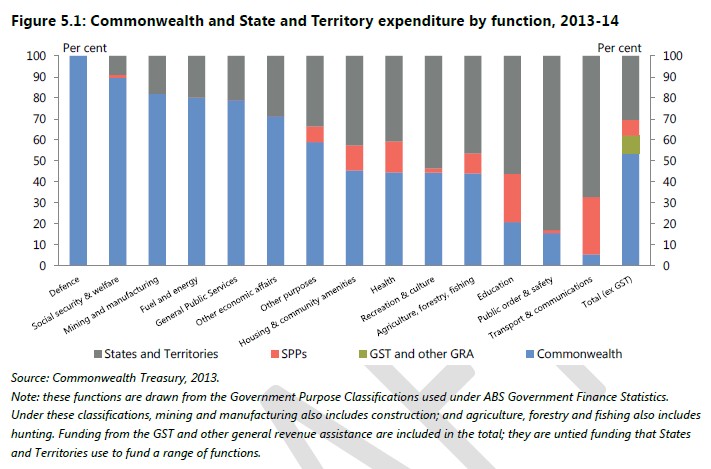
As the saying goes, “when everyone is responsible, no one is responsible”, and the shared responsibility between the commonwealth and states across many areas of public policy is creating sub-optimal outcomes for taxpayers and the nation at large.
In theory, ending such duplication could deliver billions of dollars of benefits to taxpayers and the economy, by slashing costs as well as delivering more efficient and accountable outcomes.
Ultimately, a better functioning federation is about having clearly delineated responsibilities, along with revenue sources that are commensurate with the level of responsibility.
