
The Grattan Institute has published a new report, entitled A GST reform package, which examines options for GST reform without adversely impacting equity (fairness).
Grattan notes that Australia’s GST is low relative to overseas, raising just 12% of government revenues in Australia – well below the average of 20% for all OECD countries. Australia’s GST revenue as a share of GDP was half the OECD average in 2012, and Australia relies less on its broad-based consumption tax to raise revenue than all but two OECD countries.
Moreover, Australia’s GST coverage is also narrow by international standards, applying to just 47% of consumption versus the OECD average of 55%. It is also well below New Zealand’s, where the GST covers 96% of all goods and services consumed.
Australia’s GST revenues are also shrinking relative to the economy. In the decade to 2014-15, GST revenues fell from almost 4.0% to 3.4% of GDP. And there is no reason to expect this trend to reverse given expenditure on GST-exempt items, such as health, is expected to rise as the population ages.
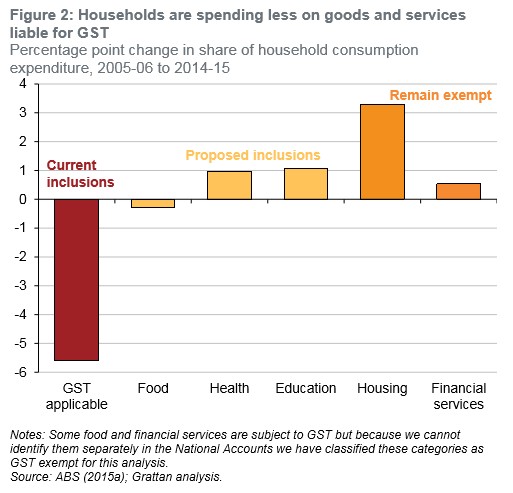
Grattan also notes that the GST is a relatively efficient source of tax. This is because they are relatively difficult to avoid, and create fewer distortions in decisions to work, save and invest.
An increase in consumption tax also acts as a lump sum tax on accumulated wealth, and so collects more from households such as retirees that are living off savings. Such older households otherwise contribute far less to tax collections than do working households on equivalent incomes.
Grattan argues that extending the GST to cover many of the categories currently exempt could raise $17 billion a year:
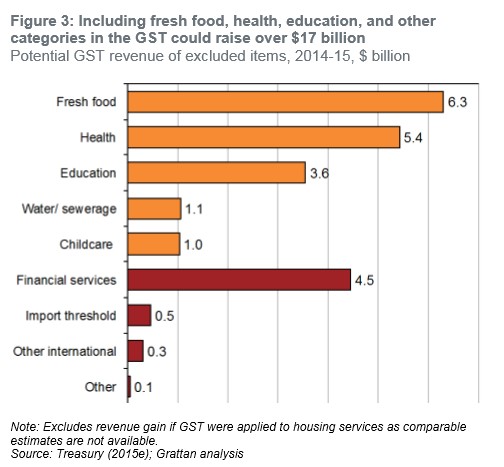
By comparison, increasing the rate to 15% would generate about $27 billion a year. Either way, it would be preferable to raising more tax revenue via higher income taxes from bracket creep.
Broadening the GST base to include fresh food, health and education would be more efficient and would reduce compliance costs, and is therefore Grattan’s preferred approach. However, if the political hurdles are too great, it believes that raising the rate of GST would be a satisfactory “second best” option.
In order to ensure that any GST package is fair, and won’t adversely punish low-income households, Grattan proposes a package that carefully “balances the need for fiscal consolidation with fairness and efficiency”:
It overcompensates the bottom 20 per cent of the income distribution on average, mainly through higher welfare payments. In terms of their real purchasing power, most of the poorest Australians would be no worse off, and the majority would be better off. Modest tax cuts focused on the low and middle thresholds would maintain or improve the incentives for work participation and ensure that most low- and middle income earners are also better off. Around 40 per cent of the additional revenue would be left over.
Specifically, Grattan proposes to increase the base rate of pensions and allowances by around 5%, thus leaving two-thirds of low-income households better off overall.
It also proposes to commit a further 30% of additional revenue to income tax cuts, thus allowing the Government to shave 2 to 2.5 percentage points off the bottom two tax rates. With the welfare increases, these cuts would fully offset the GST increase for households earning up to $100,000 a year.
Importantly, these measures would leave $11 billion of additional revenue that could help the states address the looming hospital funding gap, fund tax cuts that promote economic growth or reduce Commonwealth budget deficits.
Overall, it’s another excellent report by the Grattan Institute, which has become a thought-leader on Budget reform.
unconventionaleconomist@hotmail.com
