The Reserve Bank of New Zealand (RBNZ) has released its twice-yearly Financial Stability Report (FSR), which warns of the growing risk of sharp correction in Auckland house prices:
The interaction between low mortgage rates, high household debt, and increasing house prices poses a significant risk to the financial system… Although low mortgage rates are enabling a significant increase in debt repayment by existing mortgage borrowers, rising house prices have put upward pressure on buyer debt-to-income ratios. As a consequence, the aggregate household debt-to-income ratio has remained at historically elevated levels…
Household debt-to-income multiples (DTI) remain elevated at around 160 percent of household disposable income, of which bank mortgage loans account for around 84 percent…
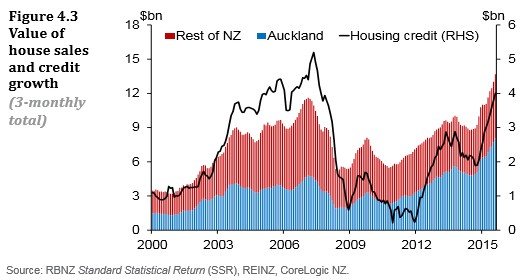
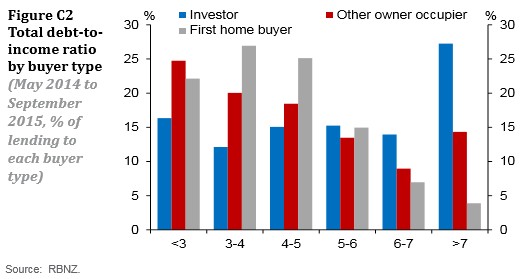
Housing debt increased at an annualised rate of around 8 percent in the three months to September… New mortgage commitments have increased sharply and are running at around 36 percent of outstanding mortgage debt. As a result, the characteristics of new mortgage commitments are being reflected in overall bank mortgage portfolios relatively quickly. Notably, a significant proportion of mortgage lending is being undertaken at elevated debt-to-income ratios (box C). Although low mortgage rates are currently relieving pressure on these indebted households, some borrowers could quickly come under pressure if their labour incomes decline or mortgage rates increase…
Mortgage credit growth is being driven, to a significant extent, by the Auckland property market. House prices in the region have increased 27 percent over the past year, supported by strong immigration, constraints on the supply of new housing, and further falls in mortgage interest rates. The price-to-income multiple for Auckland has now reached 9.2, up significantly from 6 in 2011 (figure 2.6), and is high by international standards. Rental yields have also contracted sharply alongside an increase in the investor share of sales.
With prices becoming increasingly stretched relative to household incomes and rents, there is increasing potential for a sharp price correction in Auckland. A correction could be triggered by a range of demand-side factors, such as a deterioration in labour incomes, an unexpected rise in mortgage rates, a reversal in migration flows, or a sudden reduction in investor appetite. There is a risk that a downturn could be amplified by a rise in sales by investors, given that investors have more elevated debt-to-income ratios, and appear to be purchasing on the basis of expected capital gain. Falling house prices could in turn weaken economic activity if indebted borrowers attempted to restore balance sheets by reducing consumption…
The characteristics of investor lending suggest that these trends are increasing the risks associated with the Auckland housing market. DTIs for investors are significantly higher than for owner-occupiers, with around 60 percent of lending undertaken with a total DTI of over 5 during the past year (box C). In addition, interest-only loans make up a higher proportion of investor lending than in the owner-occupier market. These statistics point to the potential for a sharp rise in investor defaults that could amplify a severe housing downturn, consistent with international evidence…
The RBNZ then explains the macroprudential measures being taken to cool Auckland’s housing market and mitigate financial stability risks:
Advertisement
Increased housing supply remains an essential factor in reducing the imbalances in the Auckland housing market, and more rapid progress in building new housing in the region is required. In the interim, macroprudential policy can help to moderate the risks to the financial sector and broader economy. Government measures relating to housing demand have also recently been introduced, including a requirement for buyers and sellers to provide IRD numbers and a ‘bright line’ test for taxation of capital gains when a property is sold within two years of purchase…
Changes to the LVR speed limit came into effect on 1 November, and include new restrictions on Auckland investor lending. Under the new policy, no more than 5 percent of Auckland investor lending by registered banks can be at an LVR exceeding 70 percent. The more targeted policy is aimed at mitigating financial stability risks in the Auckland housing market, reflecting international evidence that losses on investor loans tend to be larger during a severe downturn. The policy change is being supported by the addition of a new asset class for investor loans in the bank regulatory capital framework, with higher capital requirements being introduced for this category of lending…
By reducing sales to leveraged investors, the new policy is expected to decrease the proportion of riskier loans on bank balance sheets and temper rapid Auckland house price inflation.
Elsewhere, the FSR warns that the dairy sector is facing a prolonged period of weak prices and potential negative cashflow:
The dairy sector faces a second consecutive season of weak cash flow due to low international dairy commodity prices. Prices have shown some recovery since August, but many indebted farms are coming under increased pressure, which would be exacerbated if low dairy prices are sustained or dairy farm prices fall significantly.
Advertisement
The RBNZ has also included new modeling of what could happen to bad loans to dairy farmers if land prices crashed by as much as 40% and dairy prices rose to only NZ$5/kg by 2018/19. Under the worst case scenario, 44% of loans to dairy farmers would become non-performing, with those loans held by 25% of farmers. Eventual loss rates under the scenarios ranged from 2% to 14%, amounting to losses of 2-18% of before-tax bank profits.
Like in Australia, a housing bubble combined with an income shock via falling commodity prices are a dangerous combination.
Leith van Onselen is Chief Economist at the MB Fund and MB Super. He is also a co-founder of MacroBusiness.
Leith has previously worked at the Australian Treasury, Victorian Treasury and Goldman Sachs.