
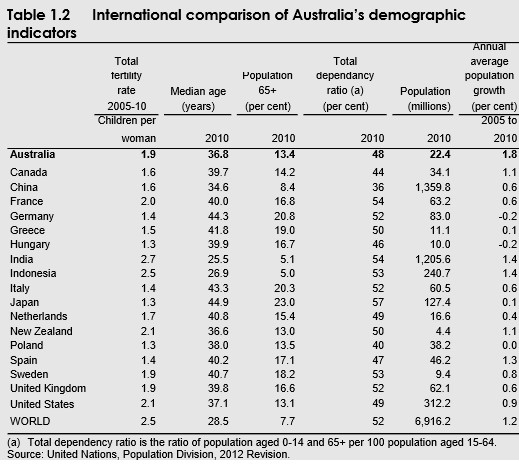
When the Intergenerational Report was released earlier this year, it included the next table showing that Australia’s population growth growth was the highest in the developed world between 2005 and 2010, running at an annual average pace of 1.8%:
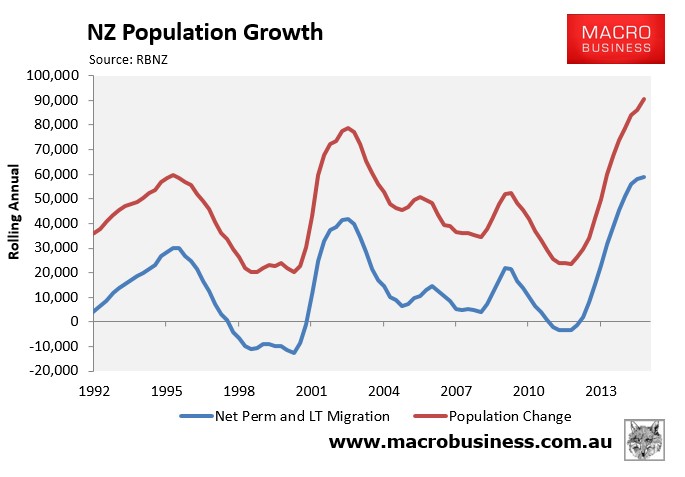
There is now a new population growth king on the block, with New Zealand’s population growing by a record 86,900 people, or 2.0%, in the year to 30 September 2015 on the back of record high immigration, easily surpassing Australia’s population growth rate of 1.35%:
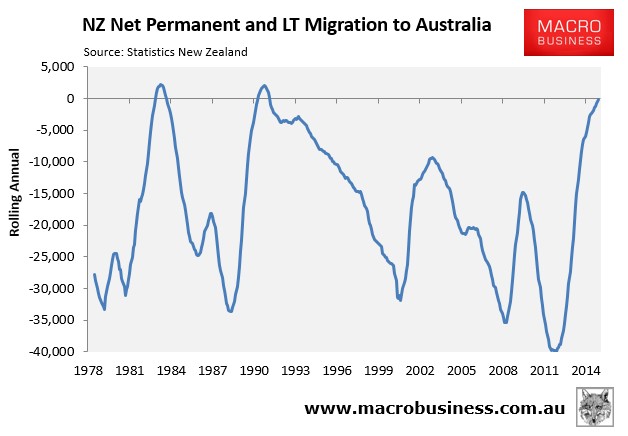
Of course, a key reason why New Zealand has overtaken Australia in the population growth stakes is because it has experienced a massive reduction in the net flow of Kiwis migrating to Australia, which is now plumbing recessionary lows:
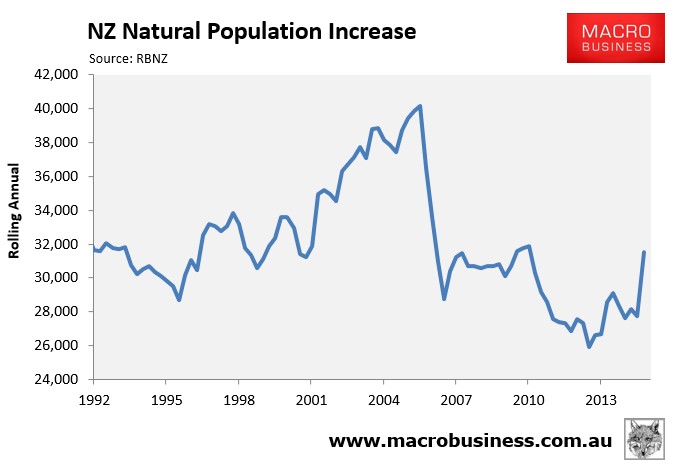
Meanwhile, natural population increase in New Zealand – 31,520 in the year to September 2015 – remains below the long-run average of 31,975 (obviously lower in percentage growth terms):
Not surprisingly, opposition to New Zealand’s population ponzi is starting to mount.
Last month, Westpac forecast that unemployment in New Zealand would rise to 6.5% from 6.0% currently on the back of strong immigration.
This prompted a harsh response from David Hargreaves at Interest.co.NZ, who called on the Government to turn the immigration tap off, fearing that “rampant inbound immigration” is helping to stoke the Auckland housing bubble and is placing undue pressure on the labour market.
Later in October, Hargreaves went further:
With an economy that’s now turning down and with unemployment levels set to rise, It makes no sense to be artificially inflating the population of this country and its largest city. Not when we don’t have the economy, the jobs, the houses and the infrastructure to cope with even current population numbers.
At the very least the Government should as a matter of urgency be revisiting the rules around overseas students and work rights. That would be a good first step.
The Government has helped to cause a situation that is likely to become a problem very soon. And it’s a problem that is not going to go away by itself, even if the Government keeps crossing fingers that it will.
Meanwhile, even skilled immigrants are struggling to find work, and are instead taking-up low skilled jobs:
Jaspreet Singh is allowed to stay in New Zealand permanently because the Government deemed his skills useful to the country.
But the only jobs the qualified mechanical engineer has found in three years here are unskilled and lowly paid.
The 28-year-old from India is one of thousands from Asia here under Immigration New Zealand’s main skilled labour policy, the skilled migrant category, with skills and qualifications that are not wanted here…
He came to New Zealand as an international student in March 2011 and gained residency after graduating with an advanced diploma in management.
The migrant category contributes nearly half of all permanent residence approvals. India and the Philippines are now New Zealand’s largest source countries for skilled migrants…
Immigration expert and Massey University sociologist Paul Spoonley said employers here did not consider all skilled migrants as equals…
“The single most important factor in getting a job is English language ability…”
It seems clear as day that the New Zealand Government is following the Australian script of artificially pumping the economy with large numbers of migrants, in the process creating all kinds of pressures on infrastructure, congestion, housing, and living standards.
It would instead do well to note the research of former RBNZ special adviser, Mike Reddell, who released a research paper claiming that New Zealand’s high immigration program had crowded-out (through higher interest rates and a high average real exchange rate) other productive investment, lowering living standards in the process.
Or research from the New Zealand Treasury, which questioned the merits of high immigration and recommended a reduced immigration intake in the event that the economy is unable to adequately cope with population pressures.
Or the 2011 report by New Zealand’s Savings Working Group, which argued that high levels of immigration in New Zealand had put upward pressure on inflation and interest rates, crowding-out productive sectors of the economy.
As argued many times on this blog, a big negative of high rates of immigration is that it places increasing pressure on the pre-existing (already strained) stock of infrastructure and housing, reducing productivity and living standards unless costly new investments are made, which in turn chokes-off other productive investment.
A “Big New Zealand” more than likely means lower living standards. It’s that simple.
