Australian business investment is falling away dramatically. Total private construction work is down notably on last year and engineering activity has contracted in nine of the last ten quarters. Deloitte Access Economics is expecting this phase to continue until about 2017-18, although at least the pace of decline will slow.
It is not too dramatic to state that commodity prices have been slashed in recent years, and they have done so at an increasing pace as China slows while a lift in commodity supply hits world markets at just the wrong time. There is a strong connection between commodity prices and the pipeline of future Australian business investment. The lower that commodity prices go, the worse the outlook for investment becomes. Yet there are limits to how bad the outlook can get. Even if commodity prices continue to fall, it is likely that most of the damage to the engineering construction sector has already been done.
Conversely, commercial construction activity has improved moderately over the past year, but this improvement is dwarfed by the dramatic collapse underway in engineering work. The fundamentals are turning in favour of the commercial construction sector; higher asset prices are making consumers richer, low interest rates mean capital is cheap, and a lower $A is good news for export competing sectors.
The good news for the domestic outlook is that resource export volumes have been rising rapidly. Up until recently the rises in volumes have been outpacing export price falls. But commodity price falls are now leading to falling resource export values.
In a boon for the tourism sector, the falling $A has underpinned a rise in total arrival numbers and Australia will continue to become more competitive as a global tourist destination in the months ahead. A similar story also holds for education exports, with the lower $A helping to restore our competitive edge.
Overall, the value of projects in the database fell by $6 billion during the September quarter to $814.3 billion. This represents a 0.7% decrease from the previous quarter, and is 11% below the level recorded a year earlier.
The value of definite projects in the database (those under construction or committed) decreased by almost $13 billion over the quarter, equivalent to a 3.1% fall. This takes the value of definite projects to its lowest level in four years.
The value of planned projects in the database (those under consideration or possible) lifted during the September quarter. The $6.7 billion increase could not, however, save the pipeline from falling to just under $48 billion below where it sat this time last year.
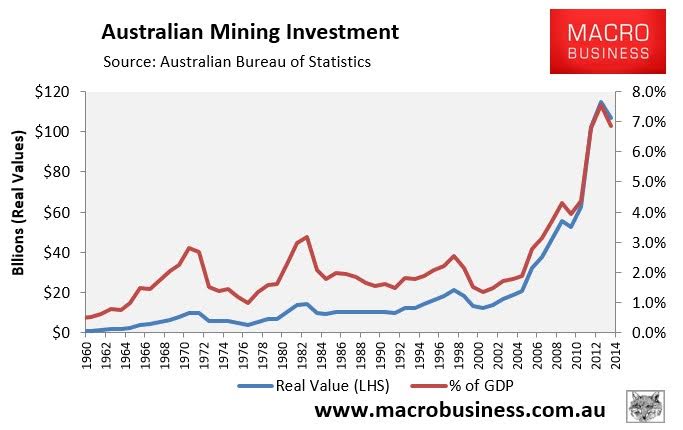
Deloitte is actually under-estimating the problem. Mining investment is going to keep falling to nothing but the most crucial sustaining capex through the next two years and then flatline for years more. The history of mining capex is illustrative in this regard:
This chart is drawn from an annual ABS publication that will be updated tomorrow and will show us now down to between 5-6% in the retracement. But we’ll be going all the way to 1% of GDP if not lower. The entire planned and possible categories for mining should be relabeled “hopes” and “dreams”.
Commercial construction is not well placed to fill this gap. It faces a glut of capacity and has only seen rising prices owing to financial repression. As residential prices come under pressure, the consumer falters and the economy sours that trade will come under pressure as well. Tourism is more hopeful but is small. Public investment is the only hope of getting anywhere near offsetting the vast mining gap.
David Llewellyn-Smith is Chief Strategist at the MB Fund and MB Super. David is the founding publisher and editor of MacroBusiness and was the founding publisher and global economy editor of The Diplomat, the Asia Pacific's leading geo-politics and economics portal.
He is also a former gold trader and economic commentator at The Sydney Morning Herald, The Age, the ABC and Business Spectator. He is the co-author of The Great Crash of 2008 with Ross Garnaut and was the editor of the second Garnaut Climate Change Review.

Australian business investment is falling away dramatically. Total private construction work is down notably on last year and engineering activity has contracted in nine of the last ten quarters. Deloitte Access Economics is expecting this phase to continue until about 2017-18, although at least the pace of decline will slow.
In a boon for the tourism sector, the falling $A has underpinned a rise in total arrival numbers and Australia will continue to become more competitive as a global tourist destination in the months ahead. A similar story also holds for education exports, with the lower $A helping to restore our competitive edge.