

![Red-tailed_Hawk_lg2[1]](https://www.macrobusiness.com.au/wp-content/uploads/2011/05/Red-tailed_Hawk_lg21.jpg)
by Chris Becker
Many Australian investors are waking up this morning to find US stocks tumbled overnight, stopping the epic rally in Asian stocks on Wednesday. For a technical look, check out my Macro Morning post here.
While it’s near impossible to put a reason behind every gyration in the market, last night’s cardiac arrest can be pinpointed to a single economic release, one that may actually shift the balance between the interest rate hawks and doves to the former.
One of the key factors in the Federal Reserve normalising its very abnormal interest rate policy, now in its ninth year of near zero rates plus the occasional multi-hundred billion easing programs, is jobs growth. The headline unemployment rate in the US has been steadily dropping – unlike here in Australia – and last night’s “JOLTS” report indicates that growth could be accelerating.
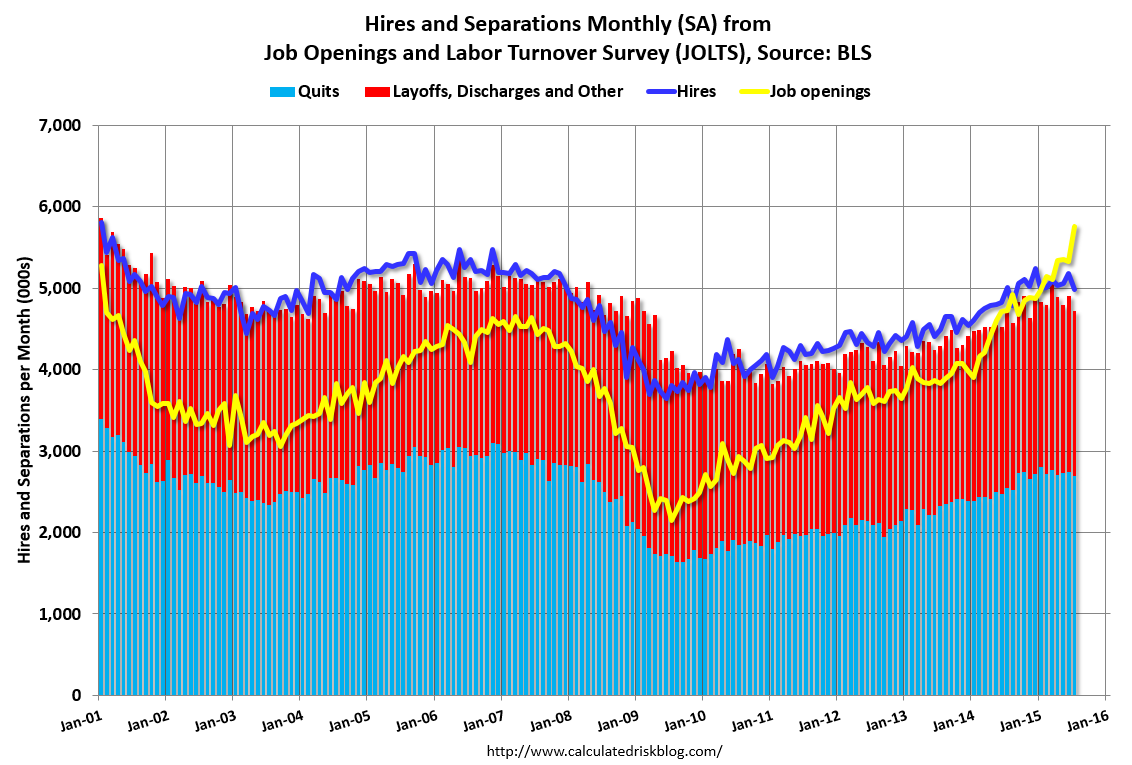
JOLTS stands for “job openings and labor turnover summary” and it was a record positive print with 5.8 million job openings in July up from 5.3 million in June.
More from Bill McBride at Calculated Risk:
The following graph shows job openings (yellow line), hires (dark blue), Layoff, Discharges and other (red column), and Quits (light blue column) from the JOLTS..
Note that hires (dark blue) and total separations (red and light blue columns stacked) are pretty close each month. This is a measure of labor market turnover. When the blue line is above the two stacked columns, the economy is adding net jobs – when it is below the columns, the economy is losing jobs.The number of job openings (yellow) are up 22% year-over-year compared to July 2014.
Quits are up 6% year-over-year. These are voluntary separations. (see light blue columns at bottom of graph for trend for “quits”).
All of this does point to an acceleration in jobs, but wage growth – the real determinant of inflation as discretionary income increases – has not yet caught up, although average earnings have spike recently (to an anemic $10.50 an hour – whoop de do). Maybe it will be coming into the consumer orgy over the Christmas period.
But strike one for the hawks, with interest rate expectations for the mid-September Fed meeting rising again, although the probability is pointing more to October or later.
The transition to normalcy in interest rates will happen, but how it affects markets and consumer confidence thereafter is the greatest unknown known.