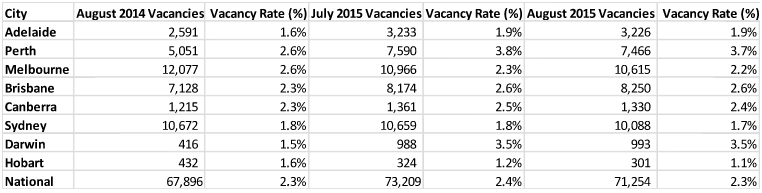
Figures released by SQM Research this week have revealed the number of residential vacancies fell slightly across the nation in August 2015, with a vacancy rate of 2.3% posted based on 71,254 vacancies. Vacancies dropped slightly in most capital cities, excluding Adelaide, Brisbane and Darwin, where vacancies remained the same.
Over the year, vacancy rates in Darwin have continued to climb with a significant 2.0% jump from this time last year. Vacancy rates in Perth have also climbed up 1.1% over the last 12 months.
Year-on-year, vacancy rates are down for Hobart and to a lesser extent Melbourne, with Hobart vacancies falling 0.5 percentage points over the last year, bringing the total number of vacancies down to 301. Melbourne experienced similar yearly falls with vacancies falling from 2.6% to 2.2%, a total fall of 0.4 percentage points. Both falls reflect the tightening of the both residential markets post downturns.
Asking rents
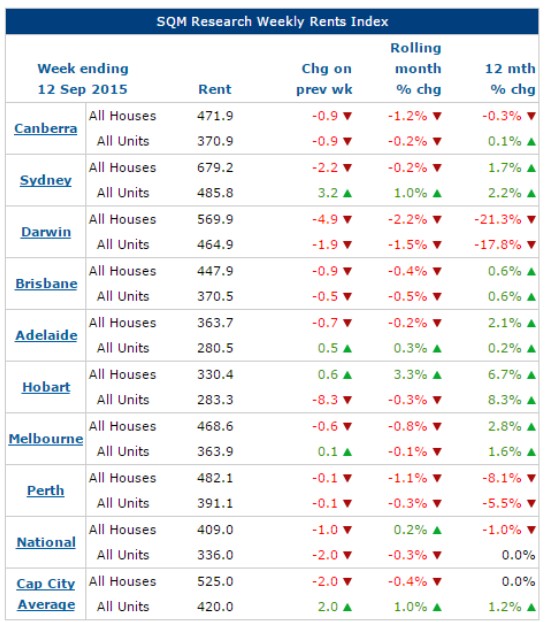
Notably, Darwin has recorded a fall in asking rents of 21.3% for houses and 17.8% for units for the past 12 months, according to SQM Research. Yearly falls have also been recorded in Perth, with asking rents down 8.1% for houses and 5.5% for units.
In contrast, Hobart has recorded a rise of 6.7% for houses and 8.3% for units. Asking rents in Adelaide, Melbourne and to a lesser extent Sydney have also recorded modest rises for the same period.
Managing Director of SQM Research, Louis Christopher, said “There was a slight fall in vacancies this month, however I am still of the opinion that vacancies will gradually rise from here over the next 12 months.
Already there has been a noticeable impact upon the rental market with rents in most cities recording slower rental growth rates or, in some cases, recording falls in rents.
It is only the tourist destinations such as the Gold Coast and Hobart which are recording stronger rental conditions.”
David Llewellyn-Smith is Chief Strategist at the MB Fund and MB Super. David is the founding publisher and editor of MacroBusiness and was the founding publisher and global economy editor of The Diplomat, the Asia Pacific's leading geo-politics and economics portal.
He is also a former gold trader and economic commentator at The Sydney Morning Herald, The Age, the ABC and Business Spectator. He is the co-author of The Great Crash of 2008 with Ross Garnaut and was the editor of the second Garnaut Climate Change Review.