
From Deloitte today:
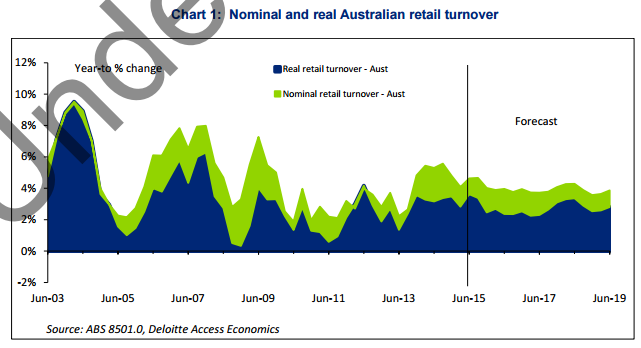
Retail sales growth recorded a strong outcome in 2014-15, with retail sales up by 4.7% over the year to June 2015.
The Australian economy continues to go through a difficult transition, with mining investment and commodity prices winding back sharply, limiting jobs growth and income growth respectively. Other parts of the Australian economy are picking up some of the slack, though not that convincingly.
Fortunately for retailers, the Reserve Bank reduced the cash rate to a new record low in May. Rate cuts, a shortage of housing supply, and increasing foreign investment from China directed at property have turned out to be just the right fuel to again fire up the housing market. The biggest impact has been seen in Sydney and Melbourne where house prices jumped to new highs in winter.
Those housing gains are one important factor that has supported stronger retail spending growth of late.
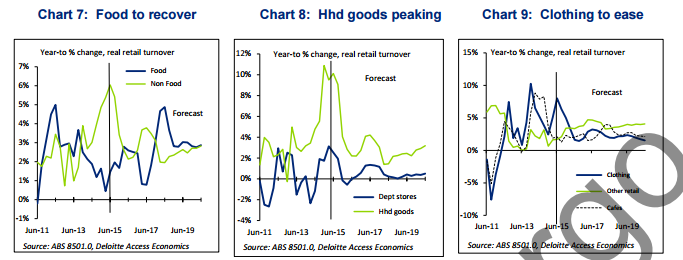
The recent strength of retail sales owes a lot to a continued boom in household goods retailing where growth has been running in double digits. The good news is that household goods retailers have recently been joined by clothing retailers where sales growth has picked up considerably. Against this picture of strength, food retailing has been going through a slower period of growth while department stores continue to underperform.
Unfortunately, low interest rates and the housing market won’t be able to support retail spending forever. The Treasury Secretary already called a bubble in Sydney and some parts of Melbourne at the start of June but prices have accelerated further since then. The longer this continues, the more likely is a correction or levelling off in house prices as underlying fundamentals kick in (and that process may well be hastened by regulators starting to clamp down on investor lending as well as on foreign investors). As those housing risks take hold, retail spending may suffer some collateral damage.
In particular, as the support provided by low interest rates and rising asset prices begins to subside and the labour market remains patchy as a driver of household income growth, retail growth may moderate from its current level. Extreme share market volatility over recent weeks won’t help, both by undoing some of the wealth gains seen earlier, and in keeping consumer confidence in pessimism territory. The fall in retail sales seen in the month of July reflects these pressures.
Overall, real (inflation-adjusted) retail sales growth came in at 3.3% for 2014-15, a solid result and the best financial year retail outcome since 2007-08. We see the 2014-15 financial year as the peak of the cycle for retail, with sales growth moving down to 2.7% in 2015-16 and 2.4% in 2016-17.
Retailers in New South Wales saw the strongest sales outcomes over the 2014-15 financial year, followed by Victoria. It is not a coincidence that the Sydney and Melbourne housing markets have also been the strongest, with those housing wealth gains feeding into an increased rate of consumer spending. Housing momentum should see retail growth in both States continue to perform well in 2015-16, though less reliance should be placed on wealth gains and rising housing activity to drive retail spending thereafter.
More rate cuts are coming.
