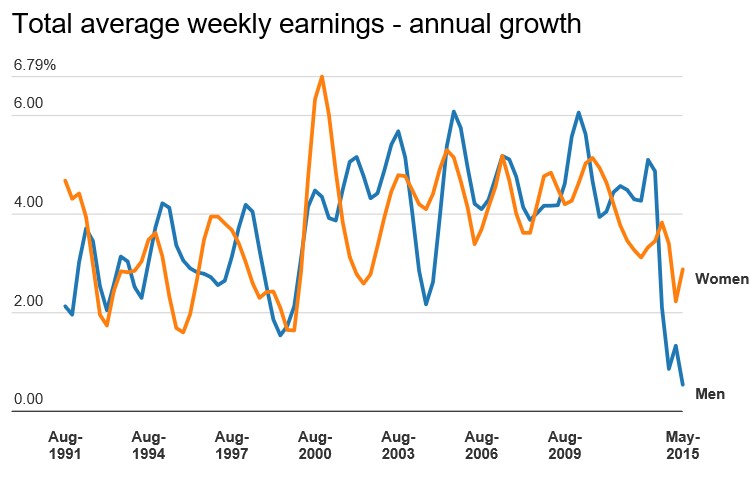
The Guardian’s Greg Jericho has written a good post examining household income growth, which dissects the latest wages price index and average weekly earnings data from the ABS.
Jericho argues that the rotation out of high paying mining-related jobs into lower paid services jobs is a major cause of the slump in average weekly earnings growth, particularly for males, and also goes a long way to explaining why, despite positive GDP and jobs growth, it still feels like a recession for many people:
Coming off the back of the record low growth in the wages price index, the latest figures for average weekly earnings show that for male workers total earnings in the 12 months to May rose just 0.5% – easily the lowest on record, reflecting the lack of income growth in the economy at the moment…
Average weekly earnings – unlike the wages price index – are not weighted. Thus, if there is a shift from high-paying jobs – such as those in the mining industry – to lower paid work, then the average will fall (or rise slower) even if wages are rising.
In the past year, while employment has grown, a sizable shift from high-paying jobs to lower paying ones has occurred…
Of the 10 industries which saw an increase in employment, only four pay above-average wages…
Thus the rise in the average earnings of full-time workers is dampened due not just to slow wage growth in each industry, but because of the greater numbers of people shifting to lower paying jobs…
The pathetic growth is even more striking when you consider that the last time full-time average earnings grew by such a low amount, the unemployment rate was 10.8%.
Right now wages and incomes are growing as though we are in a recession. The only positive is that, partly because of that weak income and wages growth, at least unemployment is not rising as it would if we were really in one.
Advertisement
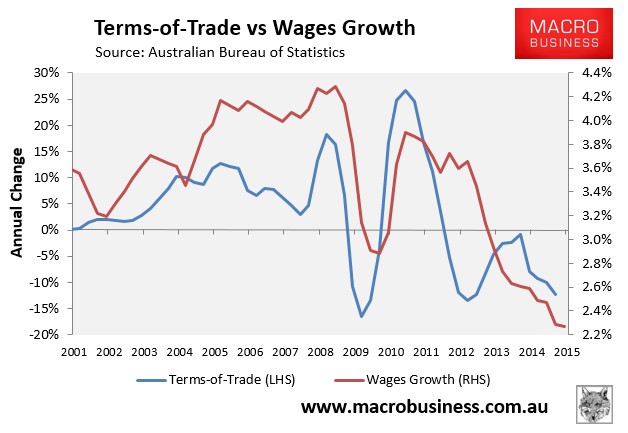
I will add, once again, that incomes will remain under pressure as long as the terms-of-trade continues to unwind back to historical norms: a process that will likely take another three years:
Unemployment is also likely to rise from mid next year as the triple headwinds of falling mining investment, falling dwelling construction and the shuttering of the car industry collide.
Leith van Onselen is Chief Economist at the MB Fund and MB Super. He is also a co-founder of MacroBusiness.
Leith has previously worked at the Australian Treasury, Victorian Treasury and Goldman Sachs.