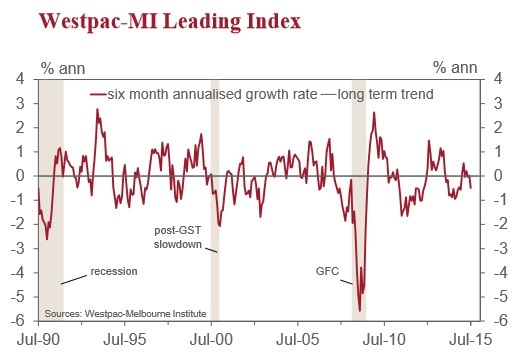
The six month annualised deviation from trend growth rate in the Westpac–Melbourne Institute Leading Index, which indicates the likely pace of economic activity three to nine months in the future, decreased from 0.02% in June to –0.49% in July.
As we noted last month, the change in the growth rate of the Index is indicating that the economy appears to be losing momentum through the middle of 2015. In the first four months of 2015 the average growth rate was 0.20% above trend. That was a welcome lift in momentum from the second half of 2014 when the average growth rate was 0.66% below trend. However, in the last three months the growth rate has eased back again averaging 0.17% below trend.
With the deviation from trend now back below zero the promising signs that we saw in the early months of 2015 that growth in the economy might be lifting into ‘above trend’ territory through the second half of 2015 appear to be waning. That profile is certainly in line with Westpac’s forecasts that annualised growth pace in the economy will be stuck around 2.5% in both halves of 2015, largely unchanged from the disappointing result in 2014 of around 2.5%.
The disappointment from the lacklustre Leading Index growth prints mid-year is that a lack of momentum going into 2016 might start to question the generally held view that 2016 will be a better year than 2014 and 2015. For example our own forecasts pitch growth in 2016 at around 3%, up from 2.5% in 2014 and 2015, while the Reserve Bank is also forecasting 3% growth in 2016, recently lowered from 3.25%.
The growth rate of 3% in 2016 had been considered ‘around trend’ although the Reserve Bank has recently indicated that because population growth has slowed, trend growth in the economy may be lower. We expect that a level of 2.75% may now be considered trend by the authorities. Consequently growth of 3.0% can be considered above trend and consistent with the Bank’s view that the unemployment rate has stabilising and can continue to hold steady. We are less sanguine, expecting that the unemployment rate will lift from this point to around 6.5% by year’s end – consistent with the signal from the Leading Index that growth is likely to remain below trend for the remainder of 2015 at 2.5%.
Of most interest in the Reserve Bank’s recent forecasts has been the forecast for growth in 2017 to centre around 3.75%. Achieving such a target would most likely involve a significant fall in the unemployment rate particularly if trend growth remains around 2.75%. Our Leading Index does not provide a guide on growth 18 months into the future but, at Westpac, we are much less sanguine about growth in 2017 favouring a likely 3-3.25% range.
In February the deviation from trend in the growth rate of the Index printed 0.53%. As discussed, this promising pace earlier in the year has faded with the deviation in the growth rate back to 0.49% below trend in July. Apart from the yield curve, all other components of the Index deteriorated in terms of their contribution to growth. Component-wise the changes have been: dwelling approvals (–0.38ppts); AUD commodity prices (–0.34ppts); Westpac–MI Consumer Sentiment Expectations Index (–0.26ppts); US industrial production (–0.25ppts); hours worked (–0.25ppts); Westpac – MI Unemployment Expectations Index (–0.14ppts); and the ASX 200 (–0.12ppts).
Partly offsetting these drags has been the yield curve component which has added 0.71ppts. Although markets have progressively moved to price out the likelihood of a further rate cut from the Reserve Bank later this year (in our opinion correctly) the yield curve overall has steepened over the last six months, reflecting the RBA’s May rate cut and a firming in bond rates globally. The mix implies more stimulatory financial conditions and is indicative of an improving economic outlook.
The Reserve Bank Board next meets on September 1. There is very little chance that the Board will choose to move rates. Westpac expects that rates will remain on hold over the course of the remainder of this year and in 2016.
The Bank currently expects growth in 2017 to centre around 3.75%. If indicators, including our own Leading Index, were clearly pointing to that prospect during the second half of 2016 then the Bank might consider an earlier rate hike although, as discussed, we are sceptical that Australia’s growth rate can bounce back as quickly as indicated by the Bank’s latest forecasts.
Growth will be weaker in CY 2016 and weaker again in CY 2017. Why? Because capex will fall more sharply over those years, dwelling construction will turn south along with prices, and the car industry will close.
This means the next movement in official interest rates will very likely be down, not up. It’s only the timing that is uncertain.
Leith van Onselen is Chief Economist at the MB Fund and MB Super. He is also a co-founder of MacroBusiness.
Leith has previously worked at the Australian Treasury, Victorian Treasury and Goldman Sachs.