A few years back, I watch the US documentary Gaslands (available on Netflix), which documents in great detail communities in the US that have been adversely impacted by natural gas drilling and, specifically, hydraulic fracking. The film shows the destruction of many US farming communities via poisoning of drinking water and the natural environment, often leading to severe health problems for its citizens (watch key extracts here and here).
Extraction of shale gas or coal seam gas (CSG) can require hydraulic fracking, which essentially involves drilling and inserting a pipe deep into the ground and then pumping millions of litres of high pressure water and ‘fracking fluid’ into the shale rock or coal seam, causing it to fracture and releasing stored natural gas where it is then captured for energy production (see below image).
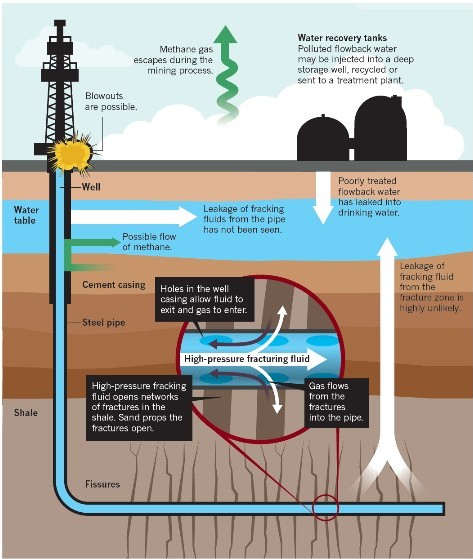
While natural gas is a relatively clean burning fuel, the process of fracking is highly controversial as it risks contaminating nearby water tables with both methane and fracking fluid, which is believed to contain a number of carcinogens.
To be frank, the Gaslands documentary scared the crap out of me and turned me from a neutral observer of hydraulic fracking to a concerned citizen.
Whilst I acknowledge that the documentary likely gives a one-eyed assessment against fracking, even if one-quarter of what it says is true, then I believe there is cause for concern.
With the above in mind, it was highly disconcerting to watch ABC’s 7.30 Report last night, which aired a segment showing how fracking for underground coal gasification (UCG) has caused possible severe toxic damage to ground water, soil and air around hundreds of square kilometres of prime agricultural land west of Brisbane, in what is shaping as one of Australia’s biggest environmental contaminations:
MARK WILLACY: There’s a persuasive reason why the Benders can’t dig any deeper than two metres. It’s the risk of explosion. A dangerous cocktail of gases lies just under the ground, a legacy the Queensland Environment Department says of Linc Energy’s underground coal gasification project.
BRIAN BENDER, HOPELAND FARMER: Always had that in the back of me head, that there the – the Linc Energy site was going to be an environmental disaster.
MARK WILLACY: Above ground, this looks like it’s going to be a bumper crop, but it’s what’s happening beneath this land that’s worrying many people out here. The Queensland Environment Department alleges that toxic gas is leaking through underground pathways, polluting a massive area of subsoil two to six metres below where I’m standing.
For months, more than 100 investigators and workers have been crawling over farms and properties at Hopeland. They’ve uncovered dangerous levels of carbon monoxide and hydrogen sulfide as well as hydrogen and methane at explosive levels.
JON BLACK, QLD ENVIRONMENT DEPT DIRECTOR-GENERAL: We’ve put in place what we’ve called a caution zone of approximately 320 square kilometres outside of the Linc site itself and that is where we’ve uncovered concentrations, varying concentrations of these gases.
MARK WILLACY: That’s the size of a small country.
JON BLACK: Well it’s a large area, yes, indeed.
MARK WILLACY: The Linc Energy project was always controversial. Pioneered by the Soviet Union, Underground coal gasification, or UCG, has rarely gone further than the trial stage anywhere in the world. Unlike coal seam gas extraction, UCG involves the burning of subterranean coal seams to convert the coal into a synthesis gas, or syngas, a mixture consisting primarily of hydrogen and carbon monoxide. The syngas is the brought to the surface for use as fuel, fertilisers or chemical products.
JON BLACK: They wilfully and knowingly undertook the operation and they knowingly knew that this could lead to catastrophic events…
[The report] warns that some of the land surrounding the site can no longer be classified as strategic cropping land because Linc’s activities have caused irreversible acidification of the soil and released toxic contaminants into water and air as well.
According to Wikipedia, UCG “is an industrial process which converts coal into product gas. UCG is an in-situ gasification process carried out in non-mined coal seams using injection of oxidants, and bringing the product gas to surface through production wells drilled from the surface”. The difference between UCG and CSG are also explained on the Australian Syngas Association website.
To a layman like me, both forms of gasification appear to use similar production methods. So does this mean that the problems currently being experienced in Queensland with UCG could equally apply to Australia’s myriad of CSG projects?
I am interested in reader’s views.