
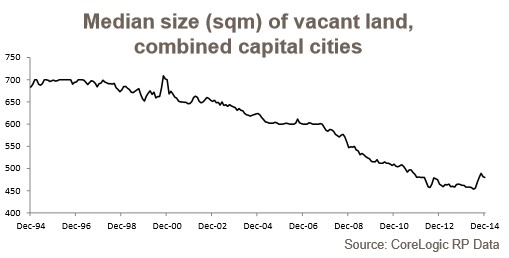
I have written previously about how Australian lot sizes have shrunk over the past 20 years, all illustrated by the next chart from RP Data:
And how the price per square metre of land has rocketed by more than five-fold over the same period:
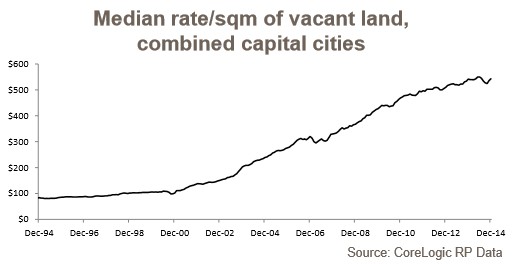
As noted by RP Data:
“…buyers now get much less for their money than they did 20 years ago. As an example, 20 years ago the typical lot size was 684 sqm and cost $58,750. Based on current prices if you purchased 684 sqm of vacant land it would cost $365,256.”
Well, according to the RBA, the actual size of dwellings, as opposed to the land, has also shrunk in recent years:
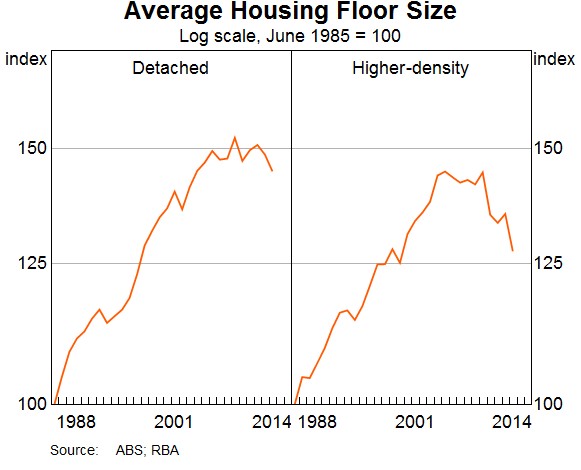
Moreover, this recent shrinkage in the size of homes has also come at a time when the number of people per dwelling has begun to rise:
Interestingly, both of these trends – that is, towards smaller households but bigger dwellings – seem to have reversed in recent times.
These data put into some perspective the claims that are sometimes made that Australians are investing too much in housing. In a sense, the upward drift in the value of the constructed housing stock, relative to our incomes, looks neither surprising, nor remarkable. Right around the world, as people’s incomes rise, they tend to use the extra income to purchase better dwellings.
Instead, what is perhaps more remarkable is the extra resources that Australian households have used to purchase, from one another, the land on which these bigger and better dwellings sit. Indeed, most of the extra money that has gone into residential property has not gone not into the physical stock of housing, but rather into land. So our fascination with housing is really, mostly, a fascination with land.
I can’t say that I am surprised by these results. After all, the building of shoebox apartments is dominating places like Sydney and Melbourne. There has also been a shift towards so-called ‘micro’ detached homes in new housing estates.
What it does show is that Australians are paying increasing amounts for housing, but getting less in return – both less land and less floor space.
