Some good news today of sorts:
A bipartisan deal – agreed to last month after a lengthy political stalemate that hamstrung the clean energy sector – will slash the target from 41,000 gigawatt hours to 33,000…the government did a deal with four crossbenchers to establish a wind farm commissioner.
The crossbenchers were also promised a “scientific committee” to research wind turbines and advise ministers on their environmental impact and potential health problems in return for their votes.
“The rest of the world is moving towards renewable energy and so should we,” Senator Lazarus told the Senate on Tuesday.
…”In Europe the hills are alive with the sound of music, not turbine noise because there is none.”
Well, that will hopefully free up some more investment in the renewables space. Utilities have been one the biggest non-mining drags upon non-mining capex, from Bloxo:
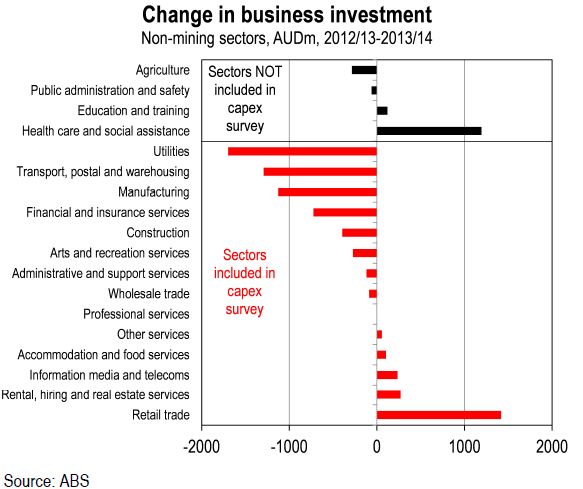
I’m not expecting any dramatic turnaround given the massive mis-allocation of capital over the previous decade in distribution networks, many of which are being fattened up for sale and are thus cutting capex outlooks to boost profits. But it all helps.
Labor should have done a much tougher deal on the RET. The Government is completely naked before the global movement towards climate change mitigation and the RET is the only remaining policy that offers it the hope of achieving deeper emissions cuts in the absence of a carbon price and without destroying the Budget. It will almost certainly have to be expanded again in the future.
As for a passing wind commissioner, it is so transparently and backwardly ideological (and thoroughly against popular support for renewables) that it can only serve to undermine the Government further.