The Housing Industry Association (HIA) has today issued a media release giving its solution to Australia’s housing affordability woes:
Public speculation about a housing bubble ignores the real culprits of Australia’s housing affordability problems, says the Housing Industry Association (HIA).
“We wouldn’t be having this conversation if Australia would get the disproportionately high level of taxation off new homes and improve the supply of new housing,” said HIA Chief Economist Harley Dale.
“The truth is that most of the problems having an impact on housing affordability are caused by governments and therefore governments can fix them.”
“The two biggest taxes on a new home are stamp duty and GST – the latter which doesn’t apply to existing homes – and when combined with all the other taxes, levies and charges on a new home can be over 40 per cent of the final price.”
“New housing, which provides a necessity of life, namely shelter, is the second most heavily taxed major sector of the Australian economy.”
“Equally, delays in planning and restrictions on land supply, mean that new housing is not reaching the market quick enough to respond to demand, which ultimately puts upward pressure on prices.”
“In 2013 HIA released its Housing Australians blueprint to address housing affordability and create economic activity in the sector, and many of these action items were re-iterated in the HIA submission to the Taxation White Paper this week.”
“A number of these points were also taken up in the recommendations of the recent Senate
Inquiry into Housing Affordability, so government has the answers,” concluded Harley Dale.
Key points for governments to address housing affordability include:
– Appoint a dedicated Federal Minister for Housing.
– Phase out stamp duty on new homes to reduce costs and improve labour mobility.
– Reinvigorate the planning system for faster approvals.
– Support alternative funding models for residential infrastructure so new home buyers don’t pay upfront for whole-of-community assets.
– No increase in the GST on new housing.
While I obviously agree wholeheartedly with the view that supply-side reforms and improved infrastructure investment would improve housing affordability, HIA’s proposed solutions to Australia’s housing affordability woes are incomplete.
Undoubtedly, supply-side barriers have forced-up the cost of development, impeding the market’s ability to supply affordable housing and significantly dampening the supply response.
Indeed, if Australia’s land-use, planning, infrastructure funding, and taxation systems were more liberal towards development, and housing supply was as responsive as, say, Houston, then increases in demand from rising incomes, population growth, and investors (both domestic and foreign) would more likely lead to the building of additional low priced housing (either on the fringe or in-fill), keeping house prices in check. Most importantly, speculators would be less likely to pile into such a market, since there would be less prospect of achieving strong capital gains. Instead, investing would be more about yield, and the market would be building more for home owners, rather than speculators.
That said, it is wrong to pin Australia’s housing affordability woes solely on the supply-side, as the HIA has done. Australia’s peculiar tax laws have made investment into housing a relatively attractive proposition via a combination of high tax rates on savings, minimal taxes on land, as well as generous tax concessions like negative gearing and capital gains tax discounts. As a result, demand for housing in Australia is much higher than it otherwise would be, resulting in too much of the nation’s capital being tied-up in housing and inflated values.
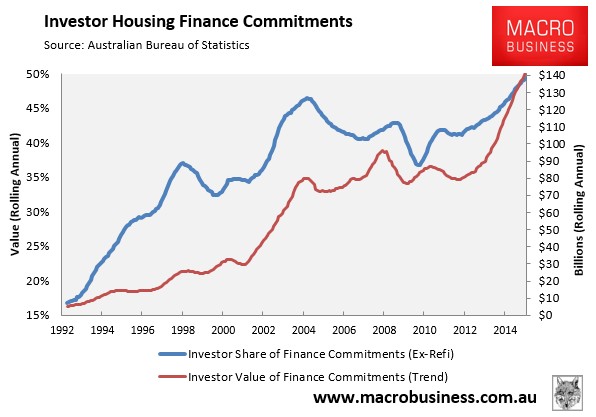
Put simply, less demand from domestic and foreign investors into pre-existing housing would lower prices (other things equal), making it much easier for first home buyers to enter the market.
Comprehensive reform of Australian housing undoubtedly requires both measures to free-up supply-side bottlenecks and improve infrastructure, as well as efforts to remove speculative demand induced by spurious tax incentives and lax foreign investor surveillance and compliance.
It is disappointing that the HIA continues to defend demand-side distortions, rather than taking a comprehensive approach to housing affordability.
unconventionaleconomist@hotmail.com