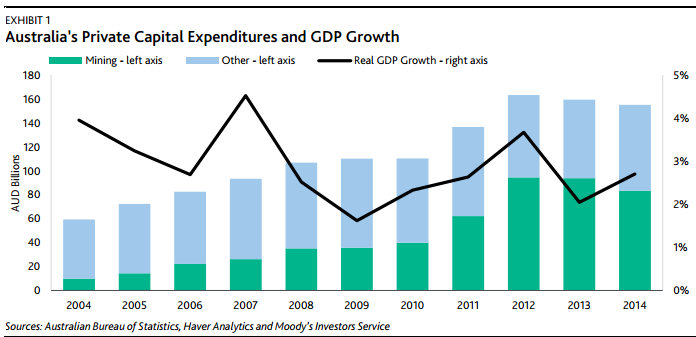
Last Thursday, the Australian Bureau of Statistics announced that Australia’s (Aaa stable) capital expenditures had fallen 4.4% in first-quarter 2015 from fourth-quarter 2014. The day before, the Australian Bureau of Statistics released data showing that construction activity had fallen 2.4% during the same period. These numbers and accompanying projections for investment in the coming year signal a decline in investment in Australia despite historically low global and domestic interest rates. Unless the trend reverses, Australia’s growth over the next two years will be lower than the 2.9% average of the past decade. We forecast 2% GDP growth this year. Lower growth is credit negative for the sovereign because government tax revenues will grow more slowly, impeding efforts to stabilize government debt, which increased to 30.7% of GDP in 2014 from 9.7% in 2008. In addition, lower growth could reduce foreign direct investment inflows, which would either exacerbate lower growth or increase the country’s reliance on more volatile portfolio and debt capital to finance its current account deficit. The decline in construction activity and capital expenditures stems from a slowdown in commodity-related investments, which helped Australia’s economy rebound from the global financial crisis (see Exhibit 1), but now contribute less to growth as projects are completed and low commodity prices limit new investment.
The end of the commodity-led investment boom is not surprising; what the recent data highlight is that low interest rates have not yet prompted other sectors to replace commodities as a driver of growth. Investment fell by 4.1% in mining, 9.4% in manufacturing and 4.2% in the so-called other selected industries, which includes services. Lower interest rates did drive up residential construction activity by 4.8%, but this was not enough to offset a 9.8% decline in private-sector engineering activity, which tends to be related to mining investment. Australia’s GDP growth has exceeded most other high income economies for two decades, and was relatively resilient following the global financial crisis. Nonetheless, average annual growth slowed to 2.5% between 2009 and 2014 from 3.3% in the prior six years. The fiscal effect of this slowdown was a decline in general government revenues to 33% of GDP, on average, during 2009-14 from 36% during 2003-08. A decline in revenue ratios partly explains the shift to an average annual fiscal deficit of 3.9% between 2009 and 2014, from an average fiscal surplus of 1.4% between 2003 and 2008.
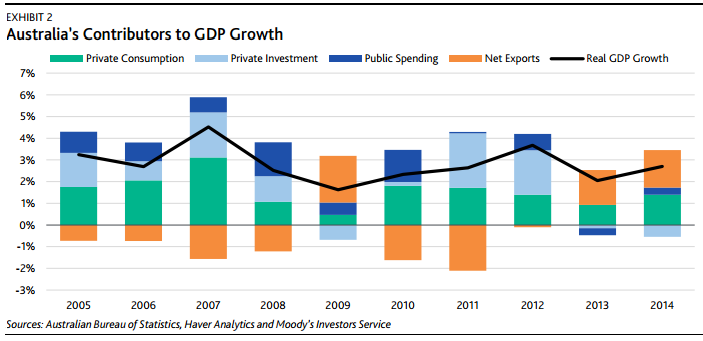
A continued slowdown in growth risks further weakening government finances, particularly if it is accompanied by lower corporate profitability. Corporate income tax receipts have already declined to about 18% of revenues in 2014 from around 21% in 2008. Total revenues grew by 25% between 2009 and 2014, helped by indirect and personal income tax receipt growth of more than 30%; corporate income tax receipts rose only 13%. Lower growth also risks hurting foreign direct investment (FDI). The stock of FDI in Australia increased annually by 8.9% on average between 1996 and 2008, when average real GDP growth was 3.6%. Over the past five years, average annual GDP growth slowed to 2.7% and FDI growth slowed to 6.7%. Lower FDI would increase Australia’s reliance on portfolio and debt flows to finance its current account deficit. These flows have generally been higher than FDI, but can also be more volatile. On the other hand, subdued growth could lower the current account deficit, limiting the reliance on financial inflows. Australia’s current account deficit declined to an average 3.4% of GDP between 2010 and 2014 from 4.7% between 1996 and 2009. But such a decline in the current account deficit could be an indication of lower domestic consumption and investment, which have been important drivers of GDP growth (see Exhibit 2).
Crikey, fellas, you’re generous. Here is what is going to happen:
as the capex cliff steepens unemployment will rise unless there a corresponding surge in consumption;
that consumption is inherently offshore funded via mortgages so as capex declines either the current account deficit will increase or growth will fall, and
as unemployment rises the Budget is going to get hammered and deficits rise more than forecast.
David Llewellyn-Smith is Chief Strategist at the MB Fund and MB Super. David is the founding publisher and editor of MacroBusiness and was the founding publisher and global economy editor of The Diplomat, the Asia Pacific's leading geo-politics and economics portal.
He is also a former gold trader and economic commentator at The Sydney Morning Herald, The Age, the ABC and Business Spectator. He is the co-author of The Great Crash of 2008 with Ross Garnaut and was the editor of the second Garnaut Climate Change Review.