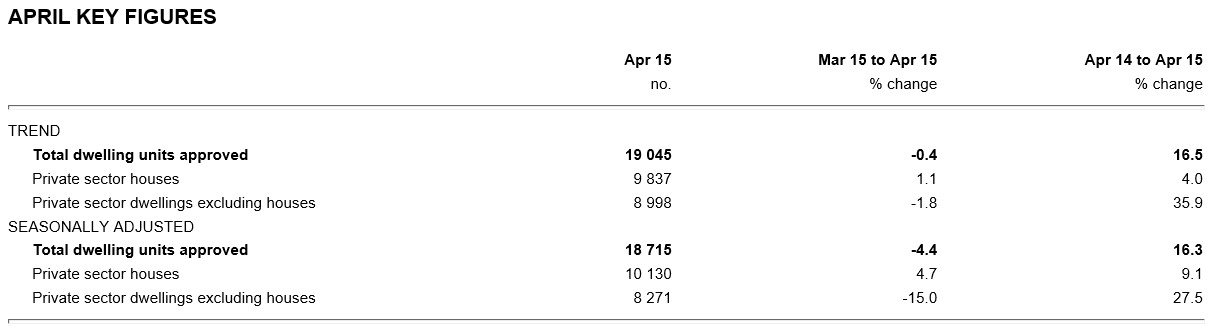
The Australian Bureau of Statistics (ABS) has released dwelling approvals data for the month of April. At the national level, the number of dwelling approvals fell by a seasonally adjusted 4.4% to 18,715. The overall fall was driven by the volatile unit and apartment segment, which slumped by 15.0% in April. By comparison, the more stable house approvals segment rose by 4.7% over the month.
The result beat disappointed expectations, who had expected a 1.8% fall in approvals over the month.
In the year to April 2015, dwelling approvals rose by a seasonally-adjusted 16.3%, driven overwhelmingly by strong growth in unit approvals (+27.5%), with house approvals up by 9.1%:
A chart showing the time series of seasonally-adjusted dwelling approvals at the national level is provided below, split-out by detached houses and units & apartments:
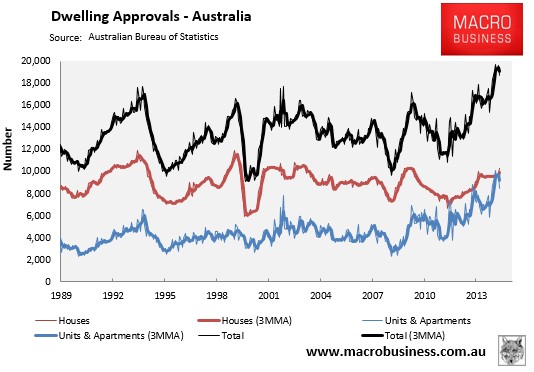
As shown above, dwelling approvals look like they may finally have topped-out.
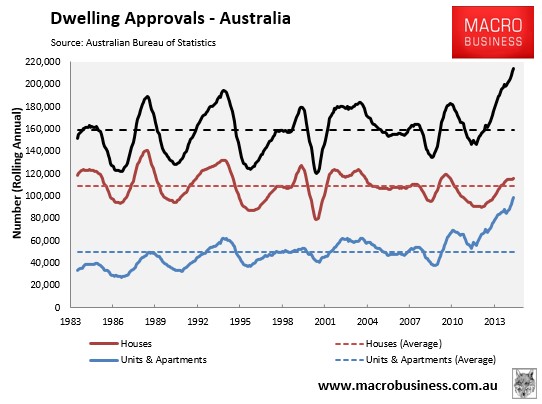
Nevertheless, there were a record 214,328 approvals in the year to April 2015, with unit & apartments surging ahead and detached house approvals merely running just above the 30-year average (see next chart).
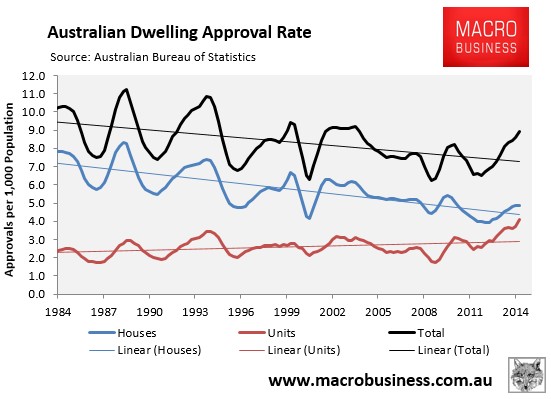
However, as I point out every month, approvals remain unremarkable in population-adjusted terms, given that Australia’s population has grown by more than 45% over the past 30-years (see next chart).
The below chart shows the time-series of approvals at the state level on a rolling annual basis:
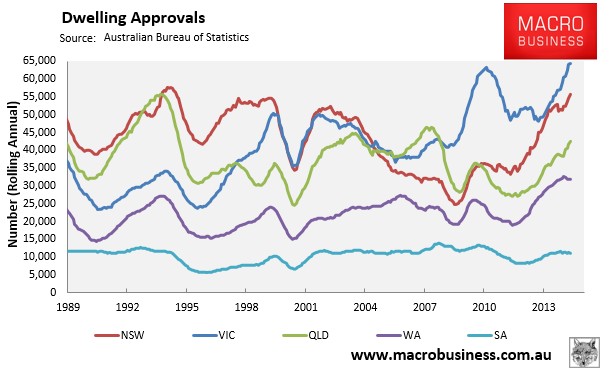
As you can see, dwelling approvals have experienced a strong second wind in Victoria, and to a lesser extent New South Wales and Queensland. However, they are weakening in Western Australia, and remain subdued in South Australia.
The next few month’s approvals data continues to be vital as it will confirm whether the mini construction boom will soon peak, pointing to a potential weakening of housing construction activity in 2015 just as the mining investment cliff intensifies.
unconventionaleconomist@hotmail.com