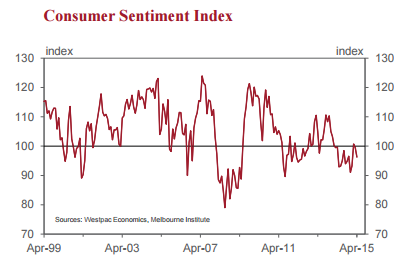
• The Westpac Melbourne Institute Index of Consumer Sentiment fell by 3.2% in April from 99.5 in March to 96.2 in April.
This is a disappointing result. We would have preferred to have seen some upward momentum in the index going into the important Commonwealth Budget that will be released next month.
Recall that at this time last year the Index registered 99.7 but tumbled by 6.8% to 92.9 in the aftermath of the 2014–15 Budget.
From that point confidence remained weak for the remainder of 2014 and was a contributing factor to the soft spending profile during the second half of 2014.
With the Index entering the Budget period well below the key 100 level and with downward momentum we must recognise that confidence is again looking vulnerable heading into the Budget announcement next month. Indeed, recognition that the next Budget is imminent may have contributed to this month’s weakening in confidence.
There are, however, some other factors behind this soft result.
Firstly we have seen an almost complete retracement of the sharp fall in petrol prices seen earlier this year. In November, pump prices averaged $1.32 per litre. They fell to $1.10 by February but have increased to $1.34 by April. Recall that we partly attributed the 8% jump in the Confidence Index in February to the sharp fall in petrol prices.
Markets gave a probability of around 75% to the Reserve Bank cutting the overnight cash rate in April. Failure to deliver on expectations, including widespread media speculation, would also have hindered confidence. Note that the rate cut in February was another factor behind the solid boost to confidence earlier in that month.
High profile coverage of the sharp fall in the iron ore price would also have been significant. The 21% fall in the price of Australia’s premier export commodity since the start of the year would have undermined households’ confidence.
All of these factors also conspired to undermine confidence about jobs and the economy.
The closely watched Westpac Melbourne Institute Unemployment Expectations Index surged by 8.5% to 156.3 (a higher reading indicates increased concern with the outlook for the unemployment
rate). That increase curtailed a promising run of three consecutive months when the index had fallen and represents the highest level since December. In fact today’s print is amongst the top seven readings since 2009. Job insecurity has been a prime explanation for the cautious consumer and this type of reading gives us no confidence that households are becoming more comfortable with their feelings of security around the jobs market.
Consistent with the jobs outlook, the components of the Index highlight that the economic outlook had also deteriorated. The sub-index tracking views on the ‘economic outlook, next 12mths’ fell by 6.7% while the sub-index on ‘economic outlook, next 5yrs’ was down by 10.2%. Sentiment around household finances also weakened. The sub-index tracking assessments of “family finances vs a year ago” fell by 7.4% while the “family finances, next 12 months” sub-index was down by only 0.7%.
There was a 5.9% boost in the sub-index measuring assessments of ‘time to buy a major household item’. That response could represent a rational anticipation that the fall in the AUD (down 9% in USD terms since the start of the year) is likely to soon lead to price increases as importers are unable to continue absorbing rising costs.
Confidence around the housing market also deteriorated. The index tracking assessment of ‘time to buy a dwelling’ fell by 10% to its second lowest level since November 2010. That response is probably being driven by recent price increases in Sydney and Melbourne with respondents assessing that prices have moved too quickly. Certainly, the responses for NSW (down 21.5%) and Victoria (down 8.3%) point to that sentiment.
Despite weakening confidence around the purchase decision prospects for house prices lifted further. The Westpac Melbourne Institute Index of House Price Expectations increased by 2.8%. The Reserve Bank Board next meets on May 5, one week before the announcement of the Commonwealth Budget. On December 4 last year we forecast that the Bank would cut rates twice in two 25bp tranches beginning in February 2015. We expected, at the time, that because it was clear that a total of at least 50bps would be needed, the second move would come in March. Readers will be aware that the Bank is still to deliver the second tranche.
Delaying the decision until May is consistent with a cautious approach near the end of a long easing cycle. The unexpected 21% fall in the iron ore price with its associated implications for the terms of trade and nominal income growth strengthens the case for more rate relief. Today’s drop in Consumer Sentiment, well into the range where pessimists outnumber optimists, also supports the case for a further cut.
We are extremely confident that the Bank will finally deliver the much anticipated second cut of 25bps on May 5.
I am extremely confident of only one thing vis the May meeting, that central bubble management does not know what it’s doing. Watch auction clearance rates.
David Llewellyn-Smith is Chief Strategist at the MB Fund and MB Super. David is the founding publisher and editor of MacroBusiness and was the founding publisher and global economy editor of The Diplomat, the Asia Pacific's leading geo-politics and economics portal.
He is also a former gold trader and economic commentator at The Sydney Morning Herald, The Age, the ABC and Business Spectator. He is the co-author of The Great Crash of 2008 with Ross Garnaut and was the editor of the second Garnaut Climate Change Review.