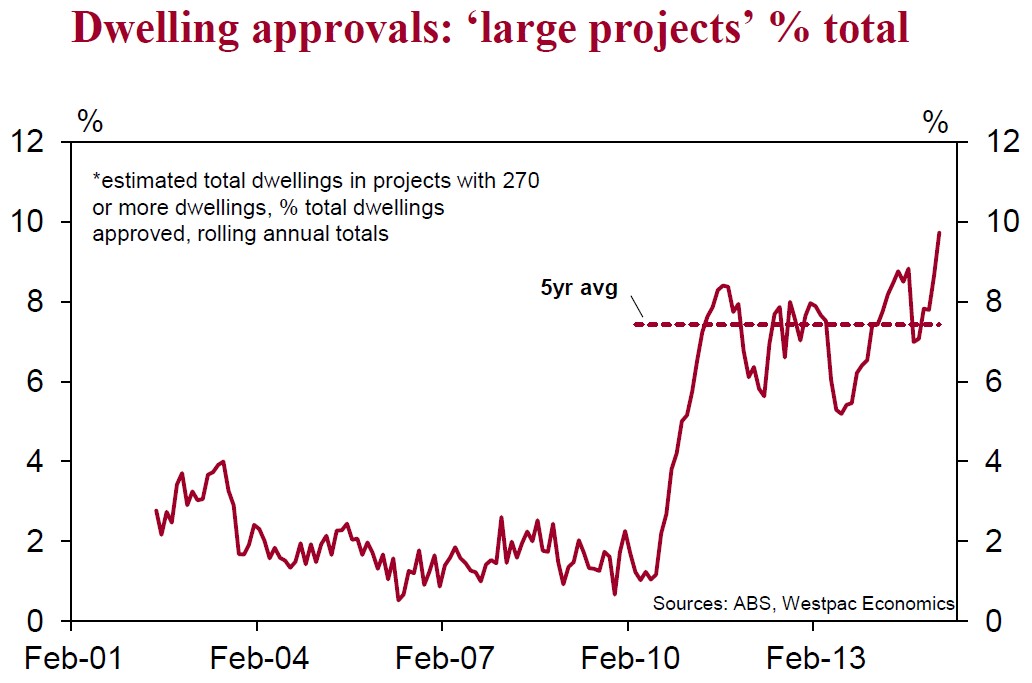
Dwelling approvals surged higher over the 6mths to Feb, +12% in trend terms to a record annual pace of just under 225k. Aggregate data shows these gains have been driven by a surge in approvals for units in blocks of 4 storeys or higher, concentrated, unsurprisingly, in the Sydney and Melbourne markets.
More detailed local area approval figures released a week after the aggregate numbers offer some additional insights. In particular, they show the degree to which ‘large projects’ are driving recent gains.
Using detailed local area ‘crosstabs’ we can identify outliers that represent large individual projects (we use a cut-off of 270 dwellings which effectively captures the very top 0.5% of the distribution of readings).
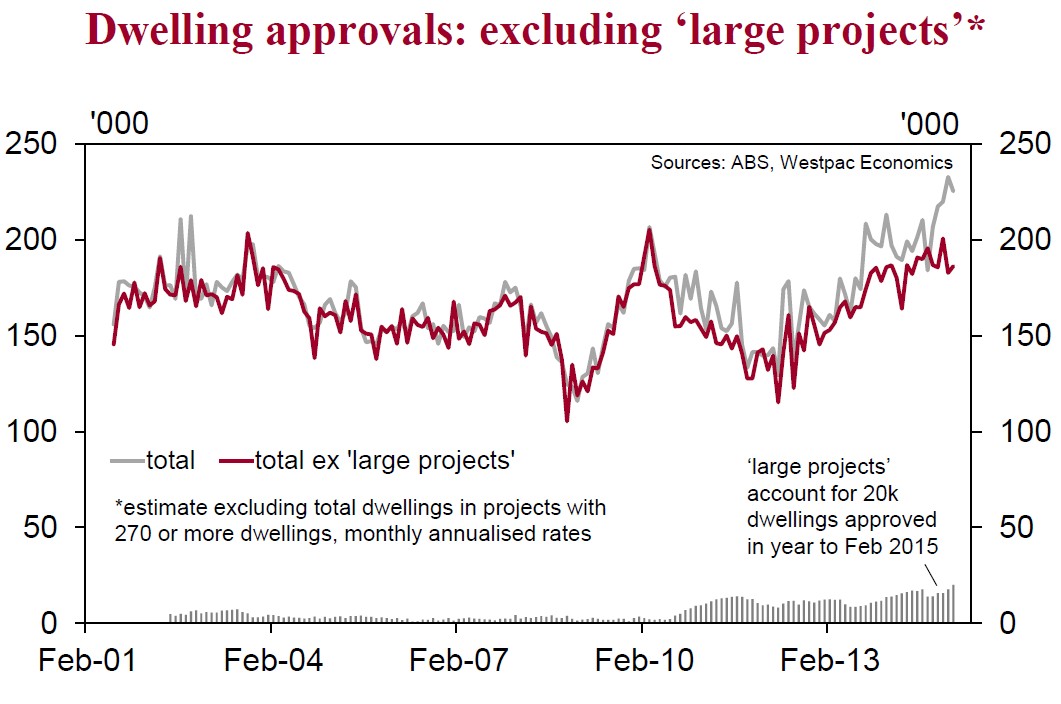
This shows ‘large projects’ accounted for 20k dwelling approvals over the 12mths to Feb, just under 10% of all approvals. That compares to an average of 7.4% over the last 5yrs and just 2% over the 8yrs prior to that. Importantly, these ‘large projects’ account for all of the gains in total dwelling approvals since Aug – a rise of just under 15k in annualised terms.
‘Trimming’ these outliers arguably gives a better indication of underlying momentum. In contrast to the 12% surge reported in the headline figures, approvals ex large projects have been flat or in a slight downtrend over the last 6mths depending on where you draw the cut-off.
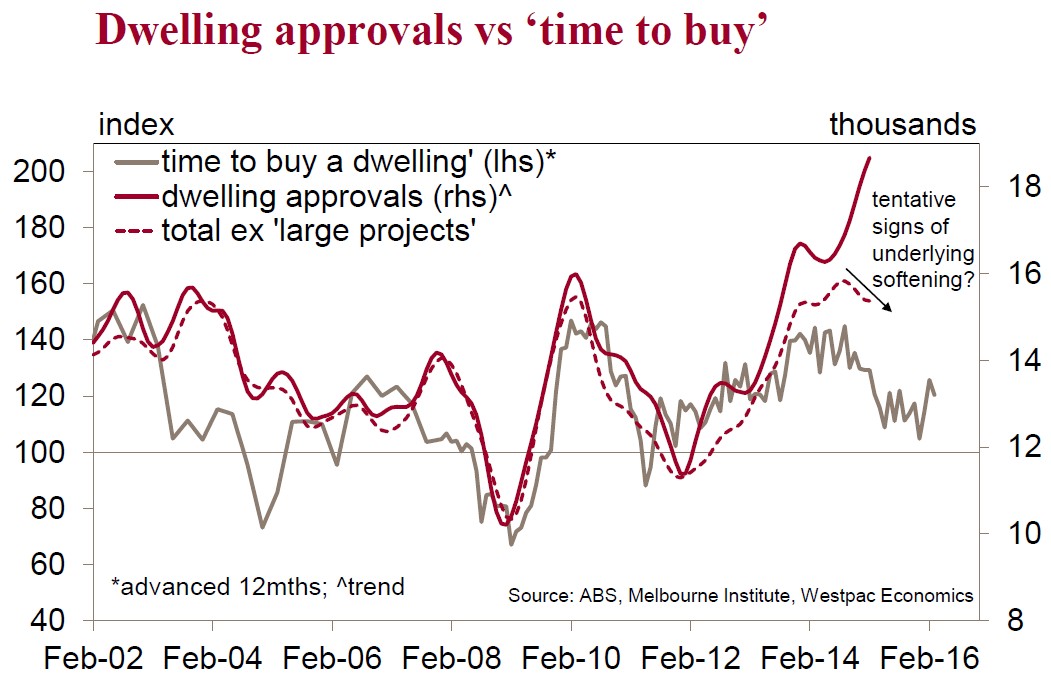
Intriguingly, this ‘underlying’ picture is more in line with trends in buyer sentiment as measured by the ‘time to buy a dwelling’ index from the Westpac-Melbourne Institute Consumer survey. This cooled off noticeably over 2014. Although the relationship between turning point in buyer sentiment and approvals have shifted around in the past, they seem to operate with quite a long lag in the past.
Buyer sentiment has improved more recently following the Feb rate cut. However the lagged effect of previous weakness and potential for gaps in the lumpy pipeline of ‘large projects’ means approvals could easily hit a nasty air pocket sometime in early 2015.
Leith van Onselen is Chief Economist at the MB Fund and MB Super. He is also a co-founder of MacroBusiness.
Leith has previously worked at the Australian Treasury, Victorian Treasury and Goldman Sachs.