The FOMC meeting takes place this Thursday at 05:00, where we should get the policy statement and revised economic projections. Janet Yellen also takes to the stage 30 minutes later for her quarterly press conference (with a question and answer session) that could promote increased volatility in markets.
In 2015 alone some 24 central banks globally have eased monetary policy as falling inflation has forced a more accommodative stance. On the other side of the scale the US Federal Reserve have been quite vocal about a desire to increase interest rates and start a normalisation process. In turn, this massive divergence in policy settings is having huge ramifications on capital markets, with the USD seemingly the epi-centre of the moves.
Much ink has been spilt debating whether the US economy is strong enough to withstand a lift in the funds rate and this has opened up the key question within the Fed; should the Fed hike earlier and be less aggressive, or act later and potentially steeper?
There could be huge implications on emerging markets as well, although the fate is these regions will be dictated to by US bond yields. An aggressive sell-off (causing US bond yields to move higher) would cause strong capital outflows from many geographies, especially from any country that runs a sizeable current account deficits and requires high levels of external funding. In this vein China is absolutely key, and how it manages its currency is going to be fascinating.
Key narrative to watch out for
The Federal Reserve has held a view that they can be ‘patient in beginning to normalize the stance of monetary policy’ since the December meeting. Importantly, this statement is largely expected to be altered and ‘patient’ removed, with Janet Yellen fully expected to temper this with a view and stress that the path of rate increases will be data dependant. This means that from June every meeting is effectively ‘live’ and we could see the funds rate going up at any stage.
Commentary around the USD is pivotal for traders, as the pace of the USD accent of late has been ferocious and must be a huge concern for the Fed. It seems logical that they will talk more openly about the USD and perhaps suggest the USD will play a greater role in its policy settings. This could take some of the heat out of the currency, which in turn could be a net positive for equities.
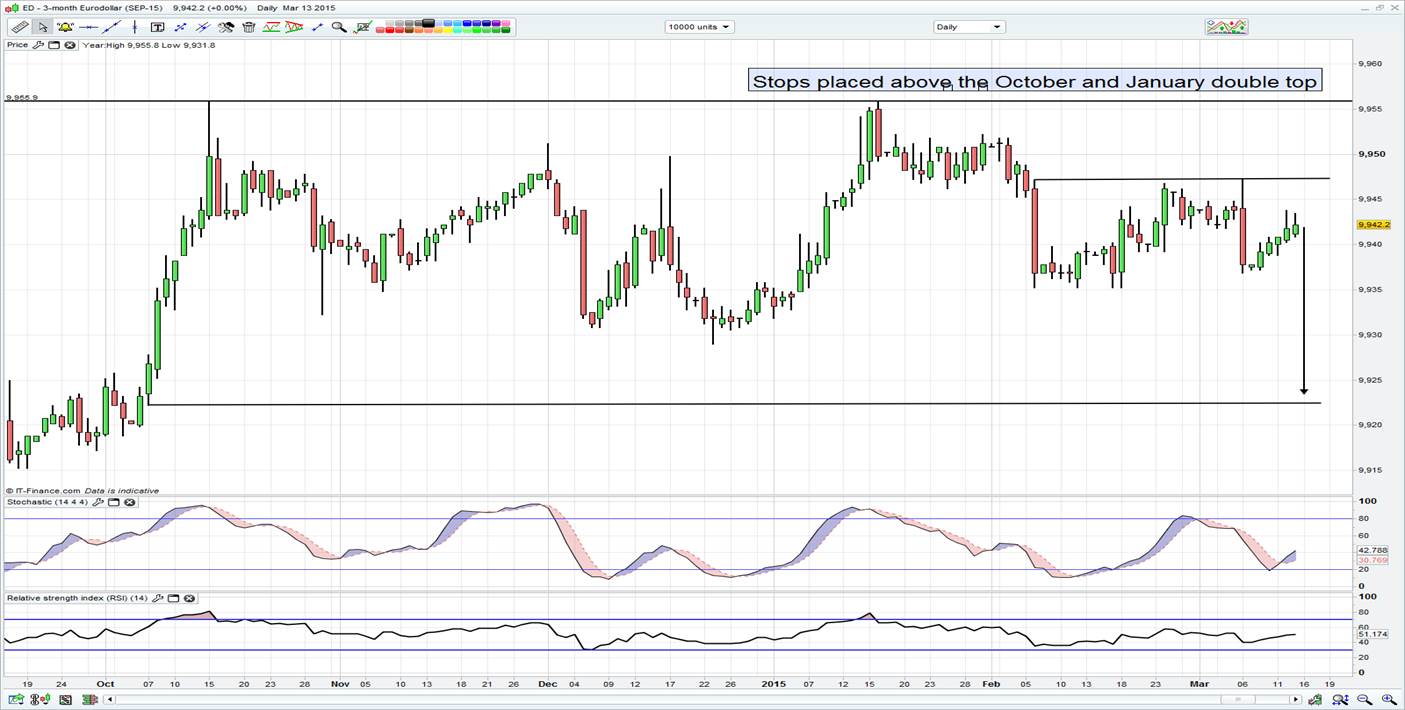
A failure to express a big concern around the recent USD strength would be a green light to add to long USD positions, although I feel playing the rates markets is a good strategy and being short Eurodollar futures (September) would be a great place to be in this regard.
Naturally commentary around slack in the labour market, wage pressures and the transitory factors affecting inflation (mainly due to the oil price) will shape interest rate expectations and subsequently market moves.
Economic projections
The Fed’s economic projections will shape market pricing around how aggressive the central bank will be with future policy settings. From the last set of economic projections (provided in December) it is really inflation that traders are most focused on. Expect core personal consumable expenditure (PCE) to be lowered to a range of 1.3% to 1.6% this year and 1.6% to 2% in 2016, down from 1.5% to 1.8% and 1.7% to 2% respectively.
In terms of growth, it would not be a surprise to see forecasts of 2.5% to 2.9% this year, which is a modest downgrade from the December projection. No changes are expected for 2016 and 2017.
We could also see some modest tweaks lower to their forecasts for the unemployment rate, with a range of 5.1% to 5.3% likely for this year. Co-incidentally, this is in-fitting with the levels the Fed see as full employment.
The Federal Reserve’s view on rates
There will be some focus placed on the Fed’s projections on where rates should be at the end of each year, or the so-called ‘dots plot’. As things stand the current median forecast for the fed fund rate held by the 17 members of the board is 1.125% for 2015, 2.5% in 2016, 3.625% in 2017 and finally their long-run objective is 3.75%. Bear in mind this is the median projection and expectations vary widely. One board official even feels rates should be at 4% next year! Imagine where US bond yields and the USD would be if we see the funds rate there!
I would not be surprised to see the median projection for rates being revised down to 1%, even 0.85% (from 1.125%). However, a failure to lower the current projection from 1.125% should cause another leg up in the USD as it implies a more aggressive tightening path than what is currently priced in.
Market pricing
Interest rate market pricing is fairly benign at present and there seems like a dislocation between what economists and traders are expecting. Looking at the Fed fund futures contracts we can see a modest 19 per cent chance of a June rate hike, compared with a 58 per cent probability for September, according to CME Group FedWatch. This tells me that traders are sceptical on Fed action and expecting the process to be very gradual. On the other hand a recent survey from Reuters saw 15 of 16 primary dealers (the firms that deal directly with the Fed) calling for rate hikes to start in June.
There seems enough evidence from the US and global economy to support being conservative with starting a normalisation process. However, the commentary from recent Fed speakers of late really suggests the probability of ‘lift-off’ by September should be higher than what is currently priced in.
What’s the trade?
Given conservative market pricing and my own view that rate hikes will commence in September, I feel selling rallies in three-month Eurodollar futures (September contract) into 9947.5 (the 6 March high) look compelling. Trading three-month Eurodollar futures is possible the purest way to play rate expectations and the likes of the USD, gold and even the S&P 500 will move according to this market.
Place stops above the 16 January high of 9955.8, while targeting a potential move lower to the 9920 to 9925 area. This would be a medium-term trade.
For traders who feel the Fed are going to outright dovish and give little indication of acting this year would do the opposite and simply buy at market, expecting rate expectations for 2015 to be priced out (price up, yield down).
David Llewellyn-Smith is Chief Strategist at the MB Fund and MB Super. David is the founding publisher and editor of MacroBusiness and was the founding publisher and global economy editor of The Diplomat, the Asia Pacific's leading geo-politics and economics portal.
He is also a former gold trader and economic commentator at The Sydney Morning Herald, The Age, the ABC and Business Spectator. He is the co-author of The Great Crash of 2008 with Ross Garnaut and was the editor of the second Garnaut Climate Change Review.