
Here’s Goldies take on the Fed:
The March FOMC statement and projections suggested that September rather than June appears to be the most likely date for the first hike of the fed funds rate. Although the change to the “patient” forward guidance was close to expectations, the shift in the “dot plot” was most consistent with two rather than three 25 basis point hikes to the target range occurring in 2015. In addition, changes to the Committee’s economic assessment were a bit more dovish.
MAIN POINTS:
1. As widely expected, the FOMC decided to drop its “patient” formulation in its forward guidance regarding the date of the first rate hike. It explicitly noted that a hike at the upcoming April meeting was unlikely, while stating that the Committee will hike “when it has seen further improvement in the labor market and is reasonably confident that inflation will move back to its 2 percent objective over the medium term.”
2. Changes to the Committee’s assessment of economic activity were generally dovish, with growth at a “solid pace” downgraded to growth having “moderated somewhat.” In particular, “export growth weakened.”
3. The median projection for the fed funds rate (or “dot”) fell 50bp to 0.625% at end-2015, fell 62.5bp to 1.875% at end-2016, and fell 50bp to 3.125% at end-2017. Two participants again indicated that a hike would not be appropriate until 2016, while one indicated a target range of 25-50bp at end-2015 and seven indicated a target range of 50-75bp at end 2015 (a group that is highly likely to include the leadership of the Committee), most likely consistent with a first hike in September. The median longer run projection was unchanged at 3.75%, but many participants reduced their longer run dot by 25bp.
4. The FOMC also released a new Summary of Economic Projections. The mid-point of the central tendency of the unemployment rate fell 0.15pp to 5.1% in 2015Q4, 0.1pp to 5.0% in 2016Q4, and 0.15pp to 4.95% in 2017, implying a 0.15pp undershooting of the longer-run or “structural” rate, which declined 0.25pp to 5.1%. Real GDP growth declined 0.3pp to 2.5% in 2015, 0.25pp to 2.5% in 2016, and 0.2pp to 2.2% in 2017. Longer run growth was unchanged at 2.15%. Headline PCE inflation fell 0.6pp to 0.7% in 2015, but was little changed after that. Core inflation fell 0.3pp to 1.35% in 2015 and fell 0.15pp to 1.7% in 2016, but was unchanged at 1.9% in 2017.
5. There were no dissents.
6. Our forecast remains for a September hike, but the risks now appear slightly skewed toward a later liftoff.
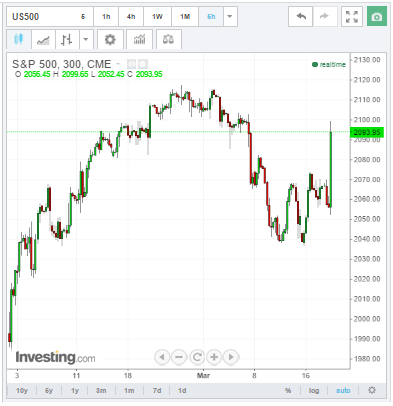
Lol. Sure. Markets know a dove when they see one and went absolutely mental buying everything in site. Stocks soared:
My personal favourite was RIO bouncing 1% on a day iron ore fell 5%. Brent oil piled on 6%:

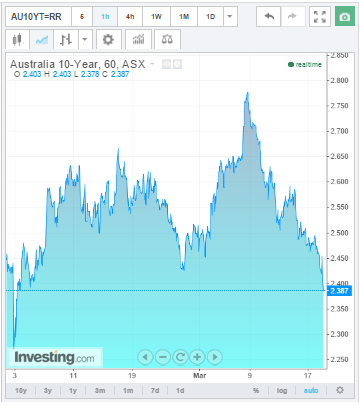
But the real action was in bonds and forex. Aussie bonds were bid out the wazoo with the ten year yield crashing 3% in minutes:
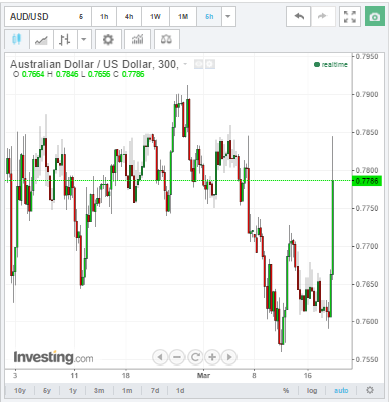
And the Aussie dollar rocketed well north of 2% to a high of $78.30:
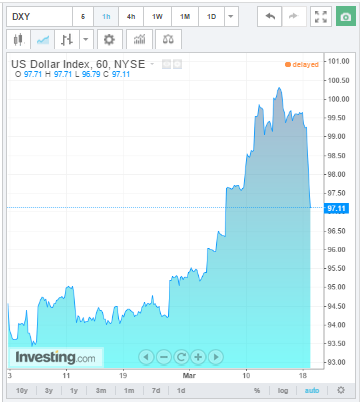
But the volatility prize of the night goes to the US dollar index (that is, the global reserve currency) which crashed 2.5% in an instant:
I guess algos are hawks!
