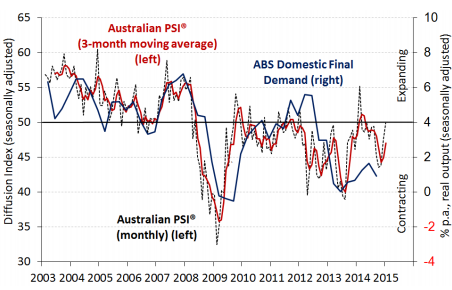
After spending most of 2014 in negative territory, conditions in the services industries stabilised in the New Year. The seasonally adjusted Australian Industry Group Australian Performance of Services Index (Australian PSI® ) improved by 2.4 points to 49.9 points this month, indicating stable conditions across service businesses in January.
• The three-month moving average for the Australian PSI® increased to 47.1 points in January. Recent results from the Australian PSI® suggest growth in Australian demand for goods and services (as measured by the ABS in the National Accounts each quarter as ‘domestic final demand’) is likely to remain subdued in Q4 2014 and early in 2015.
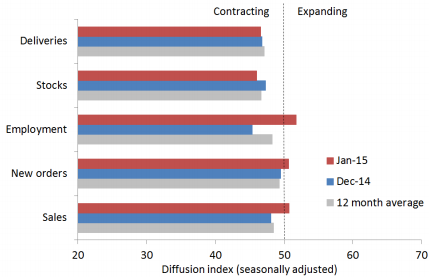
• Three of the five activity sub-indexes in the Australian PSI® returned to expansion (i.e. above 50 points) in January. Pleasingly, the sales, new orders and employment subindexes all expanded this month following four months of contraction (three months for employment). However, services businesses reduced their supplier deliveries and stock levels for an eighth consecutive month in January.
• Two of the nine services sub-sectors showed expansion this month, while one – retail trade – was stable (50.0 points). The very large health and community services sub-sector (58.1 points, three-month moving averages) expanded for a third month in January and the finance and insurance services sub-sector also returned to expansion (56.6 points). Conditions in the retail trade sub-sector (50.0 points) stabilised this month after three months of contraction. All other services sub-sectors contracted again in January.
• Respondents to the Australian PSI® indicated that the lower Australian dollar has boosted conditions in dollar-exposed sub-sectors such as retail trade and tourism, while a pick-up in residential building activity over the past year has increased demand for related services. However, service sector businesses remain concerned about weak local economic conditions and subdued consumer and business confidence. Some respondents said that state elections in NSW and Queensland, as well as uncertainties around a few large public infrastructure projects (e.g. East-West Link in Melbourne), have dampened demand for business services such as accounting, legal, personnel and administrative services.
David Llewellyn-Smith is Chief Strategist at the MB Fund and MB Super. David is the founding publisher and editor of MacroBusiness and was the founding publisher and global economy editor of The Diplomat, the Asia Pacific's leading geo-politics and economics portal.
He is also a former gold trader and economic commentator at The Sydney Morning Herald, The Age, the ABC and Business Spectator. He is the co-author of The Great Crash of 2008 with Ross Garnaut and was the editor of the second Garnaut Climate Change Review.