
It seems the childcare sector is not too happy about the Productivity Commission’s (PC) final report into childcare, which recommend (among other things) no overall increase in childcare subsidies, tighter means testing of benefits, and the benchmarking of fees on which to base childcare rebates on.
Various lobby groups representing the childcare sector have responded angrily to PC’s recommendations, arguing that many families would be worse off under the plan. From The Canberra Times:
…groups including Goodstart Early Learning cautioned that the payments in the report are not a percentage of the fees parents actually pay but “a percentage of a fixed amount set by the government”.
“The fixed amount suggested in the report is lower than the actual fees paid by up to half of the families using child care centres in Australia,” chief executive Julia Davison said…
“Because the Productivity Commission was tasked by government to come back with recommendations that don’t cost any more money, what we see … is merely a moving around of funds, resulting in a few winners, but greater sea of losers,” executive director Jo Briskey said…
Hopefully, the Abbott Government will ignore the sector’s special pleading.
A key risk from the sector’s calls to further expand childcare subsidies is that it would be inflationary – much like the first home buyers grant and private health insurance rebate have been – and would act to push-up childcare costs.
One only needs to examine last year’s report by the National Centre for Social and Economic Modelling (NATSEM), which showed that the average cost of childcare had risen by 150% over the past decade (see next chart). This is despite government subsidies for childcare rising to over $7 billion a year currently, up from around $900 million in 1999.
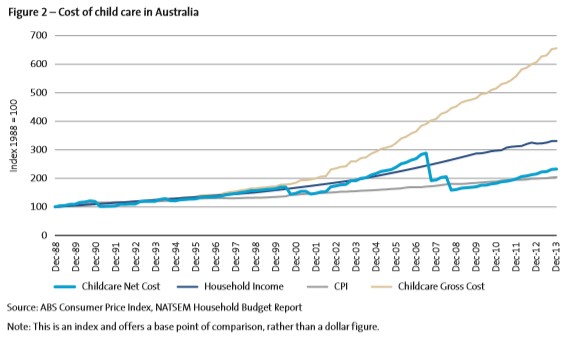
Simply raising subsidies, as advocated by the industry, without changing the fee structure system would very likely lead to further cost inflation, potentially leaving families no better-off and the Budget significantly worse-off.
This is where the PC’s recommendation to set the childcare rebate on an hourly rate, benchmarked against the median price of various types of childcare, is so sensible. By doing so, it would encourage childcare providers to keep their fees in check, effectively punishing high cost providers (whose fees are above the benchmark) and rewarding lower cost providers (whose fees are below the benchmark).
Indeed, in crafting its benchmarking system, the PC stated that the greatest dollar subsidy per hour goes to families who pay the most, which are typically those on higher incomes and sometimes for luxury or premium services.
In this regard, the PC’s targeting of incentives at lower income families is also sensible, seeing as it is lower second income earners that face the highest effective marginal tax rates from paid work, whereas those on higher incomes are less effected.
Lobby group, The Parenthood, has also slammed the PC’s “activity test”, which would preclude some mothers that work less than 12 hours a week from receiving subsidies. From The Australian:
“According to the (commission) there are at least 16.4 per cent of mothers working less than 12 hours a week and, by their judgment, this is a small-enough number not to worry about whether or not they can afford to pay full price for childcare and continue to work,” [Parenthood’s executive director, Jo Briskey, said].
“What this recommendation says to the tens of thousands of mums coming back to work after having children is that we don’t value your contribution to the workforce or your desire to come back to work.”
As shown in the table below, which comes from the PC’s interim report, the proposed “activity test” for eligibility to childcare subsidies isn’t exactly onerous, with mums/dads only needing to work, study or look for work for 24 hours a fortnight in order to qualify for taxpayer subsidies, which is less than half the average hours worked by second income earners. Exemptions from the activity test are also available for parents with babies, grandparents, children at risk, etc:

Given its huge cost to the Budget, whereby childcare subsidies are forecast to grow to $8.5 billion by 2017-18, and that subsidies are aimed at boosting female labour force participation, how is a modest activity test unreasonable?
Sure, implementing an activity test would reduce demand for childcare services at the margin. But chances are, this reduction in demand will come from those that are using taxpayer subsidised childcare more for convenience rather than need, and not materially adding to the productive capacity of the labour force. Moreover, their absence from childcare would also help alleviate the upward pressure on childcare costs, benefiting other more genuine users.
Overall, the PC’s recommendations on childcare seem to strike the right balance, improving the equity and efficiency of the system without further raising costs to taxpayers.
