
Overwhelmingly, these experts claim that cracking down on generous tax concessions to wealthy Australians, along with counting the family home in the pension assets test, are the keys to eliminating the Budget deficit and ensuring that the Budget remains sustainable over the long-term:
Five of the six nominated curbs to super concessions, currently valued by Treasury at more than $30 billion a year and forecast by many experts to hit $50 billion.
Next, was including the family home in the pension assets test to make the retirement system for Australia’s most vulnerable people more sustainable.
…the government should [also] curb the 50 per cent discount on negative gearing…
“There is a stunning generational unfairness in our [budget] settings and all those disengaged younger Australians need to wake up to the fact they’re being massively screwed by … what the baby-boomers are leaving for them,” Mr Richardson said.
“Right now, we’re eating their future”…
If Tony Abbott was serious about addressing “inter-generation theft”, he should tell his ministers to focus reform efforts on the above areas, as failure to do so will mean that the Budget is never placed on a sustainable footing.
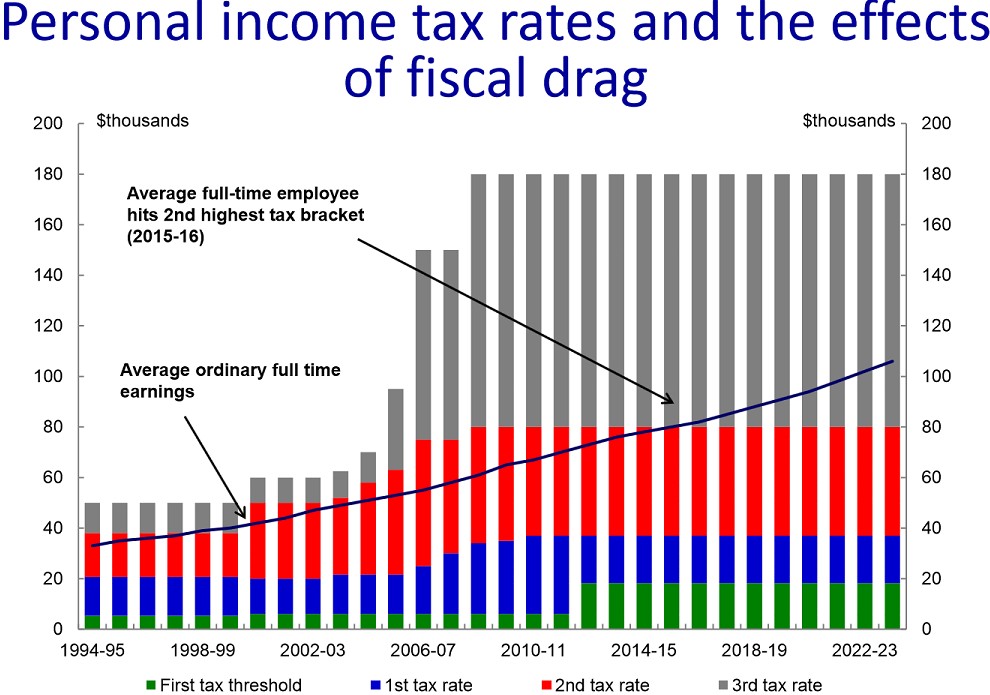
Failure to reform will also mean that the tax system will become increasingly regressive as bracket creep (aka “fiscal drag”) pushes lower and middle income earners into higher tax brackets, significantly increasing their tax burden. The dilemma was spelled-out perfectly by former Treasury Secretary, Martin Parkinson, who said the following in speeches last year:
…over the decade ahead, the average tax rate paid by that individual is expected to rise from 23 per cent to 28 per cent, an increase of over 20 per cent. Moreover, the increase in the average tax rate for lower income earners is generally greater than for higher income earners. One consequence of this is to make the personal income tax system less progressive…
Clamping down on superannuation concessions should be front-and-centre of any Budget reform process.
While the exact budgetary cost of these concessions is difficult to ascertain – since it is difficult to determine behavioural changes as some people move their funds elsewhere – super concessions likely cost the Budget many billions in foregone revenue. They are also growing very rapidly.
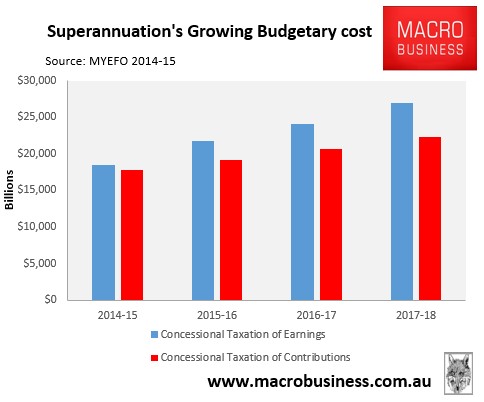
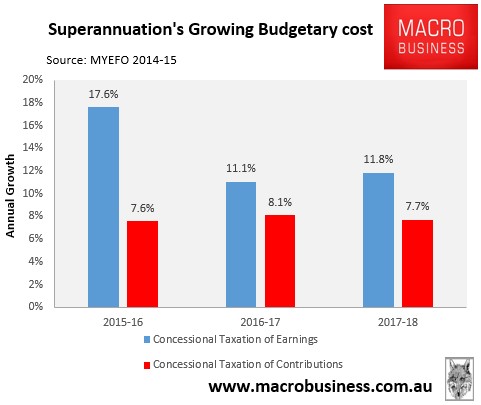
To illustrate, the Mid-Year Economic and Fiscal Outlook (MYEFO), released in December, forecast that the concessional taxation of superannuation entity earnings – whereby earnings within super funds are taxed at just 15% before the age of 60 and 0% afterwards – would cost the Budget a whopping $18,450 million in 2014-15, increasing to $26,950 million by 2017-18. That’s growth of 7.8% per annum!
Similarly, the concessional taxation of employer superannuation contributions, whereby super contributions are taxed at 15% rather than at the employees marginal tax rate, were forecast to cost the Budget $17,800 in 2015-15, increasing to $22,300 million by 2017-18. That’s growth of 13.5% per annum!
Charts showing the dollar cost of theses concessions, as well as their annual percentage growth, are provided below.
One only needs to look at the below table, which shows the amount of concession provided at each income tax threshold, to realise that the lion’s share of benefits flow to higher income earners, whilst penalising lower income earners:
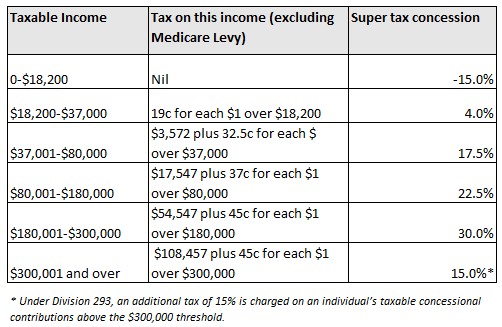
The draft report of the Murray Inquiry into Australia’s financial system agreed, noting that “the majority of superannuation tax concessions accrue to the top 20 per cent of income earners (Chart 4.3). These individuals are likely to have saved sufficiently for their retirement, even in the absence of compulsory superannuation or tax concessions”.
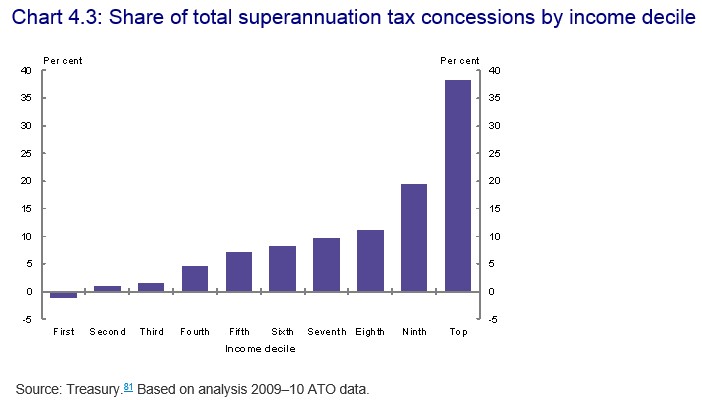
Winding back superannuation concessions, therefore, could potentially save the Budget billions whilst also improving the progressiveness of the tax system. It’s a no-brainer.
Tightening up the assets test on the Aged Pension also makes sense in light of the ageing of the population (see next chart).
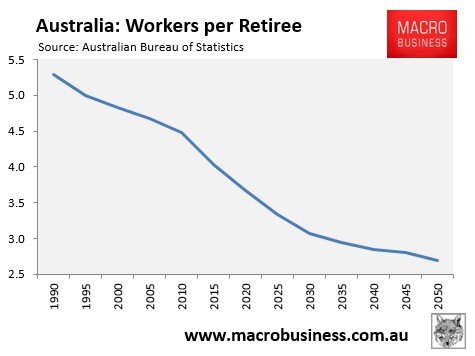
As shown above, the ratio of workers supporting retirees is projected to fall from 4.0 to 2.9 over the next 20 years, placing an overwhelming strain on younger generations through higher taxes.
That the biggest asset most households retiree with – one’s principle place of residence – is essentially excluded from their capacity to fund their retirement makes little ethical or budgetary sense. It is especially unfair to expect younger generations – who are either struggling under the weight of the high mortgage debt legacy they inherited or unable to afford a home altogether (see below chart) – to bare the full cost of their parents’ retirement while they live in homes they cannot afford.
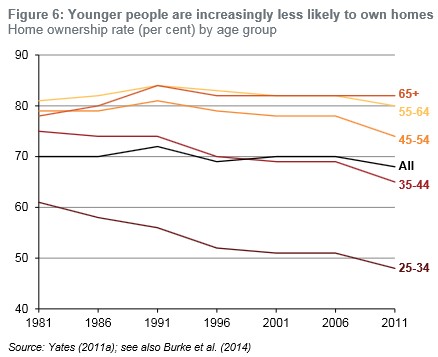
As noted by Treasurer Joe Hockey on Budget night: “…currently, an individual with a home and almost $800,000 in assets still qualifies for the age pension; a couple with a home and almost $1.1 million in assets also qualify for the age pension”. This level of pension support is clearly more generous than necessary and allows precious tax dollars to flow to those that are not in genuine need.
Unwinding capital gains and negative gearing concessions makes equally good sense.
For example, the Grattan Institute has estimated that quarantining negative gearing losses, so that they can only be claimed against the same asset’s future earnings (rather than unrelated wage/salary income), would save the Budget around $2 billion a year in revenue foregone once lower capital gains tax receipts are taken into account.
These concessions also juice housing demand:
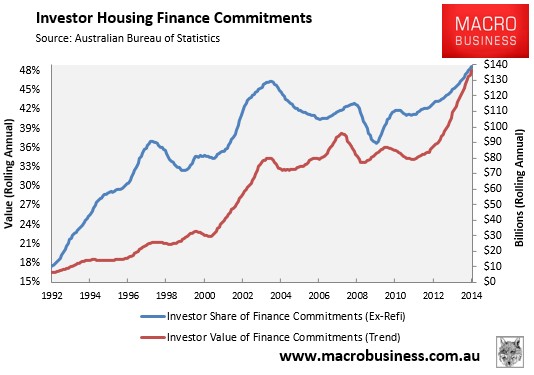
Without expanding supply:
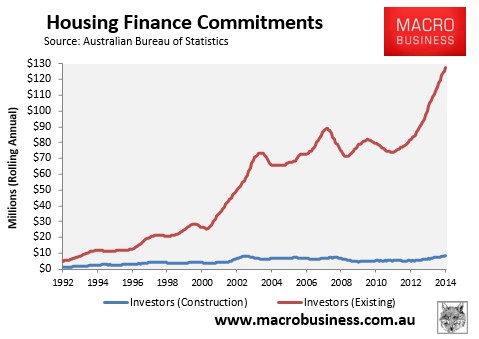
Therefore, they should be ‘abolished’ on equity and efficiency grounds, let alone for the sake of Budget sustainability.
Of course, in addition to closing Australia’s world-beating tax concessions, there is also good sense in broadening the tax base to ensure that it is built around more efficient and equitable sources, such as land, resources and consumption, whose efficiency are far higher than personal and company taxes (see next chart from the Henry Tax Review).
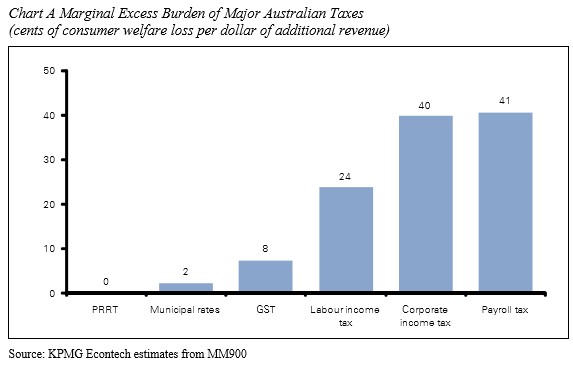
The bottom line is that it is highly inequitable to expect workers – whose share of the population will fall as the population ages and the proportion of retirees rises – to keep shouldering more and more of the tax burden. Nor is it sustainable in the longer-term. This is why root-and-branch reform of the tax and welfare system is required, encompassing the elimination of highly distorting and inequitable tax concessions, broadening the tax base in favour of more efficient sources, and better means testing of retirement benefits.
