
From Peter Martin today:
Who’d say no to the deal of a lifetime? Tony Abbott would, and it’s our tragedy.
The 10-year bond rate is the rate at which the government can borrow for 10 years at a fixed rate of interest. Right now it’s just 2.55 per cent, an all-time low.
By way of comparison in the 1970s it exceeded 10 per cent, in the 1980s it passed 16 per cent, in the 1990s it passed 10 per cent, in the 2000s 5 per cent, and until now in this decade it has usually been above 3 per cent. It dived below 3 per cent at the end of last year and is now just 2.55 per cent, the lowest in living memory.
If Australia was to borrow, big time, for important projects that took the best part of a decade to complete, it would have no risk of ever having to fork out more than 2.55 per cent a year in interest. The record low rate would be locked in for 10 years.
Australia’s inflation rate is currently 2.3 per cent. Although it will almost certainly fall in the wake of the collapse in oil prices when it is updated next week, the Reserve Bank has a mandate to keep the rate centred at about 2.5 per cent. That means that right now our government is being offered billions for next to nothing, billions for scarcely more than the expected rate of inflation.
If Abbott was the chief executive of a company with good prospects he’d grab the money and borrow as many billions as he could without impairing his credit rating.
In Australia’s case that’s probably an extra $100 billion. That’s enough to build the long-awaited Brisbane to Sydney to Melbourne high-speed rail line, or to build Labor’s original national broadband network, or Sydney’s $11 billion WestConnex road project plus Melbourne’s $11 billion metro rail project plus Melbourne’s $16 billion East West Link plus something big in each of the other states.
Hard to disagree if it were done within a rigorously examined context of productivity enhancing projects. Here are the bond rates:

Sensible borrow and invest is debt self-liquidating via the productivity dividend. Higher productivity would also reduce the degree of internal deflation required in the coming post-boom adjustment and support employment while it was at it. And if MB is proven right about the deteriorating outlook then the borrowing will happen anyway, only via inadvertent Budget deterioration on economic weakness and stimulus panic.
That said, my estimate of how much would be sensible is probably half that of Peter Martin. $100 billion would shoot the general government ratio of debt to GDP to 27%:
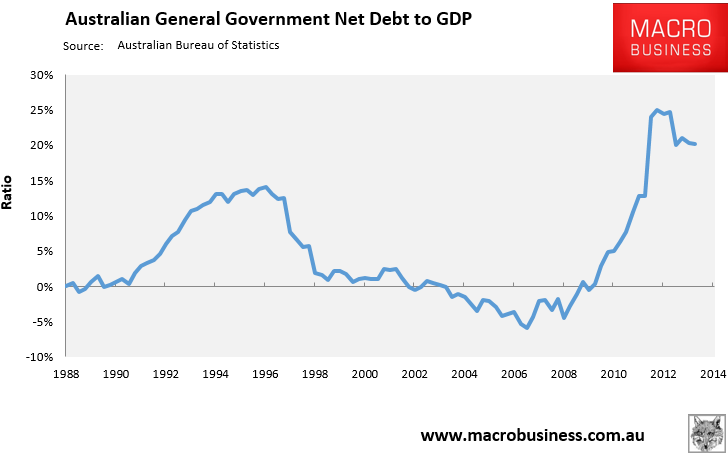
That’s getting very close to the ceiling imposed by S&P for retention of the AAA rating, which you may recall also guarantees the bank’s offshore borrowing. You’d want to keep a bit more in the can for the next global shock.
Nonetheless, Martin’s is a sensible argument in principle.
