Find below Westpac chief economist, Bill Evans’, preview on the mid-year budget update.
The Treasurer will release the Federal Government’s Mid-Year Economic & Fiscal Outlook (MYEFO) in the week beginning December 15.
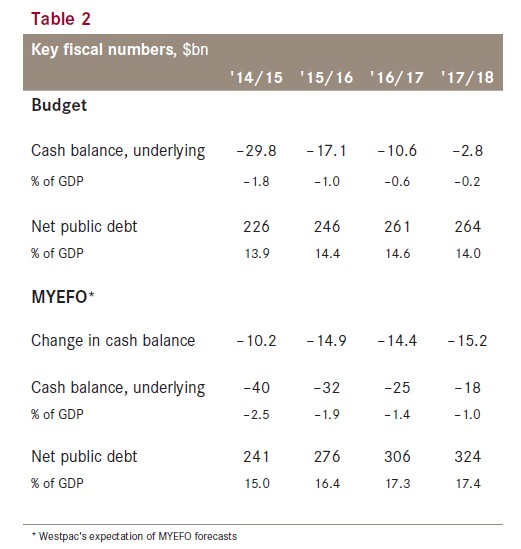
The starting position for the underlying cash deficit is likely to be a deterioration in the order of $10bn for 2014/15 and $15bn in following years.
That would have the 2014/15 budget deficit revised from $29.8bn to $40bn and the deficit for 2015/16 revised from $17.1bn to $32bn. See table 2.
Net public debt increases to $324bn, 17.4% of GDP by June 2018, revised up by $60bn from $264bn, 14.0% of GDP from the May budget forecast.
The weaker starting position for the budget reflects two factors: (1) weaker nominal GDP growth in 2014/15, centred on lower commodity prices; and (2) government savings measures being blocked by the Senate.
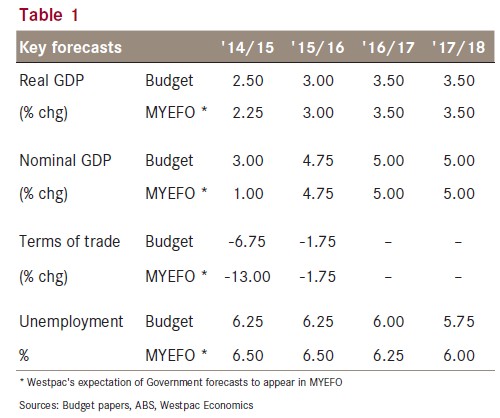
Nominal GDP growth in 2014/15 will fall short of the 3% forecast in May, potentially being lowered to 1.0%. The drop in the terms of trade has proven to be sharper than expected and real GDP growth may be closer to 2.25% than the 2.50% previously expected.
The terms of trade is likely to fall by around 13% in 2014/15, rather than the 6.75% expected in May. These numbers include an iron ore price of $60/t for June 2015 and for June 2016, rather than the budget assumption of around $95/t for June 2015 and $90/t for June 2016.
We expect the economic growth forecasts for the following years to be unchanged from those in May, see Table 1.
Our calculations reflect the following considerations:
(1) Downgrading nominal GDP growth by 2ppts in 2014/15 will increase the budget deficit by about $7bn in that year, with the budget cost increasing to around $12bn in the following years. This is broadly based on the rule of thumb provided in the budget papers. Company tax will be lower on weaker commodity prices, as will income tax from wages.
(2) Senate decisions reportedly adding around $10bn or more to the budget deficit over the four years.
(3) The expectation that MYEFO will include in the budget figuring government savings measures that have yet to pass the Senate. That is in accordance with standard budget reporting, that is,
revenue and expenditure estimates are based upon existing government policy.
(4) Any new spending measures will be fully funded by savings.
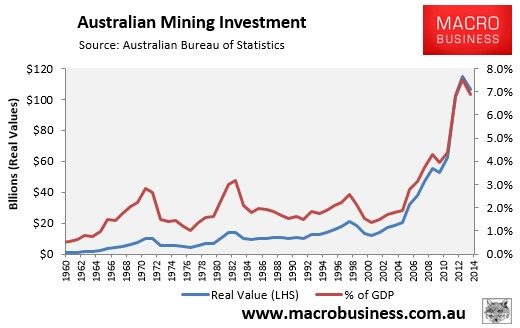
I strongly disagree with Westpac’s forecasts on GDP and employment in FY17 and FY18, which appear far too bullish, given the upcoming collapse of mining investment (see next chart), the shuttering of the Australian car industry by 2017, and the likely slowing of the housing market (both prices and construction).
Leith van Onselen is Chief Economist at the MB Fund and MB Super. He is also a co-founder of MacroBusiness.
Leith has previously worked at the Australian Treasury, Victorian Treasury and Goldman Sachs.