The Housing Industry Association (HIA) has released a report lamenting the high cost of stamp duty in Australia, which “has very detrimental effects on home affordability” and “adds hugely to household indebtedness”:
“The latest issue of Stamp Duty Watch shows that the tax adds significantly to the cost of buying a home in each state for all types of homebuyer,” commented Shane Garrett.
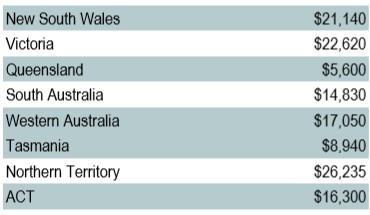
“Dwelling price growth over the past year has pushed stamp duty bills even higher, with the Northern Territory, Victoria and NSW particularly badly affected,” explained Shane Garrett. “Stamp duty bands and rates do not respond to episodes of strong price growth,” added Shane Garrett.
“Stamp duty holds back new home building activity and has very detrimental effects on home affordability,” explained Shane Garrett. “The tax adds hugely to household indebtedness by forcing monthly mortgage repayments upwards. Reform aimed at reducing the burden of the tax must become a priority for both state and federal governments,” concluded Shane Garrett.
During November 2014, the Stamp Duty bill for the purchase of a median-priced established dwelling by a non-FHB owner occupier in each state is shown below.
I live in Melbourne, and have experienced the stamp duty gouge first hand, so you will get no disagreement from me.
Advertisement
As argued many times before, stamp duties are one of the worst taxes going around. Not only do they hinder labour mobility by discouraging workers from relocating closer to employment. But they also unnecessarily penalise people that move to homes that better suit their needs. Obvious examples include baby boomers downsizing from large family homes and young growing families upsizing to bigger family-friendly homes. Such disincentives inevitably lead to an inefficient use of the housing stock, such as empty nesters occupying large homes with multiple spare bedrooms.
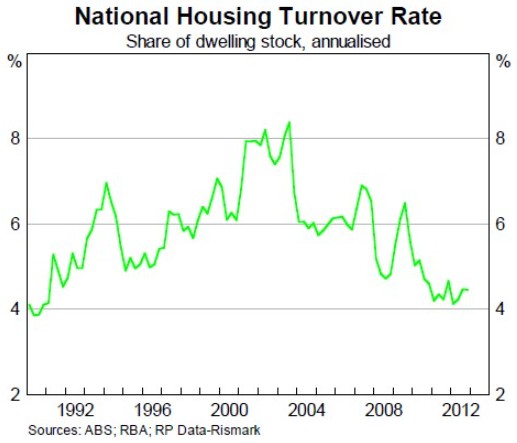
Stamp duties are also highly inequitable. As shown in the below RBA chart, between 4% and 8% of the housing stock is transacted annually. As such, we have a bizarre situation where a small minority of the population are paying taxes that support services for the whole community – all for the privilege of moving to a home that better suits their needs!
Advertisement
Still, there is no point in the HIA complaining about stamp duties unless it can recommend an alternative revenue source for the states. The logical choice for shifting state tax bases away from stamp duties is to replace them with a broad-based land value tax, yet the HIA is conveniently silent on this issue.
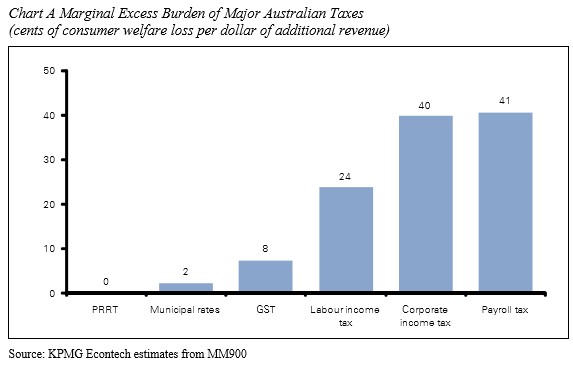
Taxes on land are some of the most efficient going around, creating minimal “marginal excess burden” (i.e. a small loss in consumer welfare relative to the net gain in government revenue), according to the Henry Tax Review. This is because they are applied to a tax base that is completely immobile – land (see next chart). By contrast, the Henry Tax Review found the marginal excess burden of stamp duties to be a high at 34%.
Advertisement
There are also broader reasons to endorse the implementation of land value taxes (LVT) in place of stamp duties. First, an LVT would help make infrastructure investments self-funding for governments, since any land value uplift brought about through increased infrastructure investment (e.g. new roads, trains, etc) would be partly captured by the government via increased LVT receipts. Accordingly, governments would be more likely to facilitate development, rather than act to restrict it in a bid to save on infrastructure costs. Second, an LVT would penalise land banking and vagrancy, effectively increasing the supply of land in the process and bringing new homes to market more quickly.
Past Commission inquiries have recommended replacing stamp duties with a more efficient form of taxation, such as a broad based land tax, as this will improve flexibility and efficiency in the housing market (PC 2013b). A more flexible housing market will also support geographic labour mobility, allowing more workers to move to areas with better employment opportunities…
RECOMMENDATION 12.2
State and Territory Governments should remove or significantly reduce housing related stamp duties, and increase reliance on more efficient taxes, such as broad based land taxes.
If taxpayers are to endure the upset of tax reform, then the change should be to best practice – the tax bases economists have identified as causing the least harm. The HIA seems to want all property taxes removed to further inflate the staggering cost of land. Doing so would not help builders one bit.
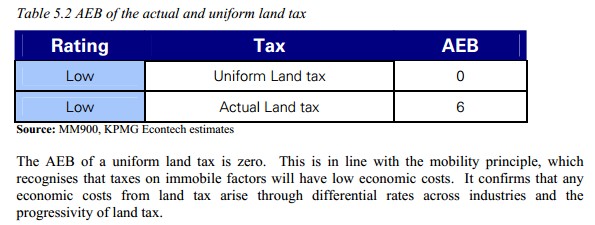
Right next to Stamp Duty sits the ideal base: State Land Tax. A uniform SLT has deadweight losses and an average excess burden of zero. It causes no harm – a rare and special virtue among taxes, as KPMG Econtech clearly identifies:
Builders, who buy land and sell homes, would bear only the holding cost for the time it takes to construct the house. The most efficient builders pay least. Removing the transaction charge would also make buy-renovate-sell more profitable and enhance our housing stock.
All of which suggests the HIA is once again more interested in supporting the land banks of its developer members, rather than driving genuine housing (tax) reform.
Leith van Onselen is Chief Economist at the MB Fund and MB Super. He is also a co-founder of MacroBusiness.
Leith has previously worked at the Australian Treasury, Victorian Treasury and Goldman Sachs.