
Coalition minister for employment and the public service, Eric Abetz, has hardened his stance on public sector pay, slamming public servants for pushing for above-inflation pay rises in the decade following the commodity price boom. From The Canberra Times:
A union bulletin to its members at Employment urges them to reject the minister’s “dud deal” that offers 1.4 per cent over three years in return for more job cuts, a longer working day and the loss of other entitlements.
But the minister produced figures to Senate question time on Monday showing that median public-service pay rises since 2004 had totalled nearly 42 per cent while the headline inflation rate for the same period was 28 per cent…
“The CPSU should also remind its members that over the last decade, median public-service pay rises outstripped CPI by 14 per cent.”
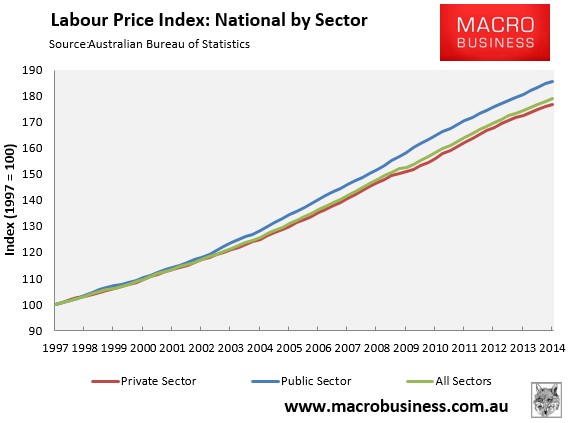
A quick glance of the Australian Bureau of Statistics’ (ABS) labour price index seems to support Minister Abetz’s claims.
In addition to outpacing inflation by some 14% over the past decade, public servants’ wages growth has easily eclipsed the private sector’s (see next chart).
That said, there is arguably a bigger issue than pay, and that is the large increase in public service numbers, which have increased by around 25% since the Howard Government was elected, as noted in a separate article today in The Canberra Times:
If remuneration policy had been achieving its objectives, labour productivity should have increased at an annual rate of at least 1 per cent. That would have been sufficient, allowing for a modest increase in outputs, to keep the number of staff in the APS at about the same level since 1997. Instead, since then, the number of staff has increased by about 25 per cent. That is, labour productivity has almost certainly gone down.
With the Australian economy likely to deteriorate over the medium term as the terms-of-trade falls, mining investment unwinds, and the automotive industry shutters, workers across the board will have to accept falling real wages, or face even bigger increases in unemployment.
That said, the Government’s demanding of cuts to employment numbers, longer work hours, and cuts to other benefits across the public service doesn’t seem particularly clever, and risks leaving some agencies, such as the ABS, unable to fulfill its critical functions.
As noted in the same Canberra Times article:
Let’s be absolutely clear: except for the staff reduction, none of [the Government’s] measures has anything whatsoever to do with productivity improvement. While such cheese-paring may save a small amount of money and even marginally increase output, it is highly likely to reduce the department’s productivity…
Productivity is about how many widgets (or whatever) can be made in an hour. Fooling around with conditions of employment or imposing longer working hours is worse than irrelevant to productivity. Reducing employment conditions will not make staff work harder or smarter and so produce more per hour. Flogging reduces productivity. The same is so with longer working hours because growing tiredness means fewer widgets will be produced in later hours of the work day than in earlier hours…
I’m interested to hear readers’ views on this matter.
