Some very good if overdue analysis today from Morgan Stanley:
The Macro Outlook Has Deteriorated
Whilst the unwind of Australia’s resources boom has been the “known” challenge for several years, the ability to transition the economy through this and again avoid an official recession has remained a topic of market conjecture. Indeed our constructive stance on the momentum in a housing-led, East Coast Recovery to achieve such an economic transition has been challenged in recent months by both direction in data and looming headwinds in both the regional and domestic macro outlooks
Growth outlook tougher than expected
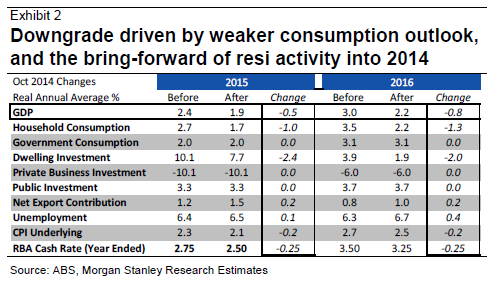
We now forecast CY15e GDP to fall below 2% and settle at 1.9%, which compares to current consensus of 2.9%. In our view, the combination of a deeper than expected Terms of Trade shock and the missed opportunity to springboard consumer spirits off the housing recovery leave the near-term growth profile anaemic.
Complacency on Policy Options is a Risk
One seemingly common view we receive from investors is that any threat of a downturn is somewhat mitigated by the scope for both Monetary and Fiscal Policy to become more stimulatory. Whilst we agree that policy options are available, and that the state of the fiscal balance sheet is indeed not as stretched as the federal narrative would suggest, we believe the risk is that conditions will almost certainly need to worsen before this shift can occur, given the corners that monetary and fiscal policymakers find themselves in regarding focus and positioning. A change in stance would most certainly be a “buy the dip” or “don’t fight the Fed” moment for the Australian market, but the deterioration in earnings and conditions to catalyze such a change is worth being cautious of in the near term.
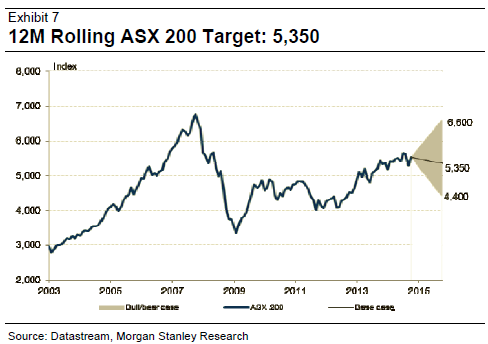
Growth conviction remains low within aggregate consensus forecasts. In the past this could have been seen as a bullish signal, should earnings momentum turn positive. The reality is that the current single digit growth profile between FY15e and FY17e seems to fit the current trading and macro backdrop. A deterioration in conditions would only pressure EPSg forecasts further – and when compared to a 12 mth forward PE for the ASX 200 Industrials-ex-Financials of 17.7x, creates a scenario of valuation concern rather than optimism.
The spirit of Gerard Minack lives! Those are nasty forecasts. 2% with much of the that dominated by net exports will hurt. The 6.7% peak in unemployment in 2016 is probably optimistic if the growth forecasts are right. Indeed, if this scenario does play out, it is one in which sudden downside cannot be ruled out because house prices will not be rising. Bizarrely, it still sees interest rate hikes and a dollar at 76 cuts by the end of 2015. More likely is macroprudential, slowing housing and growth and rate cuts. 76 cents is not low enough for what’s coming.
MS sees the same answer for equities as MB: get offshore exposure.
David Llewellyn-Smith is Chief Strategist at the MB Fund and MB Super. David is the founding publisher and editor of MacroBusiness and was the founding publisher and global economy editor of The Diplomat, the Asia Pacific's leading geo-politics and economics portal.
He is also a former gold trader and economic commentator at The Sydney Morning Herald, The Age, the ABC and Business Spectator. He is the co-author of The Great Crash of 2008 with Ross Garnaut and was the editor of the second Garnaut Climate Change Review.