One key tenet of George Megalogenis’ rather unfortunate book, “The Australian Moment”, is that the Australian consumer is much brighter than his/her leaders. Megalogenis recounts how local households were pulling in their belts several years before the Global Financial Crisis, even as our leadership became ever more fiscally profligate with the mining boom windfall.
The Australian consumer made a structural adjustment to his/her spending in 2006 and eight years later that decision is unbowed by the assault variously launched upon it by successive governments and the Reserve Bank of Australia, whose time frames for success is less propitious for the national interest than is that of households.
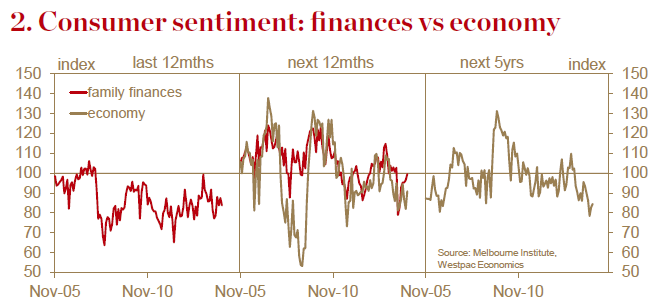
The structural adjustment to lower spending and higher savings has never been clearer than in today Westpac November Red Book, the bible of Australian consumer attitudes:
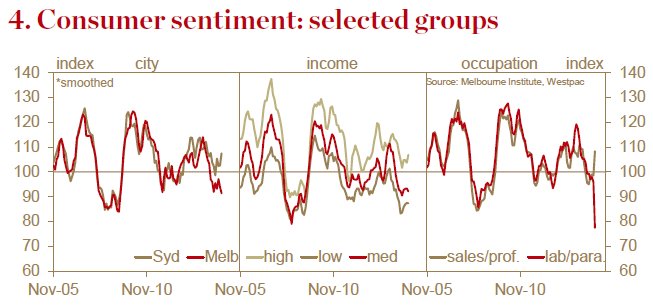
The Westpac–Melbourne Institute Index of Consumer Sentiment rose 1.9% in Nov, to 96.6 from 94.8 in Oct.
― The modest increase likely reflects financial market developments with the ASX recovering and the AUD stabilising after sharp falls in Oct. Overall though it is another disappointing result with sentiment still in ‘cautiously pessimistic’ territory,12.5% below its level this time last year.
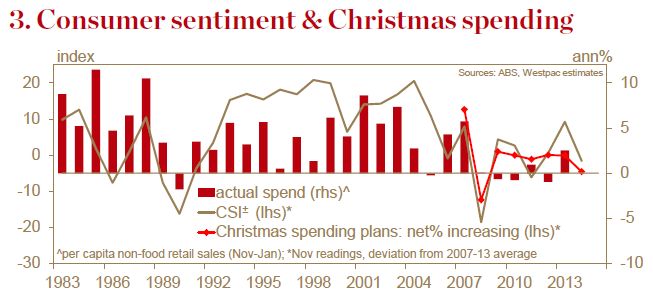
― CSI±, our modified sentiment indicator that we favour as a guide to actual spending, is a touch softer in Nov, slipping 0.5% to 96.0, in line with the average reading of 2014 but down 10.1% on this time last year. It continues to point to spending growth in the 1½-2%yr range.
― Latest data on actual spending and surveyed business conditions have been more positive, although the iPhone release in Sep appears to have given a significant additional one-off boost to retail sales and there are question marks over some sharp swings in recent business surveys. These more positive updates have also been counter-balanced by downward revisions to annual national accounts estimates of spending – annual consumption growth to Jun is likely to be revised down from 2.5% to 2.2%.
― The sub-index on ‘time to buy a major item’ slipped 0.8% in Nov. At 124.2, the sub-index is down 13%yr and 3.9pts below its long run average. We estimate that real per capita household goods retail sales, excluding the aforementioned iPhone eff ect, were up about 1%qtr, 3%yr in Q3.
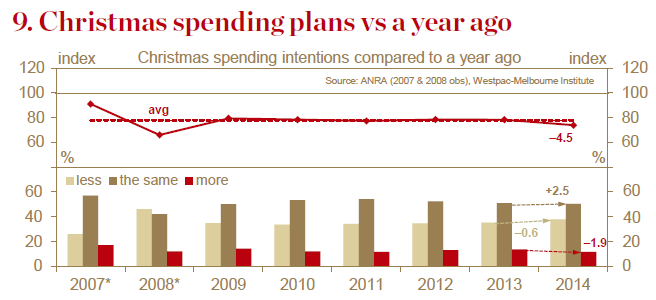
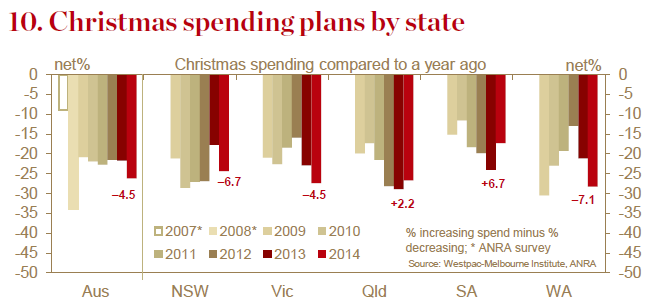
― The Nov survey included an update of our annual question on Christmas spending plans. It shows consumers taking a more restrained approach to spending this year with 38% planning to spend ‘less’, 50% ‘the same’ and 12% ‘more’ than last year. In recent years the less:same:more mix has been around 35%:51%;14%. The detailed responses show significant variations across sub-groups.
― Overall, the soft readings on consumer sentiment and more restrained responses on spending plans point to a more subdued Christmas spend compared to last year. While the lead-in is not as bleak as 2008 it is comparable to 2011 with a clearer intention to economise on gifts. A flat or slightly negative result looks likely this season.
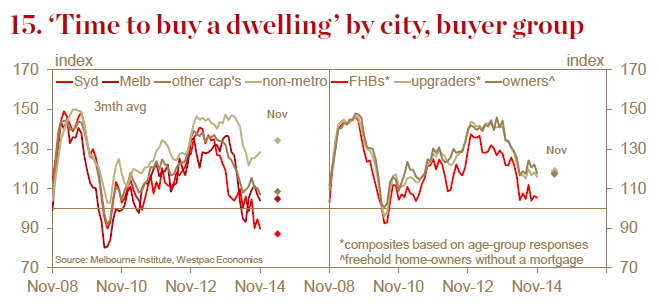
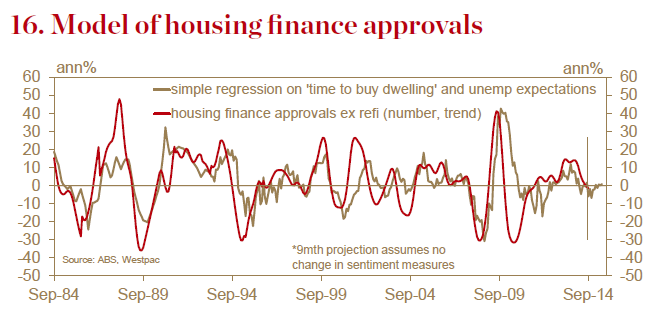
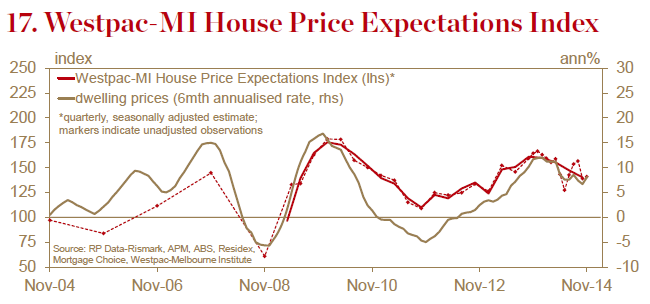
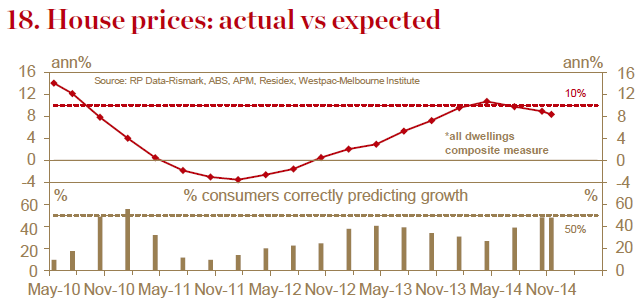
― Confidence around housing remains choppy but both purchase attitudes and price expectations appear to be settling in moderately positive ranges. The ‘time to buy a dwelling’ index increased 3.1% in Nov following a 2.3% gain in Oct but an 8.7% drop in Sep. At 117.4 the Index is in net positive territory but below long averages and down sharply on last year’s 140+ highs (Sydney remains a notable weak spot). The Westpac-Melbourne Institute Consumer House Price Expectations Index rose 1.4% in Nov – it is down 14.3%yr but still above historical averages.
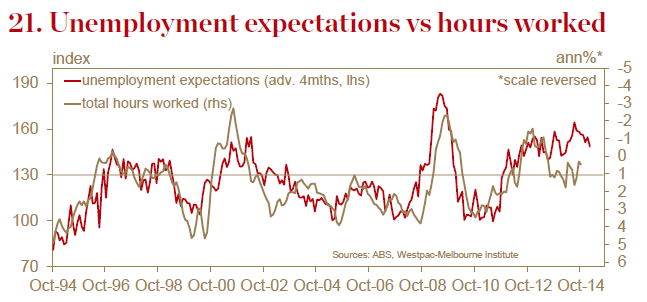
― The Westpac-Melbourne Institute Unemployment Expectations Index rose 2.7% in Nov, indicating more respondents are pessimistic about the labour market than in Oct. The rise is disappointing but not enough to halt the trend improvement since Mar. Recent confusion around offi cial labour market estimates would not have helped.
Advertisement
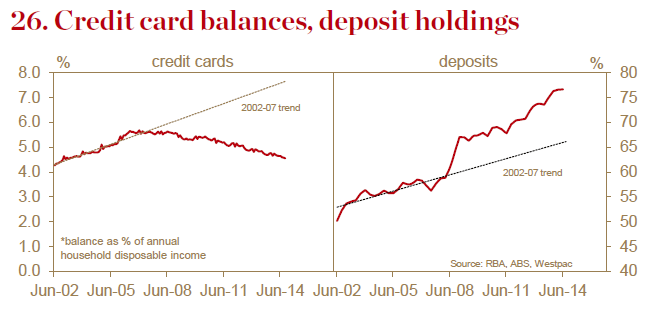
Policy-makers are aiming to slingshot the Australian economy across its many structural imbalances post mining and credit booms using house prices and consumption. Households, however, quite rightly don’t want a bar of it:
As authorities think only of the next year or so, it is households that are preparing the nation for a tougher era ahead by rebuilding bank liability profiles, reducing our need for foreign finance and limiting Australia’s current account deficit. Congratulations to them.
David Llewellyn-Smith is Chief Strategist at the MB Fund and MB Super. David is the founding publisher and editor of MacroBusiness and was the founding publisher and global economy editor of The Diplomat, the Asia Pacific's leading geo-politics and economics portal.
He is also a former gold trader and economic commentator at The Sydney Morning Herald, The Age, the ABC and Business Spectator. He is the co-author of The Great Crash of 2008 with Ross Garnaut and was the editor of the second Garnaut Climate Change Review.