
From Paul Kelly at The Australian:
Speaking at the dinner in the Library of Congress building in Washington, Mr Murdoch said… since the 2008 global financial crisis, leaders had made the mistake of responding to the domestic “political outcry” instead of devising long-term structural reforms to restore economic confidence, investment and innovation.
…“Quantitative easing has increased the price of assets, such as stocks and real estate, and that has helped first and foremost those who already have assets. Meanwhile, the lack of any real wage increase for middle-income workers means growing societal divisions and resentment.
…The significance of his nine-page speech is his argument about the limits to both monetary and fiscal policy and the imperative for a new approach based upon the need “for government to get out of the way”. Mr Murdoch called for: labour market reform; lower and more competitive corporate taxes; a crackdown on multinationals — naming Google — for not paying taxes where they make their profits; a rethink on excessive bank regulation, warning “you would have to be mad to join the board of a bank these days”; and recognition that high taxes and over-regulation were damaging economic growth and the public interest.
Truly, the mind boggles at this misdiagnosis which, ironically, serves the interest of widening the gap further, as Alan Kohler rightly points out today:
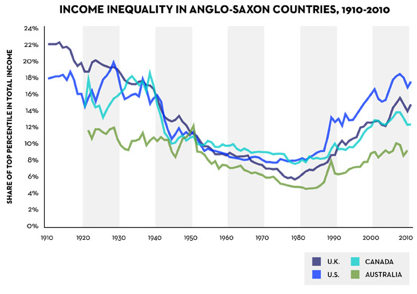
Zero interest rates and quantitative easing have definitely benefited the rich at the expense of the poor and middle classes, but as this chart from Thomas Piketty’s book on inequality, “Capital in the 21st Century”, clearly shows, it was not the source of it:
Rising inequality began in the 1980s and was the direct result of Reaganomics…The benefits of the 1980s tax cuts for the rich were meant to trickle down, but they were captured and held onto instead, and now zero interest rates and quantitative easing are increasing the value of their assets.
The financial crisis of 2008, which produced the monetary policy that is now being widely blamed for inequality, had its roots in the repeal of the Glass Steagall Act in 1999…part of the second phase of the New Deal rollback that Ronald Reagan had started.
That diagnosis is pretty much the opposite of Rupert’s wishlist for reform and rightly so. But our Joe loved it:
“Loose monetary policy has effectively been exhausted as a lever to stimulate economic growth on a global basis,” he said. “Loose fiscal policy, that is governments spending hand over fist, is limited because they haven’t got the money to be able to continue to do that and put it on the credit card forever.
That is so contradictory with the Treasurer’s stance on Australian property price rises being good for all that I’m not sure where to look.
To be clear, I’m in favour of cutting corporate tax rates if it comes with general tax reform to boost productive investment, am in favour of taxing Google properly, and am absolutely in favour of structural reform aimed at increased competitiveness and productivity. I would free up commerce, trade and labour markets everywhere, enforce strict anti-trust regulation and regulate banks far more heavily.
I just don’t see much of any of that coming from either Mr Murdoch or Mr Hockey.
