In lieu of Leith this week (he returns next), find below a cross-post of Westpac’s detailed take on today’s Labour Force survey.
With the ABS admitting there is something not right in the survey, and switching off the seasonal factors, it is still not clear what the underlying trend in the labour market is. In the ABS’s own words “If the ABS had not set the seasonal adjustment factors to one, the seasonally adjusted estimate of total employed persons for Australia would have declined by approximately 172,000 persons between August and September 2014. The published estimate is a decrease of 29,700 persons. The seasonally adjusted participation rate would have decreased by 1.0 percentage points.” We note that this fall would have been the largest in the history of the monthly survey so it is understandable why the ABS was uncomfortable with it.
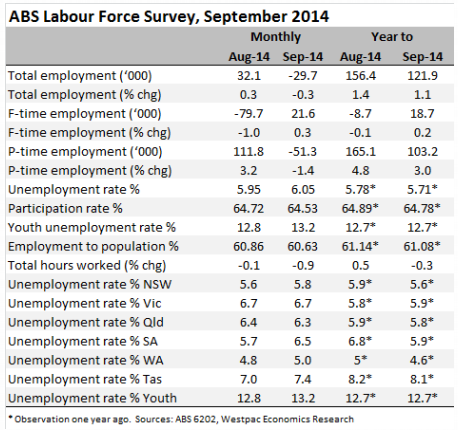
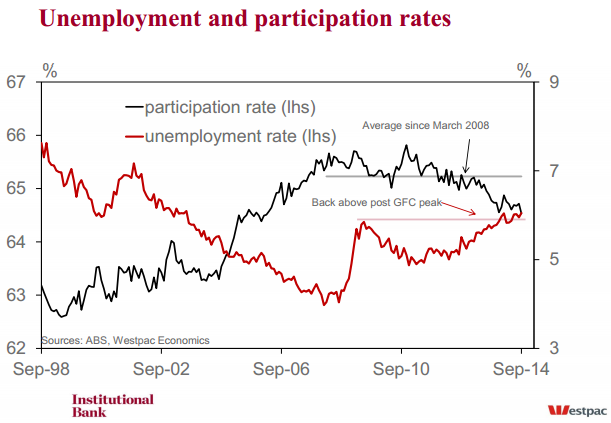
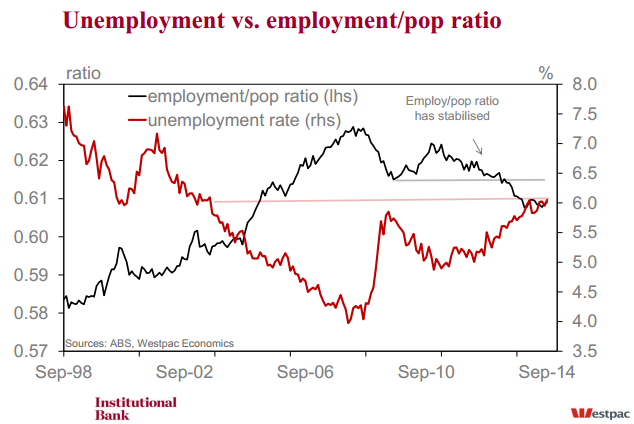
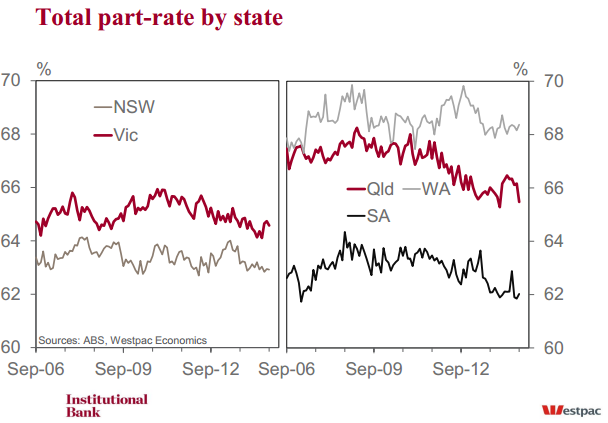
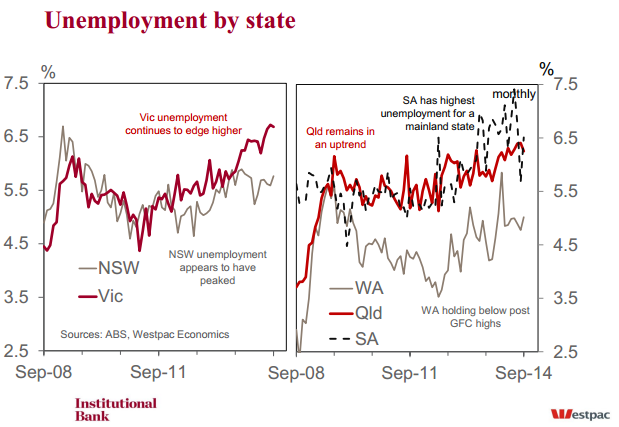
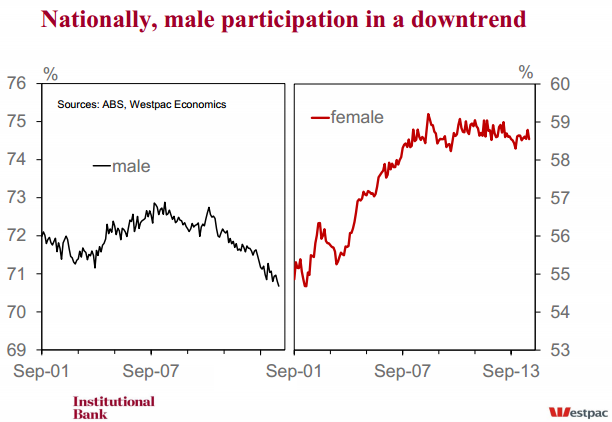
With the revised data the ABS is now reporting that the unemployment rate has held at around 6.0% so far this year, which is a positive sign. But with the revisions they have also confirmed that this is, in part, due to an ongoing trend decline in participation, particularly for males. This suggests that the more positive than expected outcome from unemployment is due as much to people exiting from the workforce than it is to a more positive labour market environment.
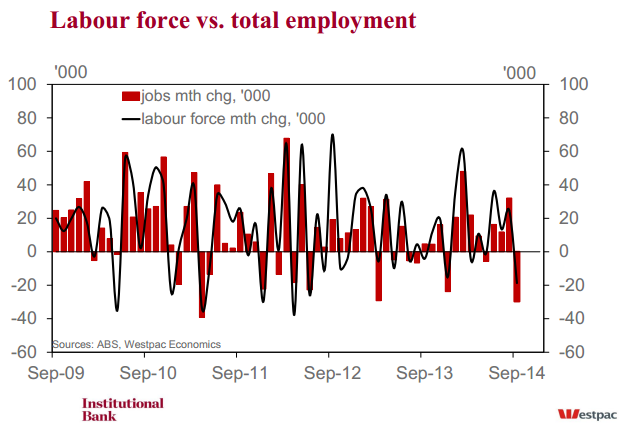
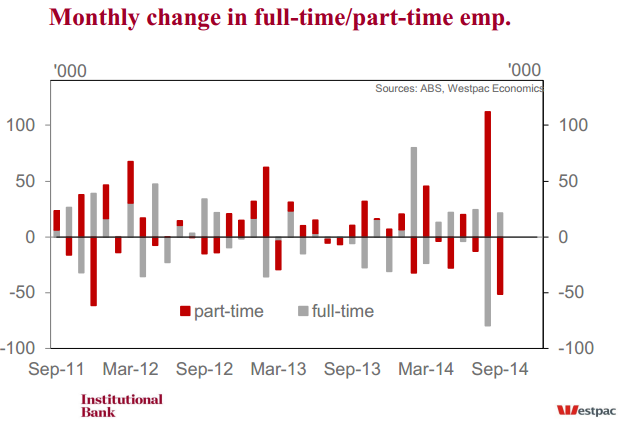
On that issue, the 29.7k fall in total employment in Sep has taken the annual pace of employment growth down to 1.1%yr (121.9k in the year) from 1.4%yr (156.4k in the year) in Aug. This feels a little soft compared to the other labour market indicators but we do accept that it is broadly in line with the normal volatility in this survey. As such, if the business surveys are correct then we should be looking for a positive bounce next month. On that front, the 18.7k decline in the labour force in Sep (remembering that the underlying population in this survey has a trend rate of growth) is also pointing to an Oct bounce.
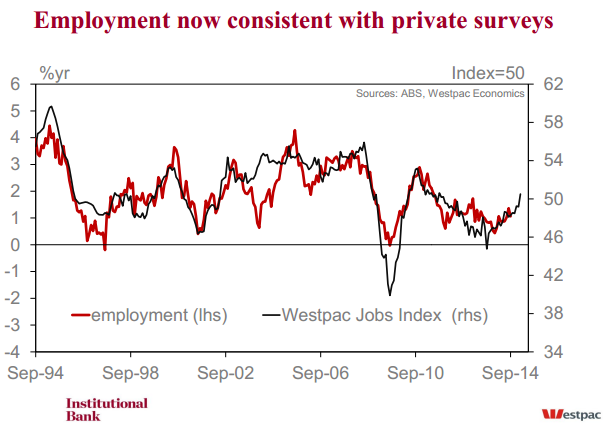
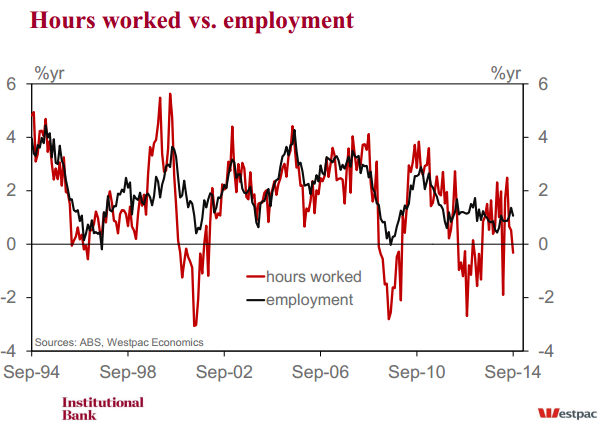
This is a soft update, something that is confirmed by the 0.9%mth decline in hours worked which are now running at a –0.3%yr annual pace, quite a bit softer than recent history and the over growth in total employment. But given the volatility in the survey, we would like to clear the Jul, Aug and Sep uncertainty before we embark on any major changes to our forecasts.
Why could have the seasonality have changed? Readers of our research would be aware of Westpac’s view that at least in part this change has been caused by changes in the ABS’s methodology. In the ABS’s own words, what may have been the causes? “The ABS has been unable to determine a definitive cause of this change in seasonality. It could have resulted from one or more factors including changes in ‘real world’ labour market behaviour, changes in the timing and content of the supplementary survey program (run in conjunction with the Labour Force Survey), the introduction of web-forms, the introduction of the new labour force questionnaire, or refinements to collection procedures.”
The ABS has also highlighted that it takes up to at least three years to get a fix on a new seasonal pattern. So if there is a new seasonal pattern, we are going to face this problem on a regular basis at least for the next few years.